

Cast your mind back to the mid-2000s. BMW had just unleashed the first M5 powered by a V10, doubling down on a high-revving philosophy already cemented with the third-generation BMW M3 and its brilliant inline-six, at a time when rivals were increasingly turning to forced induction for easy power. The company was also preparing for an ill-fated Formula 1 campaign through its acquisition of the Sauber F1 team, just as the sport’s V8 era was kicking off.
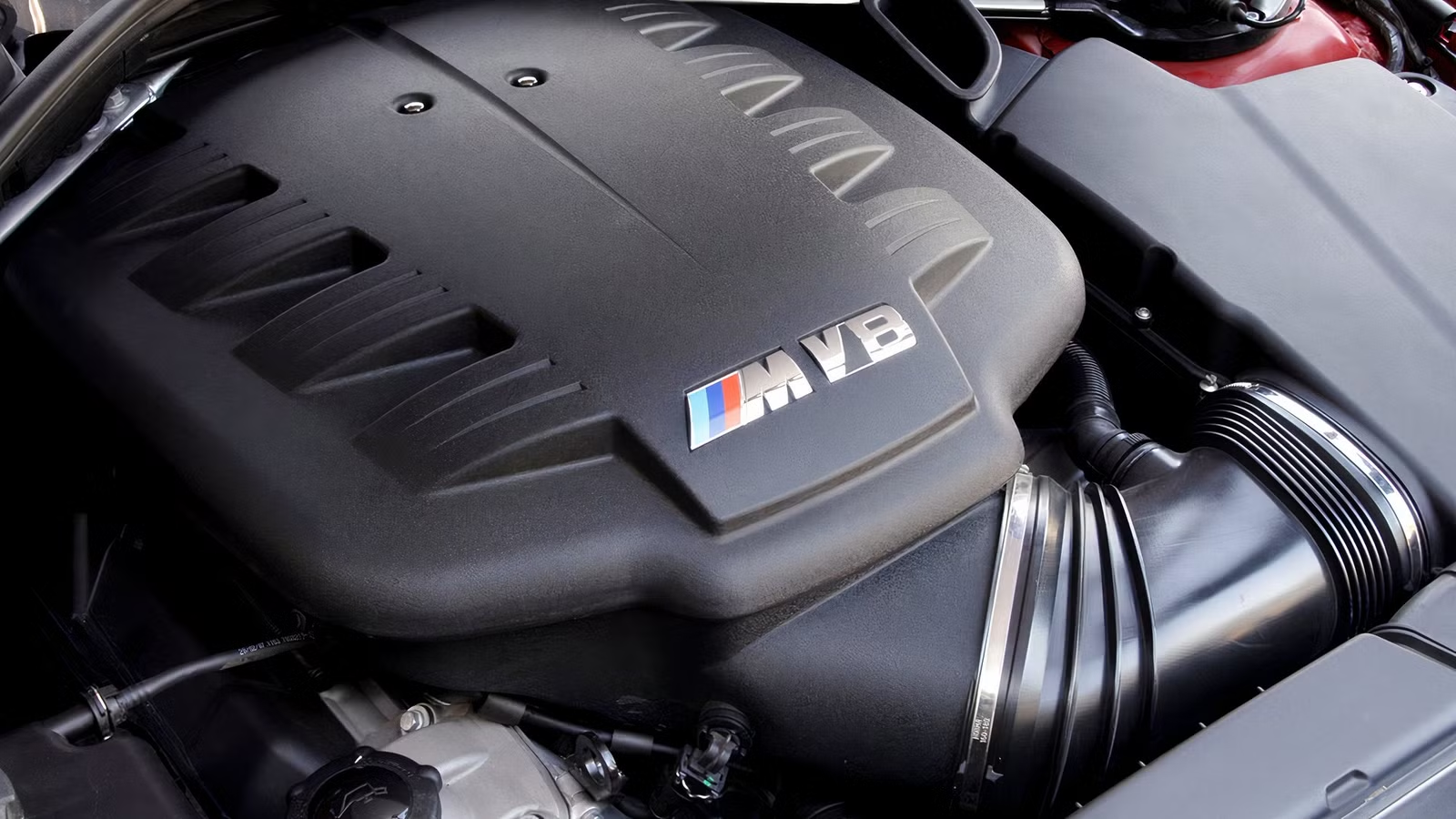
The BMW M3 E90 is powered by a glorious four-liter V8 engine.BMW
BMW was also in the midst of developing its fourth-generation M3 and wanted to combine its high-revving philosophy with that F1 V8 flavor. The result was an all-new naturally aspirated V8 engine that would ultimately power one generation of the M3 only, a compact, free-breathing screamer that borrowed heavily from the brand’s racing ambitions. Known internally as the S65, the engine delivered one of BMW’s most memorable driving experiences and remains a coveted prize among M-car collectors today.
2008-2013 BMW M3: All The Specs
BMW S65 V8 Engine Found In Fouth-Generation M3BMW
The third-generation M3 had already set a high watermark, but BMW M engineers didn’t hold back when developing its successor. At the heart of the fourth-generation M3 sat the new S65 V8, a naturally aspirated 4.0-liter engine tuned to spin all the way to 8,300 rpm. That’s 300 rpm higher than the revered inline-six it replaced, and more than a thousand revs higher than the redline of BMW’s modern turbocharged V8s. And despite the S65’s high-rev nature, 250 pound-feet of torque was already present at just 2,000 rpm.
Key Facts To Know
- Sold from 2008 to 2013 model years
- Came in coupe, convertible, and sedan body styles
- Engine block cast in the same foundry responsible for some of BMW’s F1 components
- Wasn’t the first M3 powered by a V8
Buyers could also opt for a lightning-quick seven-speed dual-clutch transmission that was a major leap forward from the previous car’s automated manual. Add in adjustable dampers and the M Drive system, which allowed drivers to tailor throttle, steering, suspension, and transmission responses, and the result was the most technologically advanced M3 yet.
BMW also gave buyers more choice when it came to body styles, helping to broaden the appeal. For the first time since the second generation ended production in 1999, an M3 sedan (code-named E90) returned to the lineup, joining the traditional coupe (E92) and convertible (E93) variants. BMW unveiled the fourth-generation M3 at the 2007 Frankfurt Auto Show before launching US sales for the 2008 model year, with all three body styles available from the outset.
2011 BMW E92 M3 GTS Exterior In Orange Rear Close-UpBMW
A limited-edition M3 GTS Coupe with a 4.4-liter version of the S65 V8 and 444 hp was also launched in 2010, and while it never came to the US, we got the Lime Rock Park Edition sporting the car’s signature bright orange paint. A sedan version sharing many of the GTS’s goodies, including the enlarged V8 was also launched at the time. Dubbed the M3 CRT, this model also skipped our market.
2008-2013 BMW M3
Engine
4.0-liter V8
Transmission
6-speed manual/7-speed DCT
Power
414 hp @ 8,300 rpm
Torque
295 lb-ft @ 3,900 rpm
0-60 mph
4.7 seconds (coupe)
Top Speed
155 mph/174 mph with M Driver’s Pack
Curb Weight
3,704 lbs
MSRP
$53,800–$62,845
The transformation from a standard BMW 3 Series to an M3 ran far deeper than a larger engine and chassis tuning. BMW replaced nearly every exterior panel, carrying over only the doors, trunk lid, windows, and lighting from the donor car. The rest was unique to the M3, including its wider stance, more aggressive bodywork, and signature power-dome hood.
Under the hood, the S65 V8’s aluminum block came from BMW’s Landshut light-alloy foundry, the same one supplying components for the company’s F1 program, though at roughly 445 lbs, the engine wasn’t exactly a lightweight. Coupe models also gained a carbon-fiber roof as standard, a feature previously reserved for the limited-run CSL, helping lower the center of gravity and sharpen handling.
Related
BMW M3 Generations: Everything You Need To Know In One Place
See all generations of the BMW M3: discover information about every model year and check out what was changed.
Note that the S65 wasn’t the first V8 ever fitted to an M3. An M3 GTR race car based on the third-generation M3, and a matching M3 GTR Strassenversion homologation special also featured V8 power. Introduced in 2001 to satisfy American Le Mans Series regulations, the M3 GTR Strassenversion was originally slated for a production run of 10 cars, though only three were ultimately completed. Both the road and race car packed a 4.0-liter V8, but this was a different design to the S65. Code-named P60, it was a pure race-bred design that laid the groundwork for BMW’s future V8-powered M3 ambitions.
A Pure Driving Experience That’s Rare Today
2010 BMW M3 Sedan – side viewBMW
The fourth-generation M3 with its V8 engine occupies a special place in BMW history as the last naturally aspirated M3 ever built. Its engine delivers an experience that today’s turbocharged inline-six M3s simply can’t replicate, responding instantly to every throttle input and rewarding drivers with a soaring soundtrack to boot.
The tradeoff is torque. Anyone accustomed to the effortless low-end punch of modern M3s may find the V8 feels relatively subdued at lower revs, but that’s precisely what makes it so engaging. To unlock its performance, you have to chase the upper reaches of the tachometer, turning every drive into an event.
The chassis is equally rewarding. You get sharp steering, near-perfect balance, and playful rear-drive antics, and you can’t go wrong picking either the standard six-speed manual or available seven-speed DCT. By modern standards, the car feels relatively compact and agile, changing direction with an eagerness that newer, heavier M3s struggle to match. There were quicker performance cars on sale then, and there certainly are now, but few deliver such a satisfying blend of precision, feedback, and driver involvement on both road and track, especially when the manual is present.
Related
You Can Still Get A New Manual BMW M3, But Here’s Why You Shouldn’t
A BMW M3 is great, period. But is an automatic version better than a manual one?
The styling has also aged remarkably well. More restrained than today’s M3, the fourth-generation car combines muscular proportions with clean surfacing that still looks fresh nearly two decades later. Opt for the sedan, and you get genuine everyday usability too, with four doors, a usable rear seat, and a decent trunk. It’s one of those rare performance cars that can feel special on a back road and perfectly at home during the daily commute.
How Much To Pay And What To Watch Out For
2008 BMW M3 Interior View DashboardBMW
Perhaps the most compelling argument for buying the fourth-generation M3 today is that values have yet to fully reflect its significance. A look at the CarBuzz Marketplace and other popular classifieds shows that prices remain surprisingly attainable, largely because the preceding generation with its famous inline-six continues to attract much of the attention from collectors and enthusiasts.
High-mileage examples with well over 100,000 miles can be found starting at around $15,000, while imposing a more reasonable 70,000-mile limit still uncovers plenty of cars listed for less than $30,000, or roughly half of their original MSRP.
Pricing also varies noticeably by body style. Convertibles tend to be the most affordable entry point, while sedans often command the strongest prices, likely due to their combination of performance and everyday practicality as well as the fact that their production only lasted until 2011, making them rarer than the two-door models whose production ran until 2013.
Across the market, the average asking price for the fourth-generation M3 appears to fall in the low-$30,000 range, though clean, low-mileage examples are beginning to attract a premium. Values haven’t skyrocketed yet, but the trend is clearly upward, suggesting the window to buy BMW’s last naturally aspirated M3 at a relative bargain may not remain open for much longer.
Reliability is often the biggest concern with any used BMW, but the fourth-generaiton M3’s reputation is arguably worse than the reality. The S65 V8 does have a pair of well-known weak points: rod bearings and throttle actuators. Both issues tend to surface somewhere around the 50,000-100,000-mile mark, and ignoring them can lead to expensive repairs. The good news is that the problem is well known and preventative rod-bearing replacement has become common practice, and rebuilt throttle actuators are widely available.
Related
How Much You’re Paying For BMW’s Last NA V8 Engines In 2025
BMW exited the NA V8 market well over a decade ago, which means that its last unit can be found in used cars. Here’s how much you can expect to spend.
Buy an example with documented maintenance, or budget to address these items proactively, and the V8 M3 can prove surprisingly durable. CarComplaints even notes that this generation of the M3 has relatively few reported owner complaints overall (though this could also be due to its relative rarity), while RepairPal gives the entire M3 family a below-average reliability score of 2.0 out of 5.0, largely due to repair costs rather than any single fatal flaw.
In other words, don’t expect the car to be cheap to own long-term, but at the same time, don’t think it’s the ticking time bomb its critics often make it out to be.
They Don’t Build Them Like They Used To
2008 BMW M3 Convertible Rear 3/4 ViewBMW
The S65 V8 represents a breed of performance engine that’s rapidly disappearing. As tightening emissions regulations and changing buyer expectations push automakers toward turbocharging and electrification, the naturally aspirated, high-revving character that defined the third-generation M3 has become increasingly rare.
With BMW already close to unveiling its first electric M3, the S65 stands as a reminder of a time when driver engagement mattered more than outright efficiency, making the fourth-generation M3 feel more special with every passing year. No wonder smart collectors are already snapping them up.
Sources: BMW, CarComplaints, RepairPal
