

In the lates 80s, VW’s engineers faced a conundrum. The product planning department expressed the need for a compact six-cylinder engine that could be squeezed into a front-wheel-drive car. Traditional V6 engines, the cylinder banks arranged between 45 and 90 degrees, would simply not suffice, and could not be mounted transversely in a compact, front-wheel-drive engine bay.
So the engineers came up with an ingenious solution: a narrow design of between 10.5 and 15 degrees. The new engine, which became known as the VR6, would not only go on to power a vast range of products from Volkswagen, Audi and Porsche, it also boasted a unique, rather beautiful noise. This is the VR6 story.
An Accidental Hero Is Born
In 1991, the VW Corrado came with the brand’s first-generation, 2.8-liter VR6 engine.Bring A Trailer
In the late 80s, Volkswagen had some interesting performance engines in its hot hatch catalog. Like the G60, a supercharged, 1.8-liter four-cylinder engine that produced 160 hp, and powered the Corrado coupe. But back in Wolfsburg, Germany, product planners were looking for a more powerful halo engine option to power the company’s high-end, front-wheel-drive cars. A traditional V6 engine would not suffice. A more compact, lighter engine that could be mounted transversely in the engine bay was required.
This is where a stroke of engineering genius gifted the world one of the best-sounding V6 mills ever made. By combining a shortened block with an inline design, and an extremely narrow “V” angle, it allowed the use of a single cylinder head. This not only reduced cost, it gave the VR6 engine its unique, and rather striking sound.
The VW V6 engine versus the VR6 engine, and how it all goes down.Wikimedia Commons (Toffguy)
The new 2.8-liter VR6 engine, initially rated at 178 hp, made its debut in the Volkswagen Corrado and Passat variants in 1991. By 1992, the engine’s service had been expanded to the popular Golf range, turning the compact hatch into a pocket rocket that would become the poster hot hatch for thousands of teenagers around the world.
The 1992 Volkswagen Golf VR6 was the poster hot-hatch dream for thousands of teenagers around the world.Volkswagen
The Volkswagen Golf VR6 not only sounded great, it had the bite to back up the bark. It could complete the sprint to 60 mph in around seven seconds, and reach a top speed of more than 140 mph. The legend of VR6 had well and truly been born. VW’s innovative engine design – in various configurations – would go on to be deployed in virtually the entire VW Group inventory.
That included Audi, Porsche, SEAT, Škoda and, of course, a vast number of VW products. The engine would remain in service in the USA until 2023, where it served in the VW Atlas. But more about that later.
Did we mention the noise it makes? Here is a compilation of some great-sounding VR6 engines:
Peak VR6?
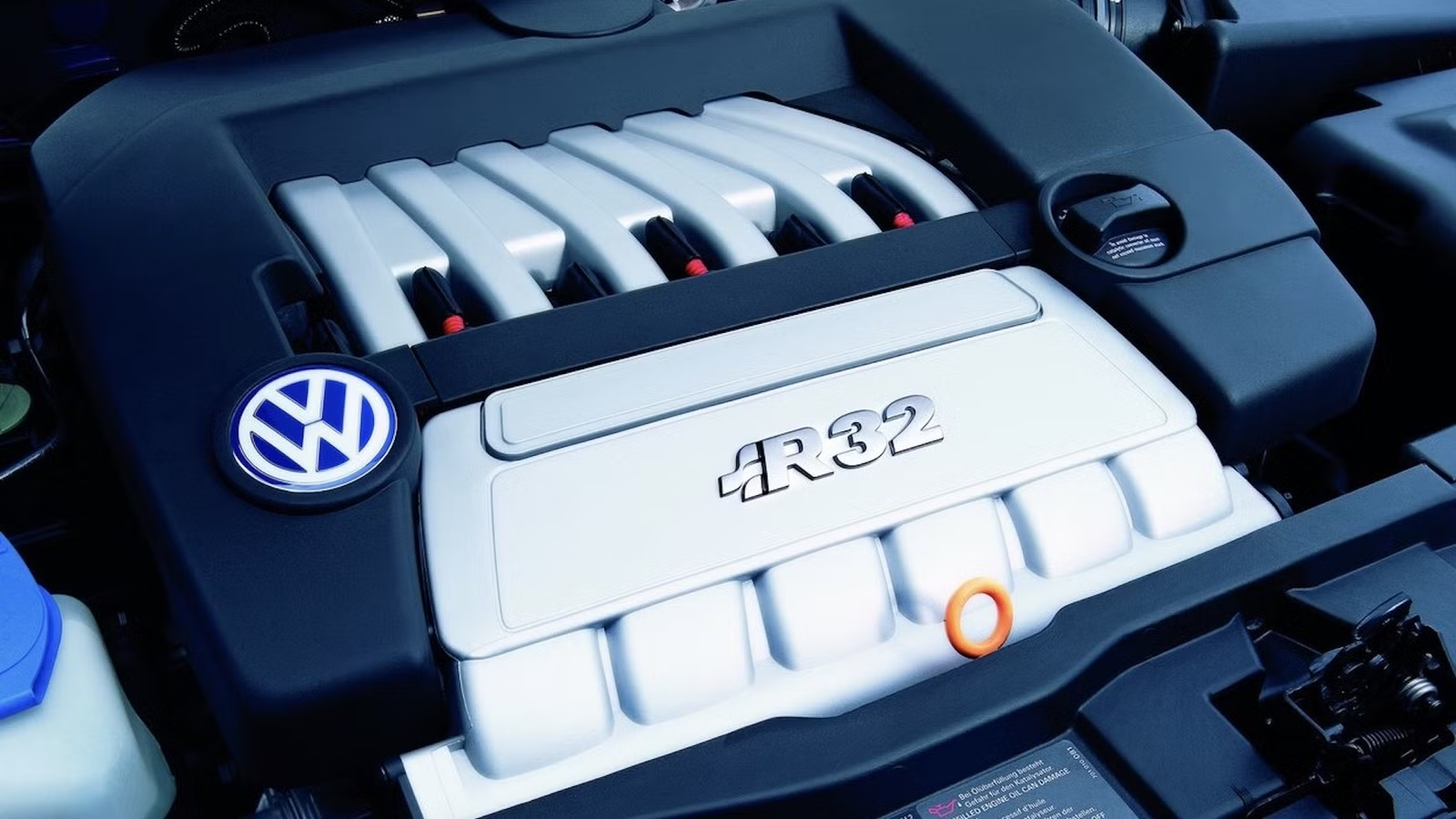
Is the 2002 Volkswagen Golf R32 peak VR6?Volkswagen
Volkswagen’s innovative VR6 engine served in a long and distinguished list of VW Group performance and a handful of Average Joe cars. Some hot hatch enthusiasts may claim that the 2002 Golf IV R32 represented the peak VR6 application. In the Golf, the 3.2-liter version of the VR6 engine produced 238 hp, combined with 236 lb-ft of torque. As a result, the iconic R32 reached more than 150 mph.
But calling this version the ultimate VR6 iteration would be like calling a winner 10 minutes after the Super Bowl game started. There was just so much more VR6 to come.
The 2008 Audi TT 3.2 FSI produces 250 hp, and is linked to the brand’s Quattro all-wheel-drive system.Audi
Audi installed an updated version of the 3.2-liter VR6 engine in its TT sports car. Fitted with the VW Group’s fuel stratified injection (FSI) system, otherwise known as direct injection, the engine made 250 hp. In the Audi TT, with its Quattro all-wheel-drive system, the naturally aspirated engine provided brisk, turbo lag-free performance. It will blast to 60 mph in around six seconds, and top speed is limited to 155 mph. The VR6 engine could also be linked to VW’s direct-shift gearbox (DSG) gearbox… quite the technological wonder at the time.
However, the 3.2-liter Audi TT was never the sharpest, best-handling performance car on the block, the extra weight of the VR6 engine (as light as it is for a V6) compared to the 1.8-liter and two-liter turbocharged four-cylinder engines adding some obvious gravity effects in the corners. But it sounds like a million bucks, and offers a grand GT experience, too. Ultimately, Audi’s iconic 2.5-liter, five-cylinder turbocharged engine took over the performance torch from the 3.2 VR6. So in this role, the TT was not quite peak VR6 either.
In 2014, the Porsche Panamera packed a 310 hp, 3.6-liter version of the VR6 engine. Lovely.Porsche
The naturally aspirated VR6 engine has seen service in the Porsche Cayenne SUV and Panamera GT. For its Porsche role, the engine’s capacity was increased to 3.6-liters, and the power hiked to a handy 310 hp, while torque peaks at 295 lb-ft. In the Panamera, the engine is linked to a Porsche seven-speed PDK transmission. Performance is obviously brisk, but compared to the rest of the Panamera (and Porsche) line-up, the 3.6 FSI’s performance is, well, just okay.
By 2017, the company had replaced the aging VR6 engine with a brand-new V6. Since there was no longer a need for a compact, transversely mounted V6 design, Porsche’s engineers reverted to a more traditional 90 degree V6 engine. The engine features a so-called “Hot-V” design, where the exhaust manifolds and twin turbochargers are located inside the “V” of the engine. The modern engine produces 348 hp and 368 lb-ft of torque, allowing the Porsche Panamera to get to 60 mph in 5.1 seconds (in the Sports Chrono version), and reach a top speed of 170 mph.
However, as far as the peak VR6 engine goes, the 3.6-liter version installed in a number of Porsche and other VW Group products represents the ultimate, naturally aspirated version of the unique, narrow-angle V6 engine that served the brand for 32 years.
Sources: Porsche, Volkswagen Media, Made in China, Audi, Hagerty, Motor1.
