

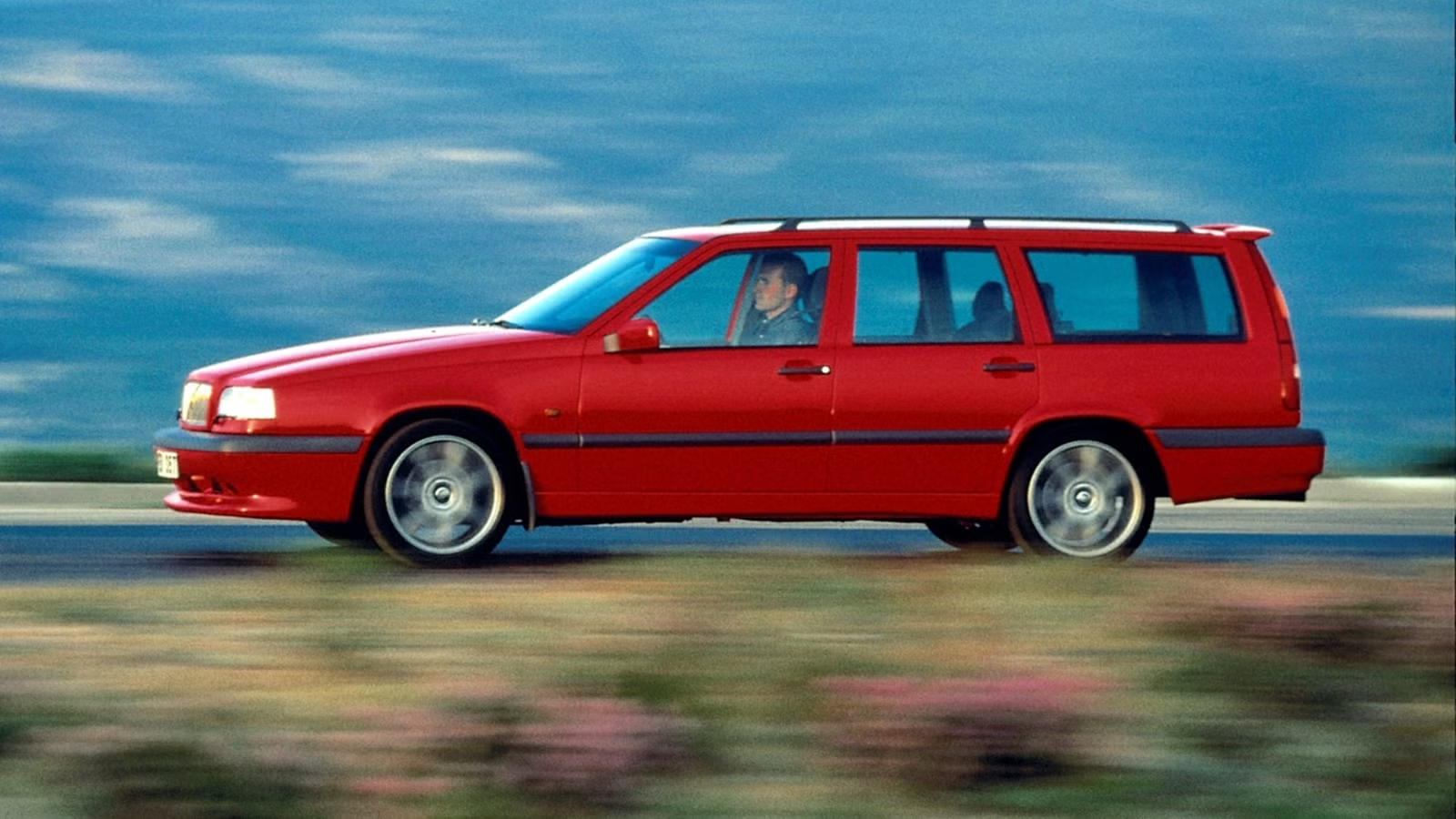
Volvo is thinking about giving station wagons another go. However, to convince its product planners that this is a good idea, we need an argument stronger than “because they’re cool” in our arsenal.
So, we have prepared a multipoint presentation of how Volvo became the yardstick against which all other wagons were measured. Whether it was through perfecting vehicle safety or surprising performance figures, the brand’s wagons have become the defining mark of Scandinavian motoring. There is nothing more Swedish than robust, understated vehicles, and there’s nothing more Volvo than a wagon.
Point 1: Volvo Perfected The Family Wagon
Volvo DuettVolvo Cars
Before performance appeared in Volvo’s vocabulary, let alone anything not a synonym of safety, it started perfecting wagons with its first, the PV445 Duett, which rolled off the line in 1953. Incorporating everything it had learned about safety and functionality, it marketed the Duett as “two cars in one,” with room for both people and stuff depending on how owners used it.
Following the Duett was the even more impressive P220 Amazon in 1962. It came packing three-point seatbelts, a padded dashboard, and a laminated front windshield, all of which put Volvo on the map in the US thanks to both its safety features and its reliability. The rear barn doors were replaced with a split tailgate that offered similar practicality and better usability.
Volvo P220 AmazonVolvo Cars
By the late 1960s, Volvo wagons were already carving out their own niche in the market as a practical, fuel-efficient alternative to the larger vehicles stamped out in Detroit. The 145, which sold over a quarter-million examples from 1967-1974, further improved Volvo’s standards with crumple zones, four-wheel disc brakes, and a collapsible steering column. The 245 followed, and Volvo put a chili up the tailpipe by creating the 245 Turbo wagon in 1981.
Point 2: The Birth Of The Performance Wagon
Whtie Volvo 245 Turbo Wagon front three quarter shotBring A Trailer
“To a radar gun, they look exactly the same,” Volvo said in a 1980s print advertisement showing a Volvo 740 Turbo Wagon next to a Porsche 944. Volvo was so proud of the turbocharged offerings that it invested in advertising these vehicles as more-usable alternatives to high-end sports cars. Before this, wagons could be loud, muscle machines (as proven by Ford and Chevrolet), but how many could genuinely be called quick?
The 850 T-5R and 850 R models followed with a bang in the mid-1990s, acting as Volvo’s first entry into the British Touring Car Championship. There, it garnered a whopping zero wins. Unfortunately, its sedan counterpart proved much more successful, earning 11 wins between 1995 and 1996 after replacing the 850 Estate. More a PR stunt than a well-planned racing tactic, despite being built by Tom Walkinshaw Racing (TWR), the 850 T-5R and later 850 R still won over the hearts of enthusiasts.
The Volvo 850 station wagon, with a few tricks in its (big) loading area.Volvo
If this picture of Volvo’s 850 British Touring Car entry askew on two wheels doesn’t get you excited about Volvo’s swift brick, chances are what powered road-going versions just might. A 2.3-liter turbocharged five-cylinder thumped out 221 horsepower and 240 pound-feet of torque and was mated to a four-speed automatic gearbox. With a five-speed manual, the output increased to 250 hp and 258 lb-ft of torque. The 6.9-second sprint to 60 MPH put Volvo on the tails of German stalwarts, causing the maestros of the sport sedan to rethink their approach to sporty wagons.
Volvo was now pitching fastballs in the majors against some of the best in the business, which served as both Volvo’s ticket into the sports sedan/wagon hall of fame and started to inch the brand upmarket. Cars were becoming more luxurious with plush leather seats and excellent ride quality, especially in the 960 sedan and wagon. The brand would be pushed further upmarket under Ford’s supervision in the early 2000s, when scalable platforms became available and the blue oval pushed to increase profit margins.
Point 3: Everyone Else Knuckled Down
1996 Volvo 850 R Yellow Rear Angle Among Trees w/ Yellow Flowers BackdropVolvo
In chronological order, BMW would produce the E34 M5 Touring for 1992, becoming one of the first German firms to get in on tuning one of its family wagons. Volvo’s performance vehicles weren’t hardcore, tire-shredding machines, but offered enough power to make a name for themselves.
At this point, AMG wasn’t yet a full, in-house part of Mercedes-Benz. It got in on the sporty wagon scene with the E36 AMG from 1993.
Audi, which would also go on to employ a turbocharged five-cylinder in the first RS2, received some help from Porsche to produce its first performance wagon in 1994. Each of these marques continued to iterate on their wagons until, one by one, they began introducing performance crossovers instead. Volvo, however, continued to stay true to the game.
1998 – 2000 Volvo V70 exteriorVolvo
Even when it wasn’t producing swift long-roofs, it was still rewriting what a wagon was and what separated it from a crossover as they became popular. The Cross Country models, which added plastic cladding and a few extra inches of ground clearance, got buyers to reconsider buying something with wagon proportions but a taller ride height. Audi did something similar with its Allroad models, and Mercedes introduced the E-Class All-Terrain.
Subaru might have been the first to offer a rugged, higher-riding wagon in 1995 with the Legacy Outback, but Volvo took the idea and ran with it. Where Subaru served the cheaper side of the market, Volvo was on its way up and brought the same functionality to a more premium vehicle.
It offered wagons in America long after others pared down their offerings. However, Volvo still had a strong enough customer base here to continue providing us with affordable luxury wagons compared to the performance cars which have returned over the past few years.
Point 4: Volvo Still Owns Its Legacy
2020 Volvo V60 front three-quarters angle in blue while drivingVolvo
In 2026, the average base price of wagons at Audi, BMW, and Mercedes is around $111,434 thanks to Audi and BMW scuttling everything but the M5 Touring and RS6 Avant. At Volvo? Well, the V60 Cross Country, which is still available for sale in 2026, starts at $53,595. The lower-slung V60 departed in 2021, followed by the V90.
However, 2026 is it for Volvo wagons as we’ve come to know them. Incorporating mild hybrid systems, as well as plug-in variants, are the first bouts of electrification to make their way into Volvo wagons. Will the next round be all-electric? Will they still have a combustion engine?
What’s coming down the pike for Volvo might not look or sound anything like the 850 R’s identifiable five-cylinder hum. Granted, that’s happening everywhere it seems. Volvo is still pushing towards its all-electric future, which means if wagons are part of that vision, their silent running will be a far cry from its lilting 5-cylinder performance cars, let alone its Polestar Engineered models, which gave us the last batch of performance Volvos.
The 850 R, 245 Turbo, or any other wagon produced by the brand for that matter, will never go unappreciated by enthusiasts everywhere. Volvo was never about building the fastest or flashiest car out there, but the few times it decided to let its hair down and have some fun are the best examples of what a car company can do when it doesn’t take itself too seriously. Safety and practicality have been, and always will be, the most important of Volvo’s criteria. For a while there, it put performance higher up on that list. And it made the entire industry rethink who it could sell wagons to, as well as what they could do.
Sources: Volvo, Car and Driver
