

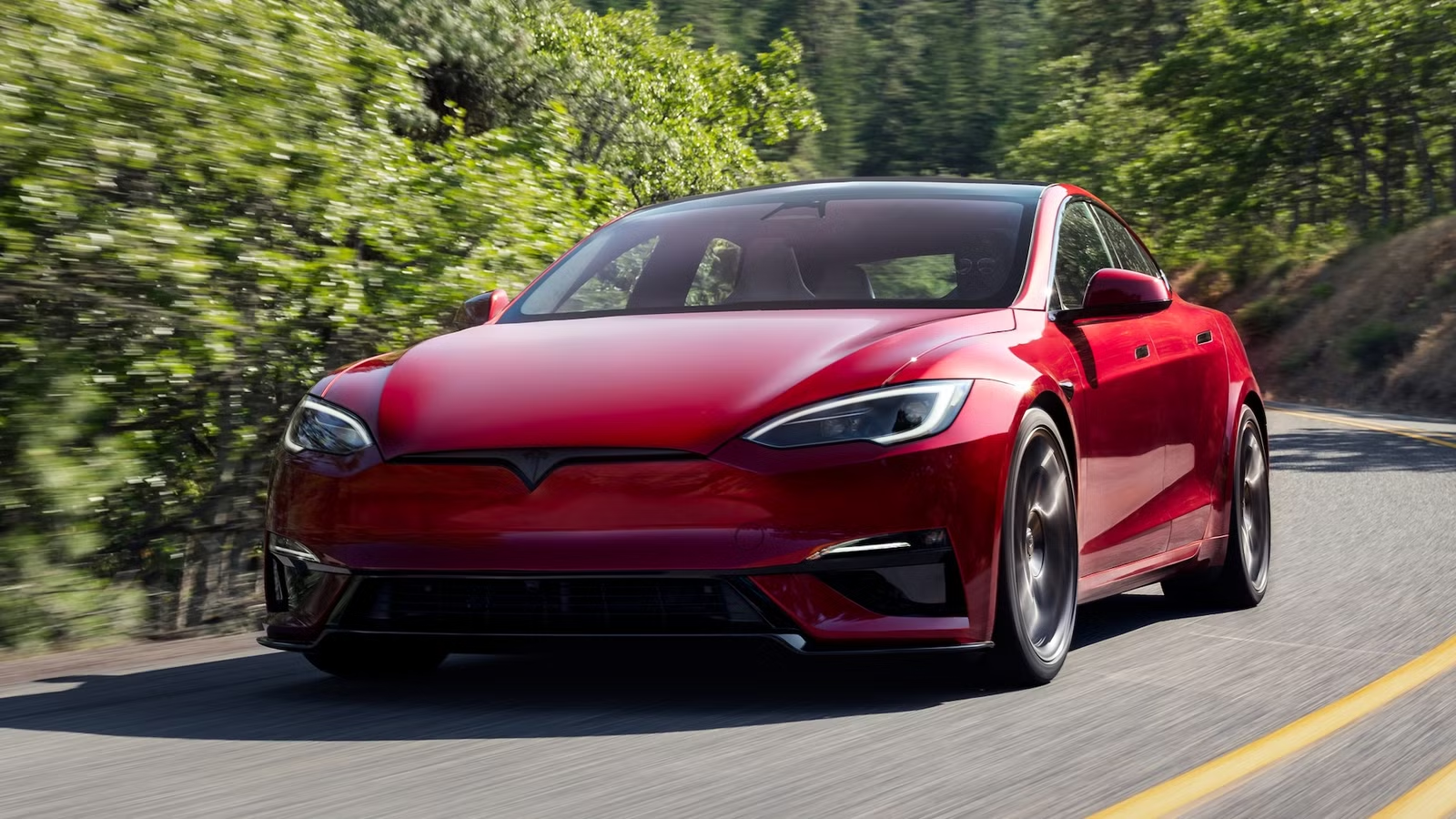
When looking to purchase a new-to-you used vehicle, there are more choices than ever before. We aren’t simply referencing the wide range of different models available by the various automakers out in the world, as that has largely been the same over the last century. Instead, we’re talking about the different types of vehicles on the menu, from the good old internal combustion-engined car that runs on either gas or diesel, to a hybrid that uses an ICE mated to an electric motor.
Then we come to a full electric vehicle, which relies solely on a number of electric motors and batteries to ensure the machine and its occupants can reach their destinations. While they allow you to charge them off your own power plan at home, which can save you a ton of money in running costs, EVs have been hammered in recent times due to a lack of charging infrastructure, a general lack of maximum range, and battery degradation that compromises their long-term usability. As it turns out though, the final of these points isn’t as bad as it’s made out to be.
Used EVs Depreciate Very Quickly
2027 Porsche Taycan GTS from the front three-quarter anglePorsche
To add some context to this story, one of the reasons many drivers consider laying down cash on a used EV is due to how much money they lose when compared to their original MSRP. Thankfully, at least if you’re looking at getting stuck into the EV life, the difference in terms of depreciation to ICE machines has narrowed considerably in recent years, even if there is still a gap you’ll have to make do with. According to Cox Automotive, the average value drop of an ICE vehicle over a three-year cycle stood at between 35% and 40% at the end of 2025, while EVs tended to lose 38% to 42% of their worth over the same period.
This relative extra value loss, alongside concerns of a drop in battery health that far exceeds the drop in efficiency of an ICE over the same amount of time, has only added to the challenge for manufacturers when it comes to selling EVs.
There Are Several Reasons For This
2027 Dodge ChargerDodge
Aside from battery concerns, there are other reasons behind EVs depreciating faster than ICE-equipped cars. These include a more restrictive charging network that can make it harder to find a charging station during trips across the US, as well as rapidly developing technology that quickly undermines a model that was brand-new just a year ago. As a result of these concerns, many new and used buyers are instead turning to hybrids, which provide the best of both worlds from either propulsion method.
The thing is, EVs provide a golden opportunity to get a premium vehicle for considerably less than you’d first expect. Even though their residual values haven’t yet fallen in line with ICE’s, they’re getting closer, as illustrated by Cox’s findings. The charging infrastructure across the US is progressing all the time, while the relative ranges of new EVs are running ICEs ever closer. But there’s an even more important, tantalizing reason why a used EV is a hugely tempting proposition.
EV Batteries Don’t Lose As Much Of Their Capacity As First Feared
Cutaway diagram of the Porsche Cayenne Electric battery systemPorsche
A loss of pure battery capacity was one of the main concerns regarding used EVs, for a couple of key reasons. Firstly, the relative lack of range sustained by an EV with a heavily degraded battery severely compromises its everyday versatility, as you’ll need to charge it more often to keep running. Seeing as many fast chargers force you to sit around for 20 to 30 minutes for a charge to a decent level, this ramps up the level of inconvenience. Secondly, the cost of replacing the battery once it reaches the end of its life, once anticipated to only be a handful of years, can be north of $5,000.
The good news is that, with the passage of time and plenty of scientific study, it has been found that the rate of battery degradation isn’t as high as once thought. According to Geotab, the average rate of battery capacity loss of EVs stands at just 2.3% per year, while Generational’s testing has recorded an even lower reduction rate of 1.8% over a 12-month period. For reference, EV batteries are deemed unusable when they reach between 70% and 80% of their original capacity. This is when they’ll be unable to reliably hold a charge, and can run into a range of problems that make using them a real hassle.
Based on this math, and by working with an average of 2% yearly range reduction based on the findings used in this piece, an EV battery should remain perfectly usable for between ten and 15 years before it needs replacing. Plus, at that rate, you could expect to buy something like a three-year-old Tesla Model S AWD, which boasts a total range of 320 miles when new, and still have around 300 miles of usable range left.
Batteries Need Help To Keep Healthy
Close-up of the 2025 Chevrolet Equinox EV LT1 instrument displayJoel Stocksdale/CarBuzz/Valnet
This welcome news means you can spend your cash on a used three-year-old EV, and save a ton of money in the process, but still have access to the vast majority of the car’s original range. While this is great news for those interested in buying a used EV, you’ll still need to do your part to ensure the battery lasts the distance in your ownership. Firstly, make sure not to leave your EV charged to 100% for extended periods, as this will cause the battery to degrade faster than one that is kept at 50%, for example, over the long term.
Related
What 10-Year-Old Used EVs Sell For In 2025
Buying a new EV can be a strain on your bank account, so this is how much a ten-year-old used example will cost on the secondhand market.
In addition, driving more carefully and not pushing the battery too hard will help, as the component will be put under less thermal pressure. On this subject, frequent rapid charging will also damage the battery, since the process puts extra heat and stress on it, which will lead to quicker degradation. Minimize these elements, and you should have a battery that should easily last you north of a decade before it needs replacing.
Some Great Deals Are Lurking Across The Used Market
2026 Tesla Model S rear 3/4 angle in red while parkedTesla
If you’re not sure where to start when it comes to tracking down your ideal used EV machine, then a Tesla Model S is a solid place to look. The practical five-door sedan offers plenty of performance thanks to its dual-motor powertrain, which kicks out 670 horsepower that it shares between all four wheels. With 300 miles left on a well-looked-after three-year-old specimen to boot, the vehicle provides a rapid and versatile option for many families. Handily, according to iSeeCars, Tesla models have a strong 4.6% chance of making it to 250,000 miles, placing them sixth overall. They’re very expensive from the dealer, with an MSRP of just under $87,000, but CarEdge reports that the model loses a commanding 65% of its original value in just three years.
Related
The Tesla Resale Collapse Used-EV Hunters Saw Coming Years Ago
As soon as Tesla started dropping major discounts out of nowhere, the writing was on the wall.
Used EV Depreciation Over Three Years
Model
Original MSRP
Level Of Depreciation Percentage (Price)
2026 Ford F-150 Lightning Pro
$54,780
48.2% ($28,080)
2026 Tesla Model S AWD
$86,990
65.6% ($29,925)
2026 Porsche Taycan Turbo GT
$239,400
39.2% ($145,556)
This translates to a used value of around $30k in just three years, which, given the car still has the vast majority of its original range, represents remarkable value. Should you fancy something more rugged and work-focused, like a pickup truck, then a used Ford F-150 Lightning also represents a great opportunity for a relatively new truck at a great discount. With a base Pro variant starting from just over $54,000, which provides a towing-assisting 775 lb-ft of torque between both axles, the F-150 Lightning already seems like decent value.
!!!MODEL TAG!!! Listing Carousel Taycan
https://carbuzz.com/cars/porsche/taycan/
Give it three years, though, and the vehicle will be worth just 52% of its original MSRP. This translates to a used value of $28k, which is impressive for such a new and powerful truck. The Porsche Taycan presents another great way of securing a premium EV for a less-premium price, with the rapid sports sedan losing around 40% of its original value over the first few years of its life. Give it half a decade, and the car will have shed 59% of its original worth.
There Are Other Elements To Consider With Used EVs
2026 Ford F-150 Lightning STXFord
While battery issues shouldn’t be as high on your priority list as you’d historically believe, there are other elements that you need to be wary of when buying a several-year-old EV. Firstly, you need to make sure all the charging equipment supplied with the vehicle is in good shape, as otherwise the car may not charge properly. There are also safety hazards involved, as a dodgy charging wire could end up overheating and catching fire in some extreme cases, so be sure to thoroughly examine them to ensure they’ve been properly maintained and stored.
Related
The 516-Mile Luxury EV That Lost $49,450 In 6,500 Miles Is Now A Used Bargain
While spending $100k on a new electric luxury sedan may be beyond your budget, having a little patience could play nicely into your hands.
Then we come to the mechanical bits. While EVs are relatively simple from a powertrain standpoint, with fewer moving parts, making them much less likely to go wrong than an ICE, the components under the skin do take more of a pounding. Thanks to those large batteries and electric motor assembly, EVs are generally considerably heavier than equivalent ICEs. As a result, they put more strain on consumables like brakes, tires, and suspension components. Therefore, these parts may be in much worse shape after three years than you’d expect on an ICE, so you may need to replace them sooner than you think.
Ensuring these elements have received ample attention is thus critical to making sure you don’t get hit with any unexpected bills. Overall though, splashing your dollars on a used EV looks as smart as it has ever been. You’ll be able to net yourself a thoroughly modern machine for half its original cost, while not having to deal with the high running costs or the range anxiety that you’d normally expect with such a deal. Buying new has its benefits, but when it comes to EVs, there are few tangible reasons as to why the extra outlay is worth it.
Sources: CarEdge, Cox Automotive, Generational, Geotab, iSeeCars, Tesla.
