

It’s only human to be a little nostalgic sometimes. Maybe you drive past the park you played in as a kid and feel just how fun going down that slide was, or you dig up an old photo at your parents’ house that brings you back to the old days. Whatever tickles your nostalgia bone usually leaves you with a melancholic happiness for an instant.
However, nostalgia is also a powerful marketing tool, especially in the automotive world. Take modern muscle cars like the Dodge Challenger, for example. Toyota has hopped on the throwback train a few times throughout its existence, too, like with the FJ Cruiser.
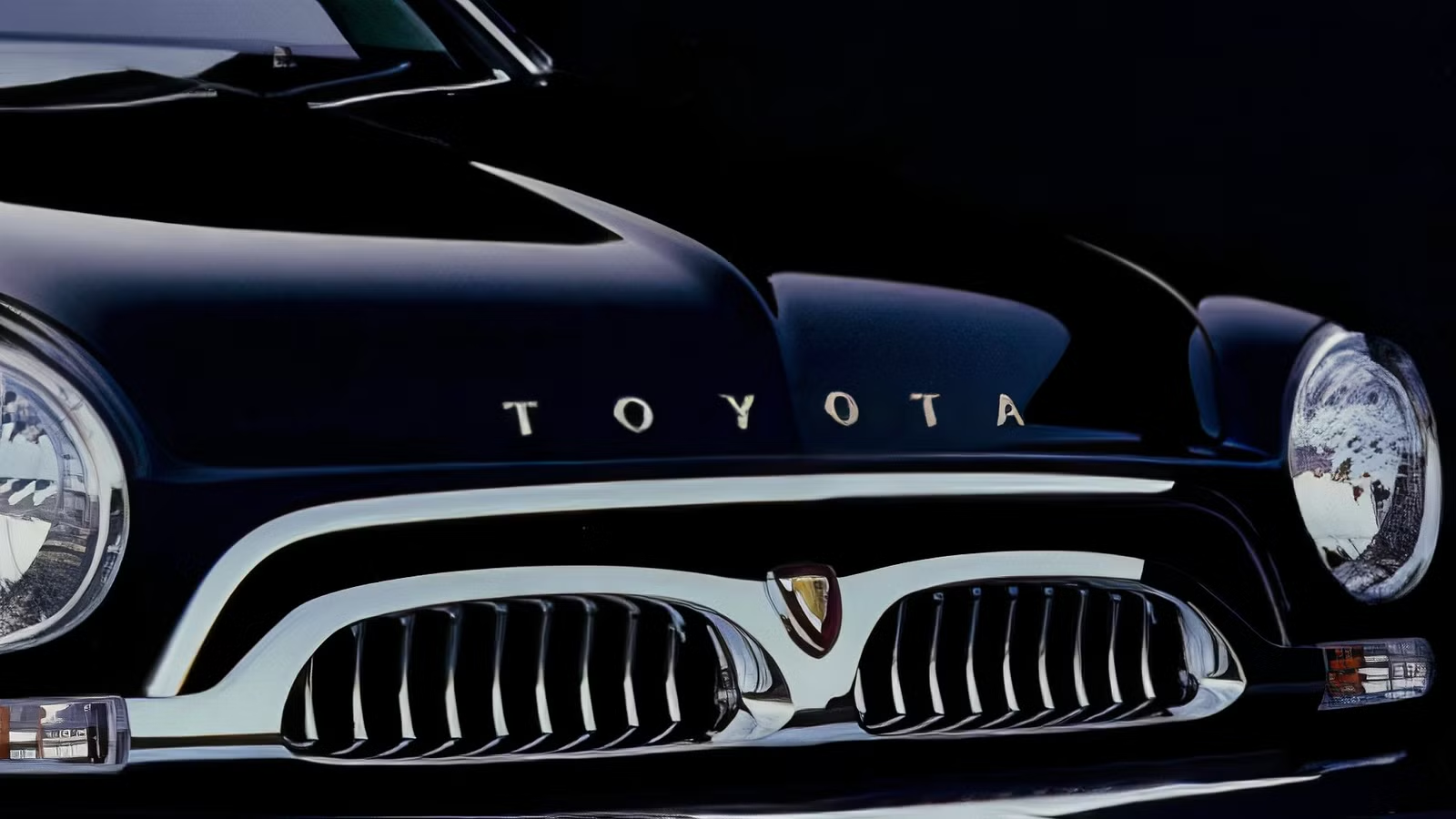
There was also the Toyota Origin, but we don’t blame you for not remembering it. Just over 1,000 were produced for the Japanese market only. In essence, the Origin was meant to utilize an old, popular look and bring it into the modern era with contemporary touches as a commemoration to Toyota’s feat of producing 100 million vehicles.
However, because it never made it out of its home country and so few were made, only a few folks in this country have ever heard of it. Not to mention, it packed a version of Toyota’s ultra-famous 2JZ straight-six under its hood to boot.
Memories Produce Cars
2000 Toyota Origin finished in silver with tan interiorGOONET Exchange
The Toyota Origin’s roots stretch back over seven decades, and nearly five when it was originally produced in 2000. Its looks are based on the first-generation Toyota Crown, a model that helped put Toyota on the map back in the 1950s. When the Original came about some decades later, Japan was in the midst of their own mid-century revival, which paved the way for some sort of bespoke, old-school-looking model that also packed a healthy dose of modern amenities.
When we say bespoke, we mean it. Instead of giving the job of producing the Origin to the common rabble down at the Takaoka Plant in Toyota City, Aichi, Toyota execs felt it best to assign the job to craftsmen at Higashi-Fuji Plant in Susono, Shizuoka, Japan. A few of you may know of the place, as it’s where the flagship Toyota Century was made for 53 years, from 1967 to 2020. There, a select team of extremely skilled workers hand-built the Century, and the Origin was slated to join in as another hand-built model sharing the same assembly line.
2000 Toyota Origin finished in silver with tan interiorGOONET Exchange
There were a few reasons behind the decision to hand-build the Origin, the largest being its odd shape. Its 1950s-era body couldn’t be replicated by modern, mass-production tech without a significant investment in tooling. Because it was meant to be a limited-production model – with 1,000 units planned – creating all-new mass-production methods was likely deemed a waste of time and money.
Not to mention, the asking price of 7,000,000 Yen was extremely steep for a mid-sized Toyota, so having the “hand-built” reputation would go a long way to justifying its price. Its paintwork also needed a human touch, as it employed what Toyota called “traditional Japanese lacquerwork”, something that, reportedly, couldn’t be replicated by a machine at the time.
2000 Toyota Origin finished in silver with tan interiorGOONET Exchange
Production at the Higashi-Fuji Plant began in May 2000, with sales commencing on November 1st of the same year. The Origin was to be offered exclusively at Toyota’s Toyota Store, the Toyopet Store, and the Toyota Corolla Store. Its time on the market lasted just under a year. Once the Origin’s sales and production were wrapped up, 1,073 examples were allegedly sold.
Related
The Toyota With More Luxury Than A Mercedes-Benz… And It’s Not A Lexus
As if the world wasn’t upside-down enough these days, a humble Toyota can out-luxury a Mercedes-Benz S-Class.
What It Offered
2000 Toyota Origin finished in silver with tan interiorGOONET Exchange
Every piece of wood found within the Origin’s well-appointed interior is real, with no trace of stick-on wood effect anywhere. Its seats are made from genuine leather, featuring piping and patterns that are all hand-stitched. The entire cabin is designed to be as large as possible, with Toyota claiming that the amount of space offered rivals full-size sedans in both passenger room and comfort.
Toyota also credits the Origin’s “highly refined” chassis for offering superior emergency avoidance. In other words, that’s a classier way to say it handles well for what it is. There’s traction control, anti-lock brakes (ABS), and Brake Assist, which detects panic braking and injects some extra braking power into the mix to help out. A slew of sound proofing and vibration-dampening measures were undertaken to try and make the Origin’s cabin as quiet and smooth as possible.
2000-2001 Toyota Origin Dark Blue Side Doors OpenYT: ユアサノ
Its exterior looks nothing like any other mass-market model produced around the turn of the millennium. Its front grille and bumper design virtually copies the first-gen Toyota Crown, along with its headlight design. Its rear doors open outward from the center, just like those found on an old-school Lincoln Continental.
2000-2001 Toyota Origin Black Rear AngleWikimedia Commons: Tokumeigakarinoaoshima
Even more classical design elements are found around the back, as it sports a decidedly 1950s wraparound rear window, and a pair of subtle tail fins jut out of either side of its trunk. However, Toyota kept its roofline and side panels looking modern, so as to not throw too much nostalgia into the mix and risk turning people off, or potentially appearing too tacky.
Related
This Hand-Built Swedish And Italian Mashup Is Selling For Peanuts
If you’re looking for a rare European weapon, there are plenty to choose from. This Swedish coupe could be one of the coolest forbidden fruits.
Under The Hood
2000 Toyota Origin finished in silver with tan interiorGOONET Exchange
Having a 2JZ-powered car that looks straight out of a black and white movie is nothing short of quirky. However, the mill itself is worth its weight in gold to the right folks. The version used in the Origin is called the 2JZ-GE, meaning it’s a naturally aspirated iteration. The engine utilizes Toyota’s Beams technology, which means it boasts things like Variable Valve Timing-intelligent (VVT-i) tech, alongside other things like an electronically controlled throttle. According to the Origin’s original press release, employing the Beams outfit allowed the Origin’s 2JZ to operate smoothly, while also providing an adequate amount of power.
2000 Toyota Origin finished in silver with tan interiorGOONET Exchange
2000 Toyota Origin
Engine Details
3.0L NA inline-six
Power
212 hp
Torque
217 lb-ft
Overall Length
179.5 inches
Curb Weight
3,439 lbs
*Specs courtesy of Toyota
Hooked up to the 2JZ powerplant is a four-speed automatic transmission. Toyota states that the gearbox uses intelligent software, meaning it can learn the driver’s driving tendencies and adjust its shift point accordingly. Rear-wheel drive is the standard drivetrain. Its suspension is fully independent, and its body is reportedly “high-rigidity”, which translates into a soft, yet responsive ride. Four-wheel disc brakes handle the Origin’s stopping needs.
Related
10 Cars With 2JZ Engines You Probably Didn’t Know About
Of course, the Supra is on the list, but did you know the 2JZ powered nearly a dozen cars?
How To Find One For Yourself
2001 Toyota Origin exteriorToyota
As you can imagine, finding a 26-year-old car, of which there were only 1,073 made for a foreign market, isn’t exactly easy. The good news, though, is that the internet does exist, and car auction sites are everywhere. Not to mention, the 25-Year Rule – which bans the importation of foreign-market cars that are newer than a quarter-century – has elapsed for the Origin. Now, you can import one without any hang-ups or illicit activities.
You still need to actually find one for sale, though. If you pop over to popular auction site Cars & Bids, you can find just one that was bid to $18,000 but didn’t sell on the platform. Classic.com, which watches numerous auction sites and reports on average pricing and such, hasn’t reported a single sale, either. Your best bet is to peruse Japanese auction sites that allow for international export. JDMExport.com, for example, has numerous Origins for sale with pricing ranging from the high-teens to low 40s, thousands of dollars, that is.
2001 Toyota Origin exteriorToyota
If you do decide to import one, just make sure you have all of your ducks in a row regarding the myriad fees you’ll have to pay, which can include:
- Import Duty
- Merchandise Processing Fee (MPF)
- Harbor Maintenance Fee (HMF)
- Ocean or Air Freight
- Inland Transport
- Customs Brokerage Fee
- Customs Bond
- Port Handling / Unloading
- Customs Inspections
- Storage Fees
The Quirkiest Toyota You’ve Never Heard Of
2000 Toyota Origin finished in silver with tan interiorGOONET Exchange
A car with a legendary engine, 50s styling mixed with modern amenities, and a Toyota badge isn’t something you’d necessarily expect from a mass-market automaker. However, Toyota was seemingly so fired up about reaching 100 million vehicles built that it felt it had to try and recreate one of its most popular models, the Crown. The Origin looks to be an excellent homage to the aforementioned model, even if it’s extremely obscure.
Sources: Toyota, Cars & Bids, Classic.com.
