

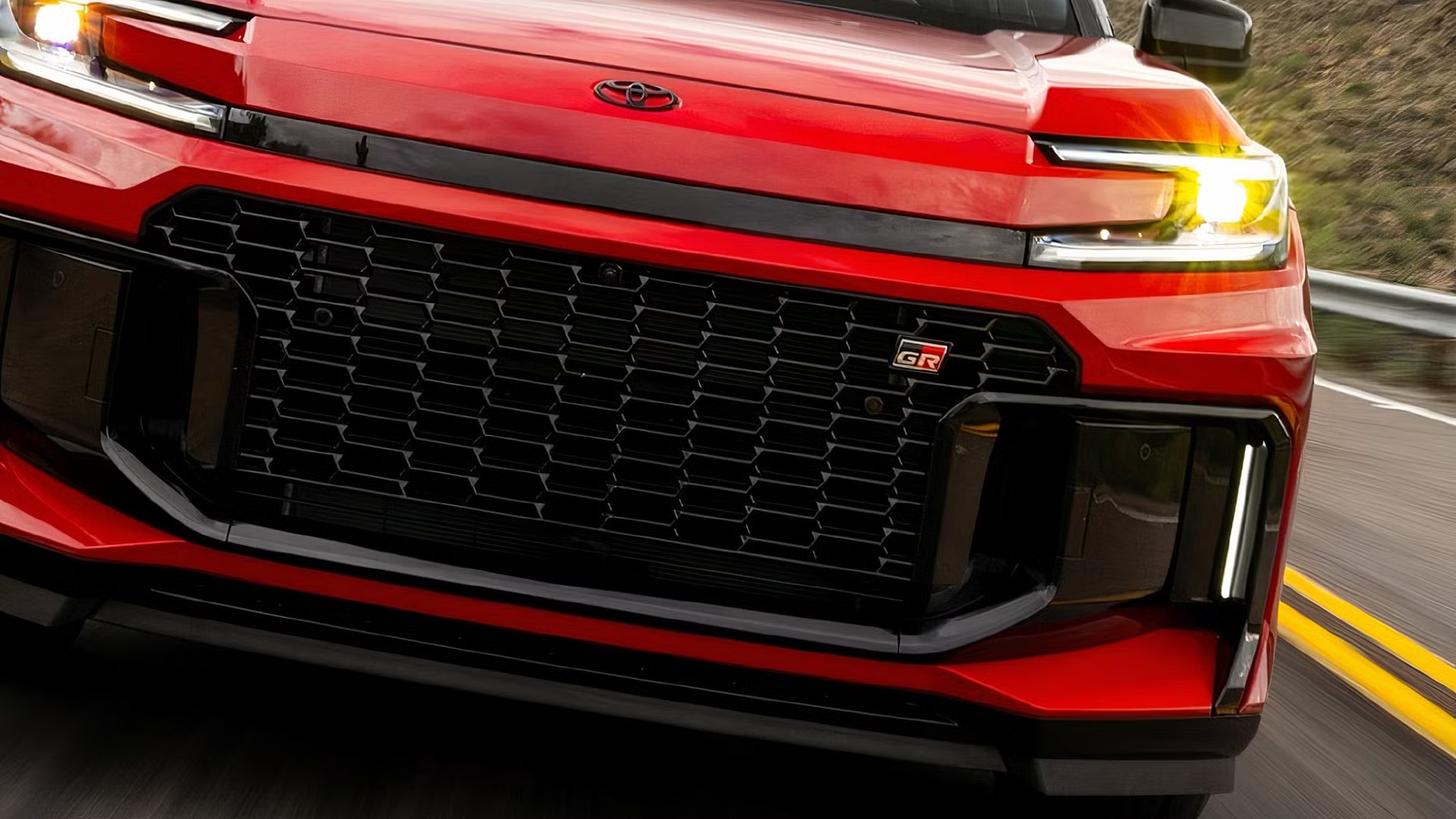
Plug-in hybrids occupy a fascinating sweet spot in the automotive landscape. Depending on your perspective, they’re either the ultimate compromise — blending EV efficiency with gas-engine flexibility — or an overcomplicated solution that fully commits to neither world. Toyota has clearly landed in the optimist camp, offering not one but two PHEVs: the Prius Plug-In Hybrid and the RAV4 Plug-In Hybrid. For 2026, Toyota even expanded the RAV4 PHEV’s reach, making the plug-in powertrain available across the Woodland and new GR Sport trims in addition to the existing SE and XSE grades.
The appeal is easy to understand, especially when Toyota executes the formula this well. Depending on the model, you get between 39 and 54 miles of all-electric range — enough to cover the average American’s daily commute entirely on electrons — while a capable gas engine stands ready for long highway stretches or road trips where charging infrastructure is an afterthought.
From an environmental standpoint, Toyota also argues that PHEVs make sense because they accomplish the same all-electric commute as a full EV while using a significantly smaller battery pack. With that context in mind, let’s break down both of Toyota’s plug-in hybrid options and figure out which one belongs in your driveway.
All pricing is for the 2026 model year and all vehicles and specs discussed are for the US market.
Prius Plug-In Hybrid
2025 Toyota Prius Prime PHEV XSE Front AngleToyota
The Prius Plug-In Hybrid is unquestionably the more efficient, more aerodynamic, and more frugal of the two. It needs only a 13.6 kWh battery (gross capacity) to deliver between 39 and 44 miles of electric range depending on trim, and it’s rated at 114–127 MPGe — well ahead of the RAV4, which just barely clears 100 MPGe on its best trim. The Prius PHEV also pairs that smaller battery with a 2.0-liter engine, keeping overall weight down. The trade-off is outright performance: the Prius posts a 0–60 mph time of around 6.5 seconds and a combined output of 220 horsepower, which is respectable but noticeably behind the RAV4.
It’s also the less capable of the two in terms of drivetrain options, being offered only with front-wheel drive versus the standard all-wheel drive of the RAV4 PHEV. Its lighter curb weight does work in its favor in corners, making it the more nimble handler of the pair — though the RAV4 PHEV’s GR Sport trim, with its dedicated chassis tuning, gives the Prius a genuine run for its money in that department.
2025 Toyota Prius Plug-In Hybrid PHEV Interior Front CabinToyota
The Prius interior is largely well-executed, aside from the forward-view-blocking gauge cluster, but it falls short of the RAV4 in a couple of meaningful ways. The most obvious is sheer size and shape. For this generation, Toyota steered the Prius in a smaller, sportier direction, which trimmed practicality compared to the previous model — headroom is tighter and the rear hatch is smaller. That was a reasonable bet given the RAV4’s presence in the same showroom for buyers who need more utility, but it does limit the Prius’s everyday usability, which may partly explain why its sales figures haven’t been particularly strong even amid elevated fuel prices.
The other area where the Prius trails the RAV4 is freshness. The current generation has been on sale since 2023, which isn’t an unusually long run by traditional standards, but the pace of interior and software development has accelerated sharply. The Prius now feels a step behind the brand-new RAV4, with older software on smaller screens and missing features like the RAV4’s larger, better-positioned gauge cluster and its built-in dashcam. In fairness, most other Toyotas are in the same boat until they receive their own updates — the Prius isn’t uniquely behind, just not at the front of the pack right now.
On the outside, the Prius has aged gracefully, with styling that still turns heads. It also offers something the RAV4 simply can’t match: a solar roof that’s genuinely capable of trickling charge back into the drive battery. That makes the Prius PHEV remarkably self-sufficient, partially insulated from both gas and electricity prices as long as the sun cooperates. It would be great to see Toyota bring that option to the RAV4 lineup someday — particularly the Woodland variant, where the extra off-grid energy could be genuinely useful for camping trips.
2025 Toyota Prius PHEV plugged into charging portToyota
Pricing is another area where the Prius holds a clear advantage. It starts at $33,775 plus $1,295 for destination and freight, compared to the RAV4’s higher $41,500 base price plus $1,595 destination. Even a fully loaded XSE Premium Prius PHEV comes in noticeably below a comparable XSE RAV4 PHEV.
So if you don’t need everything the RAV4 brings to the table, the Prius makes a compelling case for itself on value alone — and those RAV4 advantages are worth spelling out.
RAV4 Plug-In Hybrid
2026 Toyota RAV4 PHEV chargingToyota
2026 Rav4 hybrid
Prius hybrid
Engine
2.5L Hybrid
2L I4 Hybrid
Power
324 hp @6,000 rpm
220 hp @6,000 rpm
Torque
163 lb-ft @ 3,600 rpm
139 lb-ft @ 4,400 rpm
Electric Range
49–54 miles
39–44 miles
With meaningful enhancements for 2026, the RAV4 Plug-In Hybrid is Toyota’s range king and its most impressive PHEV offering. It runs Toyota’s fifth-generation hybrid system, pairing a 2.5-liter inline-four with a 22.7 kWh battery to produce 324 hp, a 0–60 mph time of around 5.4 seconds, and an electric range of 49–54 miles depending on trim. It’s less efficient than the Prius on a per-mile basis, but still manages a respectable 86–101 MPGe rating across the lineup.
Related
Toyota Prius Generations: Key Updates Across All Model Years
From a slow, ugly duckling, to a punchy looker, the Prius has come a long way since the early 2000s, but it’s kept fuel economy as a priority.
The addition of the Woodland PHEV trim, combined with standard all-wheel drive across the range, makes the RAV4 the stronger choice for drivers who regularly face bad weather or want to venture off the pavement. For those after a sportier plug-in, the GR Sport trim brings genuine chassis upgrades to complement its more aggressive appearance — something the Prius currently can’t offer. Hopefully those Toyota executive dreams of a Prius GR Sport eventually become a production reality. Until then, the RAV4 GR Sport remains the enthusiast’s pick of the PHEV lineup.
2026 Toyota RAV4 PHEV GR Sport interior view of the front cabinJared Rosenholtz/CarBuzz/Valnet
As noted earlier, the RAV4 holds a clear interior advantage in both space and technology. Standard equipment includes a 12.3-inch gauge screen and a 10.5-inch touchscreen, with a 12.9-inch unit available on higher trims. All of them run Toyota’s latest software, which brings a more intuitive interface and snappier responses — though it has also absorbed the climate controls, eliminating physical HVAC buttons. Buyers who prefer tactile controls will find the Prius more to their liking in that respect.
The RAV4’s exterior is fresher by definition, having debuted for the 2026 model year. It takes a conservative but polished evolutionary approach to the previous generation’s design — a deliberate choice that avoids alienating the loyal buyers who make the RAV4 one of Toyota’s best-selling nameplates.
2026 Toyota RAV4 PHEV rearToyota
All of those advantages do come at a premium over the Prius, but that’s to be expected given the RAV4’s size, power, and feature set. For buyers prioritizing maximum electric range, interior space, or outright performance, the RAV4 PHEV’s pricing — from its $41,500 base (plus $1,595 destination) up to $50,565 fully loaded — represents strong value, particularly when you consider it also undercuts most of the RAV4’s plug-in hybrid rivals in the compact SUV segment.
Which One Is Right For You?
2026 Toyota RAV4 PHEV rearToyota
The differences between these two have been laid out clearly, so your budget, along with your priorities around space, power, and electric range, should point you firmly toward one or the other. Subjective factors — the Prius’s physical climate controls, the RAV4’s superior gauge cluster placement and visibility — can tip the scales further depending on what you value most in a daily driver.
Related
2026 Toyota RAV4 First Drive Review: The Compact Crossover That Will Dominate America
Toyota took a bestseller, and just added more things customers wanted. Here’s why the new RAV4 will break even more sales records.
At the end of the day, both are excellent vehicles, but the RAV4 leads on nearly every measurable spec and feature that buyers tend to prioritize. If you’re drawn to the Prius but find yourself wishing for more electric range, updated styling, or the latest interior technology, a refresh should be on the horizon — and that could deliver some or all of those improvements.
In the meantime, it’s genuinely impressive that Toyota fields two such compelling plug-in hybrids, and it remains a missed opportunity that more automakers haven’t followed their lead.
Toyota’s PHEVs vs Their Competition
Close-up of the 2026 Nissan Rogue Plug-in Hybrid badgeNissan
Toyota occupies a relatively uncrowded space among its rivals, since few competing brands offer plug-in hybrids that go head-to-head with either the RAV4 PHEV or the Prius PHEV. In the compact SUV segment, the most relevant alternatives are the Nissan Rogue PHEV and the Kia Sportage PHEV. The table below lays out both models’ key specs for easy comparison.
2026 Toyota RAV4 PHEV Rivals Specs Comparison
2026 Nissan Rogue PHEV
2026 Kia Sportage PHEV
Base Price
$45,990
$40,490
Powertrain
2.4L Inline-4 PHEV
1.6L Turbo Inline-4 PHEV
Horsepower
248 hp
268 hp
Fuel Economy
64 MPGe combined
83 MPGe combined
Electric Range
38 miles
34 miles
The plug-in hybrid Prius is effectively in a class of its own, with no direct PHEV rival in its segment for the current model year. The Kia Niro PHEV was its closest competitor before it was discontinued, but as things stand, Toyota commands that space largely unopposed. Building one of the most efficient vehicles on sale and pricing it accessibly is no small feat, which is likely why most automakers have focused their PHEV efforts on the higher-volume compact SUV segment instead.
Toyota’s Regular Hybrids Are Also Impressively Efficient
2026 Toyota Camry XSE. Motion. On-road. FrontToyota
Toyota may only offer two plug-in hybrids, but its lineup of conventional hybrids — models you charge solely through regenerative braking and the engine, with no plug required — is both broad and impressively fuel-efficient. Buyers can choose a hybrid powertrain in vehicles ranging from the Tundra full-size pickup and Tacoma midsize truck to the Corolla sedan and hatchback. Other models come standard with hybrid systems across their entire trim lineups, including the Sienna minivan, Crown, Crown Signia, Camry, and more. Here’s every current Toyota hybrid’s best combined fuel economy rating:
- 2026 Toyota Tundra Hybrid: 22 mpg
- 2026 Toyota Sequoia Hybrid: 22 mpg
- 2026 Toyota Tacoma Hybrid: 23 mpg
- 2026 Toyota 4Runner Hybrid: 23 mpg
- 2026 Toyota Land Cruiser: 23 mpg
- 2026 Toyota Grand Highlander Hybrid: 34 mpg
- 2026 Toyota Highlander Hybrid: 35 mpg
- 2026 Toyota Crown Signia: 38 mpg
- 2026 Toyota Crown: 41 mpg
- 2026 Toyota Corolla Cross Hybrid: 42 mpg
- 2026 Toyota RAV4 Hybrid: 43 mpg
- 2026 Toyota Corolla Hybrid Sedan: 50 mpg
- 2026 Toyota Camry: 51 mpg
- 2026 Toyota Prius: 57 mpg
Needless to say, if you’re shopping for a new hybrid, Toyota almost certainly has a model that fits your needs. The trucks and body-on-frame SUVs may not post headline-grabbing efficiency numbers, but their hybrid systems consistently outpace their primary competitors.
Sources: Toyota, Nissan, Kia
