

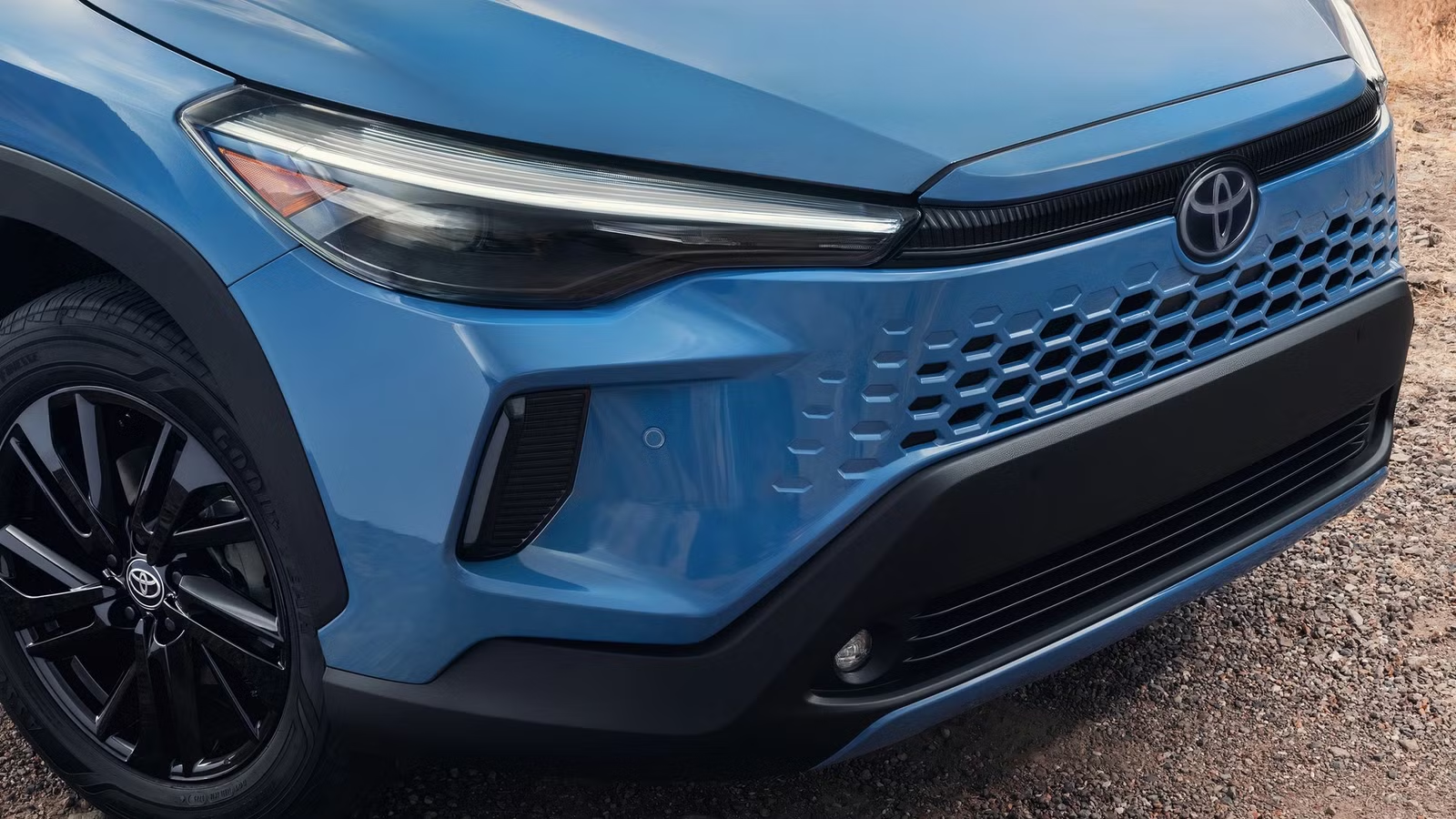
The entry point to Toyota’s enormous line of SUVs is the Corolla Cross, and it’s an important one. It’s the only Toyota SUV with a base MSRP of less than $30,000. In fact, last year, even the hybrid had an MSRP of barely less than $30,000. That hybrid was also one of very few on the market. That makes it quite appealing to people on a budget looking for the dependability and potential efficiency available from a Toyota SUV.
While it’s still possible to make a case for the Corolla Cross with the 2027 model year, Toyota’s making that harder by raising the prices without giving anything else in return.
2026 Toyota Corolla Cross HybridToyota
The Hybrid Sees The Biggest Price Increases
We’re going to start with the Corolla Cross Hybrid, because that’s where the main changes have happened. The previous model year featured a base trim called S, which started at $29,395, or $30,845 with the $1,450 destination charge that year. That trim is gone, leaving the SE as the new starting point. The 2027 SE’s MSRP is $31,415, which is $700 more than the 2026 SE and a whopping $2,020 more than the 2026 S base MSRP. For reference, the top level XSE went up by $720 for 2027. Furthermore, the destination charge increased from $1,450 to $1,595, so add an extra $145 to those differences for the full change.
The non-hybrid Corolla Cross also went up in price, but not as significantly. The MSRP for the whole range went up by $500, so with destination, they’re all $645 more than before. The base L trim starts at $25,535, and comes to $27,130 with destination. The cost to upgrade to all-wheel drive hasn’t changed. It’s a $1,300 option on the L and LE trims, and $1,450 for the XLE. You can see the full price list for all Corolla Cross models below.
Prices below do not include the $1,595 destination charge
-
2027 Toyota Corolla Cross MSRPs
-
Non-Hybrid
- L: $25,535
- LE: $27,865
- XLE: $30,460
- Hybrid
-
Non-Hybrid
2026 Toyota Corolla Cross XLE AWD front 3/4Toyota
What makes these price increases tougher to swallow is the fact that Toyota didn’t add anything to any version. Toyota isn’t even adding a extra feature or two as a standard to the lower trims. It’s just a price increase and nothing else. The base L trim is also fairly sparsely equipped with manual climate control, cloth seats, a traditional keyed ignition rather than push-button start, and steel wheels with wheel covers. It does at least come with wireless Apple CarPlay and Android Auto, plus adaptive cruise control with lane-centering. Higher trims introduce other niceties, like automatic climate control, wireless phone charging, heated seats, and blind-spot monitoring, among others.
What Is The Corolla Cross Up Against?
The non-hybrid Corolla Cross has quite a bit of competition, and many alternatives that are quite compelling and have base prices below $25,000, even with the destination charge. Among them are the Nissan Kicks and Chevy Trax. The hybrid is fairly unique, and it’s still threading the gap between the cheaper Kia Niro, which only offers front-wheel drive, and the more expensive Subaru Crosstrek hybrid. Perhaps a bigger issue is the fact that the RAV4 is very close in price. The base 2026 model has a base MSRP of $31,900. It only has front-wheel drive, but it’s far larger and more powerful for barely much more money.
2026 Toyota RAV4 front 3/4 angle in silver while parkedJared Rosenholtz/CarBuzz/Valnet
CarBuzz Insight – Why This Matters:
At the entry-level of the new car market, buyers are seriously price and value conscious. They’re also almost certainly becoming more so as people struggle to afford new car prices. So, demanding significantly more money for quite a basic car without providing anything to help make up for that stings, and makes it seem as though Toyota expects you to buy just because the vehicle has its badge. It also tightens the gap uncomfortably with the RAV4, which offers some very obvious benefits.
This seems like a bad decision by Toyota, and other automakers have an opportunity to eat into Toyota’s sales in the coming year.
