

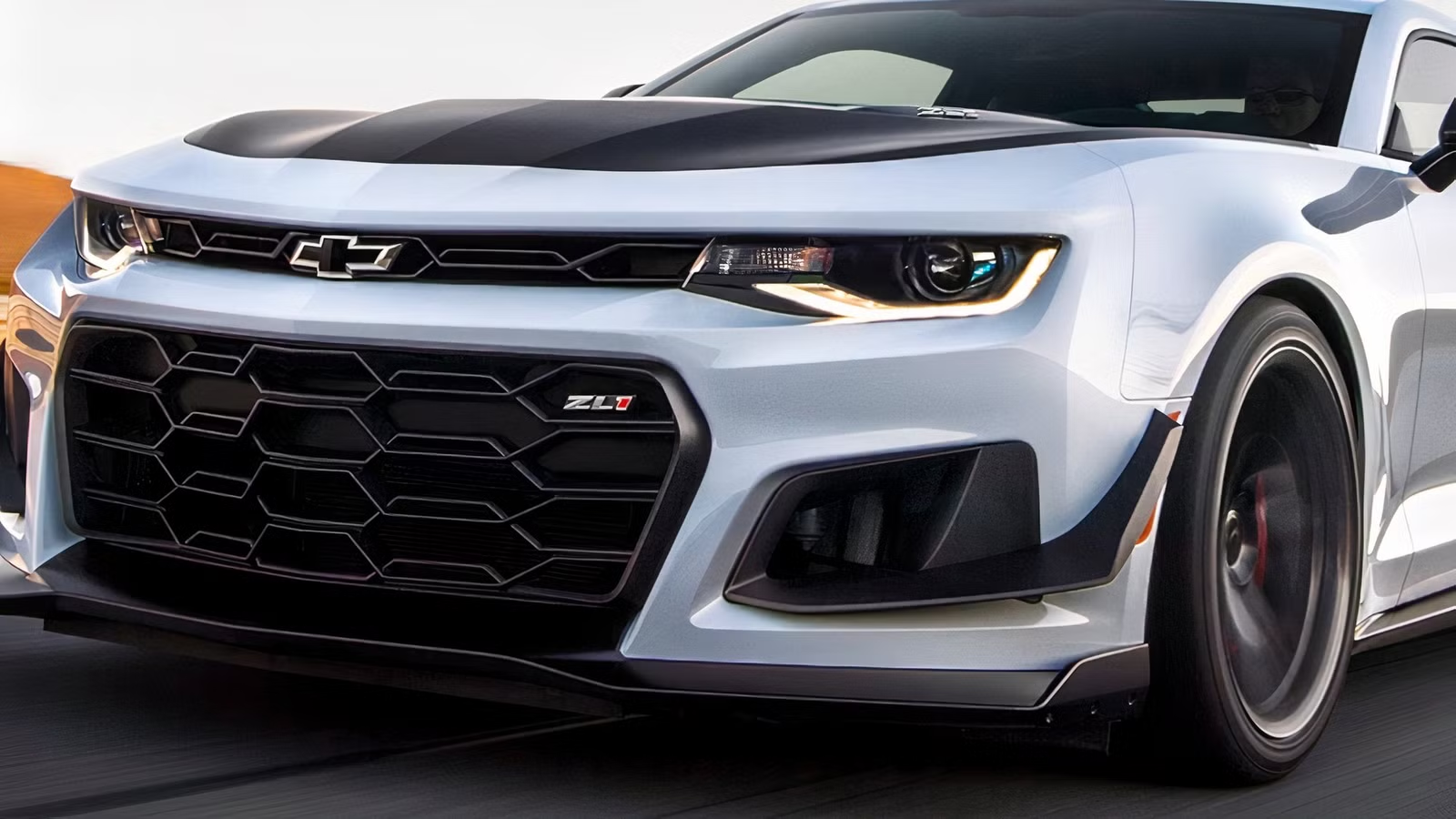
Everyone knows the legendary Camaro Z/28 and Yenko Camaro, but Chevrolet’s pony car – later transformed into a no-excuses sports car – spawned another version that could one day be remembered as just as significant. The final sixth-generation Chevrolet Camaro pushed the nameplate to new and seriously impressive heights, especially in ZL1 form. But Chevy engineers weren’t finished.
For the ultimate sendoff, they pulled out all the stops and created the Camaro ZL1 1LE, a track-focused monster that represented the peak of Camaro performance. However, the car was ultimately overshadowed by the Corvette and never given the recognition it deserved. Now, though, it’s gaining attention from smart buyers who recognize its greatness.
Launched Just As The Camaro’s Luster Was Fading
2018 Chevrolet Camaro ZL1 1LE Front 3/4 ViewChevrolet
When the sixth-generation Camaro arrived for 2016, it represented a technical leap forward for Chevrolet’s pony car. Built on GM’s Alpha platform, it was lighter, sharper, and more capable than the model it replaced, with handling that earned praise from enthusiasts and critics alike. But while the Camaro became a true driver’s car, the buying public never fully embraced it. The car delivered on the track, yet struggled to capture the emotional appeal that made previous Camaros cultural icons.
The problem wasn’t performance. It was everything around it. The Camaro’s tight cabin, poor visibility, and limited practicality made it a tough daily driver, while its evolutionary styling failed to stand out against the Ford Mustang and Dodge Challenger. Chevy also gave the car less marketing attention as it focused on trucks, SUVs, and new electric offerings – remember General Motors CEO Mary Barra promising an all-electric light-duty lineup by 2035?
Close-up front view of a 2018 Chevrolet Camaro ZL1 1LEChevrolet
The ZL1 1LE arrived for the 2018 model year, and by that time the Camaro was already fighting an uphill battle. By the end of the run, it was well behind its rivals, with Chevy moving just 31,028 units in the US in 2023 – a figure that was actually higher than in previous years as buyers rushed to buy one before production wound up at the end of that year. In comparison, the Mustang racked up 48,605 sales and the Challenger 44,960 sales over the same period.
How the ZL1 1LE Beat The Ferrari 488 GTB Around The Nürburgring
Rear view of a 2018 Chevrolet Camaro ZL1 1LEChevrolet
The sixth-generation Camaro seemed destined for a proper Z/28 sendoff. Everyone expected Chevrolet to revive the badge that turned the fifth-gen Camaro into a razor-sharp track weapon, this time on the lighter, stiffer Alpha platform. Instead, Chevy unveiled the Camaro ZL1 1LE, and it delivered everything enthusiasts wanted from a new Z/28 except the name.
The “1LE” in Camaro speak signifies a track-focused package, so the ZL1 1LE built on the already ferocious Camaro ZL1’s supercharged 6.2-liter LT4 V8, retaining its 650 horsepower and 650 pound-feet of torque while sharpening the areas that matter most on a road course: aerodynamics, suspension, and tires.
The visual changes leave little doubt about the ZL1 1LE’s intentions. Larger upper and lower grille openings feed more air to the powertrain, while functional dive planes, the previous Z/28’s air-seeping Flowtie Chevy badge, and an aluminum hood with a satin-black wrap reduce lift and glare when every apex counts. At the rear, a towering carbon-fiber wing generates roughly 300 lbs of downforce at top speed, even if that extra grip trims the standard ZL1’s 202-mph maximum.
Chevy also spent more than three years working with Goodyear to develop Eagle F1 Supercar 3R tires for the car, with a massive size rating of 305/30ZR19 up front and 325/30ZR19 at the rear, and wrapped around lightweight 19-inch wheels.
2018 Chevrolet Camaro ZL1 1LEChevrolet
Beyond the aero package, Chevy stripped about 60 lbs from the ZL1 by fitting lighter rear-seat components, among other measures. It also replaced the standard Magnetic Ride Control system with Multimatic’s race-bred DSSV dampers. These feature spool valves designed to open and close in a very precise way depending on the forces on the wheel, adjusting the damper fluid to suit.
The result is incredibly consistent and predictable damping that keeps the car stable and planted even when you’re pushing it hard on track. Note that the Brembo brakes carried over unchanged from the standard ZL1 because they already offered outstanding stopping power and fade resistance.
At the 2018 launch, the ZL1 1LE came exclusively with a six-speed manual transmission, but buyers gained the option of the Camaro’s 10-speed automatic beginning in 2019. Incredibly, Chevy managed to lap the Nürburgring in a time of only 7:16.04 – using the manual. That put it ahead of some big names, including the Ferrari 488 GTB and the Nissan GT-R. More incredibly still, a time with the automatic was never posted, but the self-shifter proved to be quicker than the manual on other tracks.
With numbers like these, how did this car fly completely under the radar? The answer is more complicated than you’d expect.
Why Even Serious Performance Buyers Skipped the ZL1 1LE
2018 Chevrolet Camaro ZL1 1LE Coupe White Overhead Rear AngleChevrolet
Sales figures for the Camaro ZL1 1LE have never been broken out, but the bigger picture tells the story. As mentioned earlier, sixth-generation Camaro sales never reached the heights Chevrolet had hoped for, and the ZL1 1LE occupied an especially narrow niche. All of its supercar-slaying performance came with a starting price of roughly $69,000, or about $7,500 more than a standard ZL1.
That looks like a bargain today, when the average new vehicle transaction price hovers around $50,000, but back then buyers could drive home in a base C7 Corvette Stingray for about $13,000 less or spend about $10,000 more for a Corvette Z06. When the mid-engine C8 Corvette debuted for 2020 with a starting price around $60,000, the value equation tilted even further away from the Camaro.
The ZL1 1LE also demanded compromises that many buyers simply weren’t willing to make. It felt blisteringly quick on virtually any road, but it was louder, more intense, and with a pavement-scraping front splitter, it also constantly reminded you that it had been engineered with lap times in mind.
Surprisingly, the Multimatic DSSV suspension delivered a ride that remained impressively compliant over broken pavement, yet the sixth-generation Camaro’s notoriously poor outward visibility and cramped cabin never disappeared. Living with it every day required more patience than its rivals, making the ZL1 1LE a harder sell than its remarkable capability suggested.
2018 Chevrolet Camaro ZL1 1LEChevrolet
Perception also worked against Chevrolet’s ultimate Camaro. Despite its world-class chassis and track credentials, the Camaro remained a muscle car in the minds of many buyers. Serious performance enthusiasts often skipped straight to the Corvette, while others looked to European sports cars. The fact that Chevy skipped the Z/28 name also didn’t help.
In the end, the ZL1 1LE had the talent to embarrass machines costing far more, but convincing buyers to spend Corvette money on a Camaro proved far more difficult than setting a fast lap.
Why Collectors Are Paying $70,000 For A Car Nobody Wanted
2018 Chevrolet Camaro ZL1 1LEChevrolet
The buying public may have overlooked the Camaro ZL1 1LE when it was new, but collectors are finally catching on. Its rarity, coupled with its performance and analog character, has started to make it a prize in the eyes of collectors. You won’t find many examples on mainstream classifieds, but listings tracked by Classic.com paint a different picture.
Most cars offered through collector car marketplaces and auctions have astonishingly low mileage, typically well under 20,000 miles, and asking prices, when available, generally start just above the ZL1 1LE’s original MSRP. The market also appears to be split almost evenly between six-speed manual and 10-speed automatic examples.
Values seem poised to climb further. Chevrolet has confirmed that the Camaro nameplate will return, but rumors suggest the next model could evolve into a new type of vehicle—specifically, something more practical than the traditional pony car. The current thinking is that the Camaro could become a gas-powered sports sedan sharing its platform with a redesigned Cadillac CT5 due out later this decade (the current CT5 dies after 2026). If the ZL1 1LE ultimately stands as the last truly uncompromising, track-focused Camaro, today’s prices could look like a bargain in hindsight.
A Modern Classic in the Making
2018 Chevrolet Camaro ZL1 1LEChevrolet
The Camaro ZL1 1LE might not have been a huge sales success, but that doesn’t diminish what Chevrolet achieved. It remains one of the most capable track cars ever to wear a bowtie badge, blending giant-killing performance with an old-school, manual-first driving experience that’s becoming increasingly rare. Whether values soar or not, owning one seems like a smart move today, especially given the very real possibility that Chevy never builds another Camaro this uncompromising again.
Sources: Chevrolet, Classic.com
