

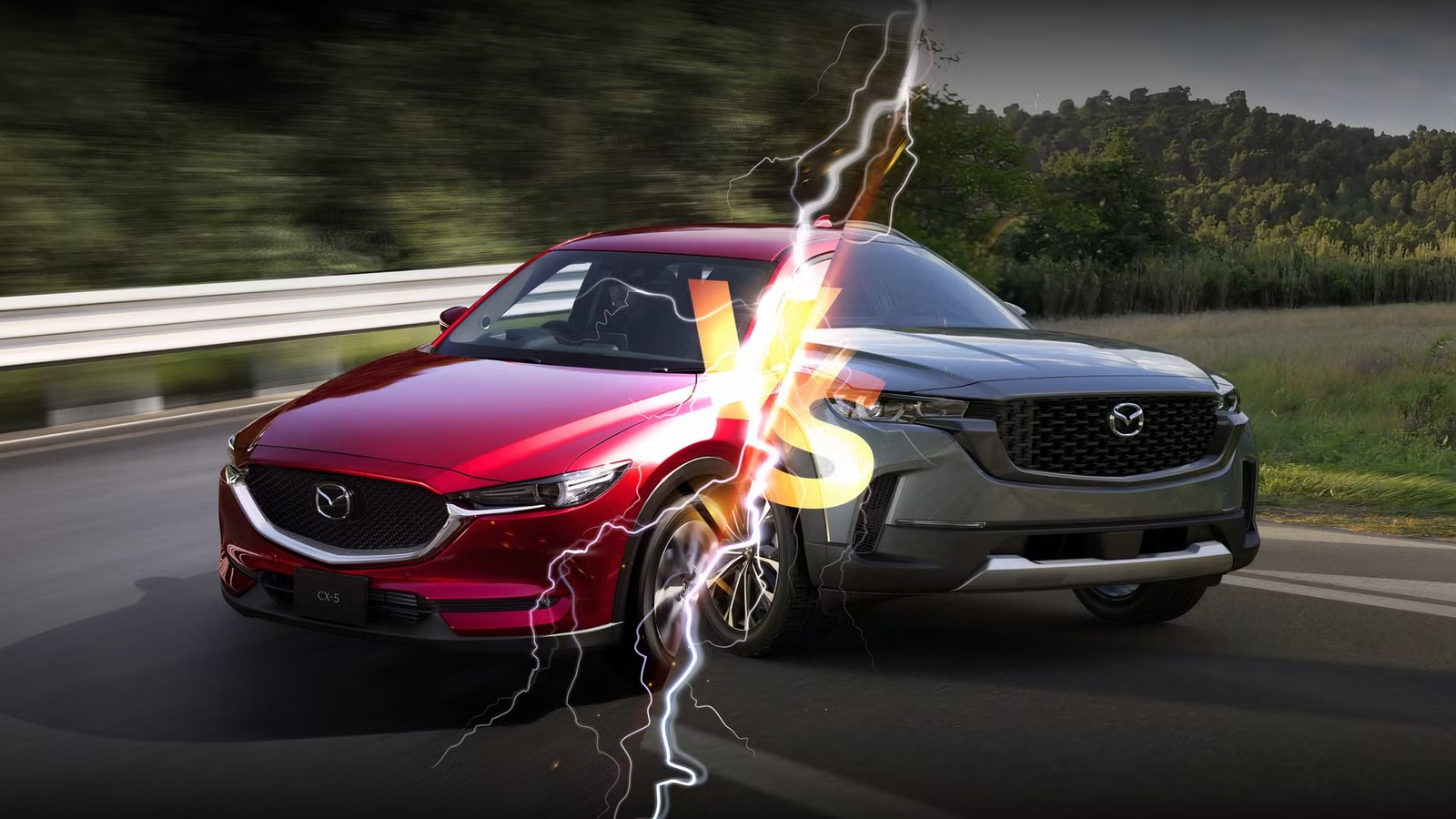
Mazda’s lineup has never been more interesting — or more confusing. With the third-generation CX-5 now on sale for the 2026 model year, the brand has made some of the boldest moves in its recent history: fresh styling, a meaningful stretch in length, and a sweeping interior overhaul that trades the beloved controller knob for a large, controversial touchscreen. It also drops the Turbo trims entirely, leaving a single naturally-aspirated 2.5-liter engine as the only powertrain choice — for now.
We’ve driven it and have plenty of thoughts. What makes this situation unique is that Mazda offers a compelling alternative right at the same dealership: the CX-50. There’s just $90 difference in MSRP, both come standard with all-wheel drive, and both deliver the engaging driving dynamics Mazda is known for. But each has its own distinct strengths and weaknesses. Here’s a full breakdown to help you decide which one belongs in your driveway.
For this comparison, we’re focusing just on the 2026 model year of these two vehicles and what they offer currently. All prices include destination and freight charges.
-
Base Trim Engine
2.5-L Inline 4
Base Trim Transmission
6-speed automatic
Base Trim Drivetrain
All-Wheel Drive
Base Trim Horsepower
187 hp
Base Trim Torque
185 lb-ft
Segment
Compact SUV
-
Base Trim Engine
2.5L SKYACTIV-G I4 ICE
Base Trim Transmission
SKYACTIV-Drive 6-speed automatic
Base Trim Drivetrain
All-Wheel Drive
Base Trim Horsepower
187 HP @6000 RPM
Powertrain Differences
Model
2026 Mazda CX-5 & CX-50
2026 Mazda CX-50 Turbo
2026 Mazda CX-50 Hybrid
Engine
2.5-liter Inline-4
2.5-liter Turbocharged Inline-4
2.5-liter Inline-4 HEV
Horsepower
187 hp
256 hp (93) / 227 hp (87)
219 hp
Torque
186/185 lb-ft
320 lb-ft
176 lb-ft
Transmission
6-speed automatic
6-speed automatic
e-CVT
0-60 mph
8.4 seconds
6.4 seconds
7.6 seconds
MPG
26 MPG combined
25 MPG combined
38 MPG combined
As mentioned, the CX-5 offers just one powertrain: a naturally-aspirated 2.5-liter inline-4 carried over from the previous generation. Mazda’s rationale for dropping the Turbo trims is straightforward — only 13% of buyers chose the Turbo. The brand has committed to releasing a hybrid variant that it says will fill the performance void left by the Turbo’s departure, but Mazda remains tight-lipped about the specifics beyond confirming it will be an in-house-developed hybrid, unlike the CX-50’s system.
The CX-50 has three different powertrains to choose from. It starts off with the same base engine as the CX-5, and due to the two vehicles’ similar size and weight, it performs about the same in both. The key difference with this engine between the two cars lies in the trim structure: Mazda only allows you to go up to the mid-grade Premium trim if you want to stick with the non-turbo engine. Features like a heated steering wheel or a 360-degree camera require stepping up to the Turbo. In the CX-5, you have no such restrictions. The CX-50 Turbo unlocks the top three trims and delivers a substantial power boost, including a best-in-class 320 lb-ft of torque, while sacrificing only 1 mpg combined — making it a hard option to ignore.
If you want even better fuel economy, the Hybrid is definitely the way to go in the CX-50. You do give up a lot of horsepower compared to the Turbo, but it is an upgrade over the base engine’s performance. The big draw, of course, is the 38 mpg combined that the hybrid provides. That comes thanks to the Toyota-sourced engine, hybrid system, and e-CVT — the same setup found in the very popular RAV4 Hybrid. The one significant compromise is that you lose the mechanical all-wheel-drive system in favor of Toyota’s eAWD. Rather than a physical driveshaft to the rear wheels, a small electric motor on the rear axle provides traction assistance when needed; otherwise, the vehicle operates primarily in front-wheel drive. The e-CVT also means you forgo the traditional six-speed automatic found in other CX-50s and the CX-5.
Exterior Differences
The exterior differences between the two are mostly obvious. Mazda’s intent with the CX-50 was to give it a more rugged vibe, with bolder cladding around the more flared fenders, and it even offers a Meridian Edition that has all-terrain tires, along with crossbars and a roof platform when equipped with the “Apex Package”. On the other hand, and partially thanks to the CX-50 checking the rugged box, the CX-5 is free to be street-focused. It has minimal cladding around the fenders, no all-terrain tire option, and picks up the newest Mazda design language seen on the CX-90 and CX-70, especially at the rear.
In terms of dimensions, the 2026 CX-5 grows by 4.5 inches in length and 4.6 inches in wheelbase, which significantly improves interior and cargo space over the outgoing model. Compared to the CX-50, the two are closely matched: the CX-5 is 1.2 inches shorter, 1 inch wider, and — perhaps surprisingly — 2.8 inches taller than the CX-50. That height difference is clearly visible in the side profile, where the CX-5’s much taller side glass gives it a noticeably more upright appearance.
Interior Differences
The interior differences between these two are also quite pronounced. Despite sharing an identical wheelbase length and very similar exterior dimensions, it’s clear that Mazda invested heavily in maximizing the new CX-5’s cabin space. The most notable gap is in the rear seat: the CX-5 offers 5.2 inches of knee clearance versus just 3 inches in the CX-50, and an even tighter 2.1 inches in the CX-50 Hybrid — likely due to a modified rear seat to accommodate the battery pack. Rear-door access is also improved in the CX-5, with doors that open 90 degrees for easier entry and exit, particularly when loading child car seats. Cargo space follows the same pattern: the CX-5 offers 33.7 cu-ft compared to 31.4 cu-ft in the CX-50 and 29.2 cu-ft in the Hybrid. Front legroom is identical between the two, and the CX-5 also edges ahead slightly in front headroom.
Now, let’s get to the elephant in the room: the screen. It seems as if Mazda heard all the complaints about the controller knob and decided to go fully to the other extreme, with a giant screen and even fewer buttons and knobs than most other screen-heavy competitors. The base screen is 12.9 inches — not outrageous by current standards, and genuinely competitive with the latest rivals. But the 15.6-inch screen found exclusively in the top Premium Plus trim dwarfs just about everyone else.
Related
A Turbocharged 2023 Mazda CX-50 Is All The SUV You Need At $35,000
Dig into what makes the CX-50 such an appealing buy, especially with its turbocharged engine, and what you’d pay for one in 2025.
That on its own isn’t that big of an issue, but what is a problem is Mazda also deciding to put all the climate controls in the screen as well, and hiding everyday controls like heated seat and heated steering wheel buttons two taps away instead of having them be ever-present like the best screen setups. To make matters worse, the only physical volume control is on the steering wheel, meaning passengers will need to navigate multiple taps to accomplish something that used to take a single twist of a knob.
The CX-50, on the other hand, brings you back to the Mazda interior design we’re all familiar with, including a restrained and nicely integrated 10.25-inch screen that is primarily controlled through Mazda’s well-executed controller wheel, though Apple CarPlay and Android Auto can still be operated via touch. Beneath the screen, you’ll find the right number of buttons, all nicely arranged and satisfying to use, complemented by knurled metal knobs for temperature and a dedicated volume knob. Sometimes you don’t know what you’ve got till it’s gone. For fans of analog gauges, the CX-50 retains a partially analog instrument cluster with a small screen in the center. The CX-5 goes all-digital for 2026, but thankfully the 10.25-inch digital gauge cluster is well-executed.
Which Should You Buy?
Deciding which one is right for you will come down to your priorities. If the touchscreen isn’t a dealbreaker and you’re content with the base engine, it’s hard to argue with the CX-5’s extra space. If the rear seat and cargo area in the CX-50 suits your needs and you prefer physical controls, the CX-50 is the clear winner. And for those seeking the best fuel economy, strongest straight-line performance, or genuine off-road capability, the CX-50 wins by default.
If none of those factors tip the scales, the specific trim you’re considering might. Despite sharing the same starting price, costs diverge across the lineup, and some trims represent better value in one model than the other. For example, the CX-50’s 2.5 S Premium trim at $34,900 includes ventilated seats, while the equivalent CX-5 trim with that same feature comes in at $36,900 — $2,000 more. Depending on exactly which features matter to you, one model may come out ahead on value. It’s worth spending time with the configurator on Mazda’s website. Finally, keep in mind that the CX-50 has been on sale for several years, which will likely make dealer discounts easier to negotiate than on the freshly launched CX-5. Both vehicles have genuine strengths — let us know in the comments which one you’d choose.
Sources: Mazda
