

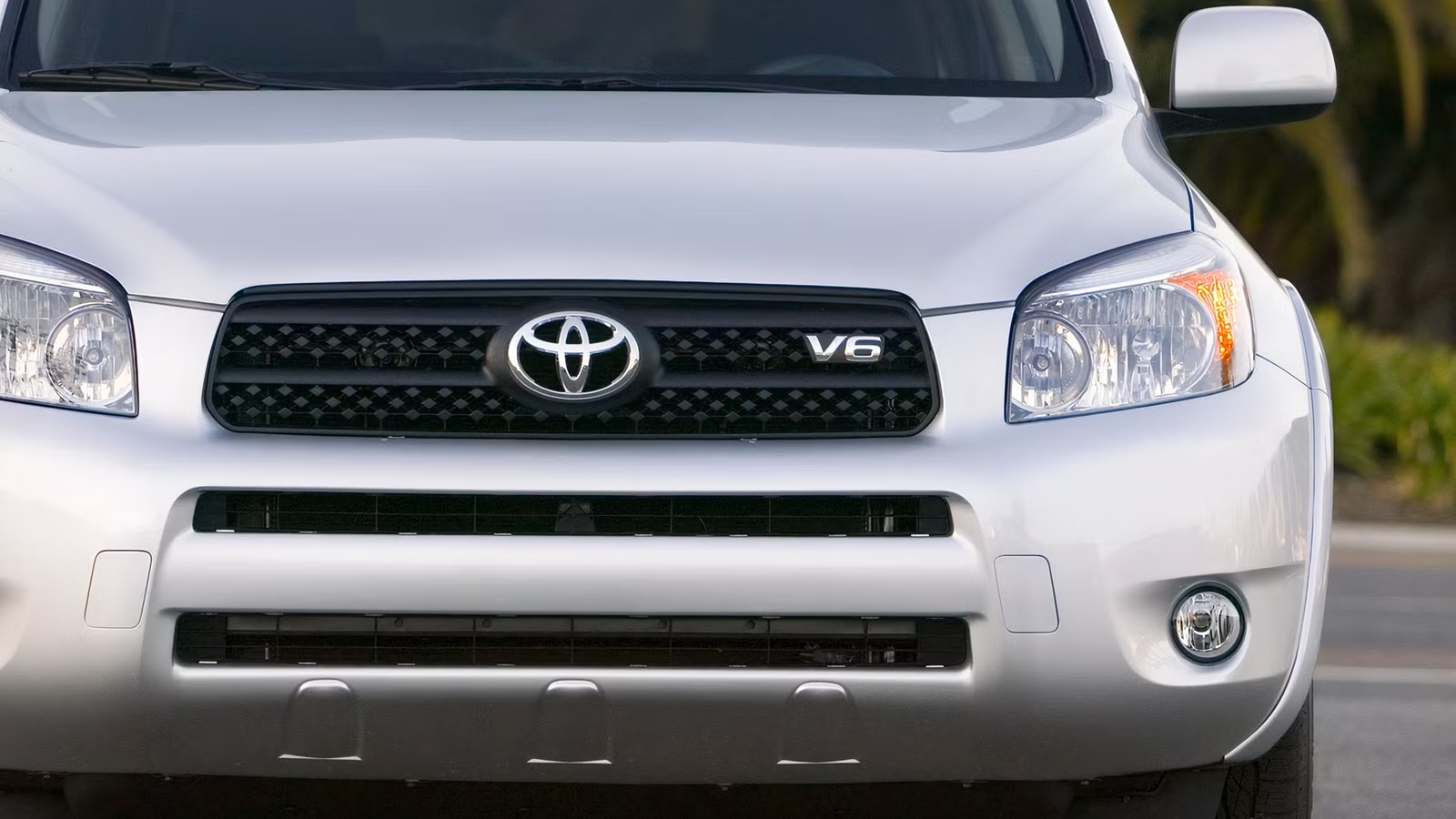
Having to accept that you need to add a practical SUV to the family is a tough reality, especially if you’re a gearhead who relishes having something with a bit of energy and verve in your driveway. High-end machines like the Lamborghini Urus and Porsche Cayenne help to get around this somewhat, but they can be expensive to purchase and run on a day-to-day basis.
Opting for something like a Toyota RAV4 is the much more sensible option, since running it will leave plenty of money left over for diapers and days out. Refrain from zoning out though, as one particular breed of the trusted SUV came with some hidden muscle.
The RAV4 Is An Almost Perfect Family Car
A front angle shot of a 2009-2012 Toyota RAV4 drivingToyota
For those looking to transport their families safely and in comfort, you generally need to look no further than the venerable RAV4. Having first turned up back in 1996, the vehicle was developed to take advantage of the SUV sector, which had started growing in popularity during the 1990s. The beauty of the RAV4 is that, aside from sporting a high-riding driving position and a roomy cabin, it also performed excellently off-road. This ensured it could be used in a variety of situations, making it one of the most versatile family machines on the market.
Combine that with Toyota’s legendary reputation for building reliable cars, and a price that most families could subscribe to, and you had an absolute winner. The RAV4 has gone on to become the most successful non-truck in terms of sales in the US, a title it has held since 2017. The third-generation RAV4, which arrived for the 2006 model year, is one of the most successful of these creations. It sits somewhere in the middle of the total six generations when it comes to dependability, with the vehicle holding strong JD Power scores across various model years.
The thing is, while all these elements are great, they all add up to create a vehicle that is practically perfect for most families, but one that will leave you feeling a little cold overall. The RAV4 excels at its job, but lacks that bit of passion that gearheads crave from their four-wheeled companion. Luckily, if you opt for a used example of the third-generation model, there is an engine option that can help to get around this.
The Third-Gen RAV4 Packed A V6
2008 Toyota RAV4 – V6 EngineToyota
Whereas its predecessors were only available with inline-four engine options, Toyota elected to offer the third-gen RAV4 with a more refined and powerful V6 power plant as an extra-cost option. The V6 was provided at the same trim levels as the base four-pot version, with each featuring pretty much the same level of interior and exterior equipment. As a result, the cost of upgrading to the six-cylinder unit was minimal, with each trim costing around $2,000 more with the V6 box ticked.
While the more powerful variant wasn’t as fuel efficient as the four-pot version (expect to give away around 2 MPG on average), the more refined engine meant that longer journeys were a little less tiresome. Plus, you had some extra grunt and a more muscular engine note to enjoy on the school run. Whereas the standard 2.5-liter four-cylinder version came with 179 horsepower, the equivalent 3.5-liter V6 got a commanding 269 hp. With the optional four-wheel drive system, this practical SUV could reach 60 mph in a rapid 6.3 seconds.
The extra grunt really made a difference, though that shouldn’t come as a surprise when you examine the difference in power-to-weight between the two variants. While the V6 RAV4 is heavier, it still manages a figure of 151.1 hp per ton, whereas its slimmer sibling can muster up just 104.6 hp per ton. The 2GR-FE engine wasn’t all show and no substance; the power plant genuinely turned the RAV4 into a dangerous sleeper.
None Of Its Rivals Could Come Close
A front three-quarter shot of a 2009-2011 Volkswagen TiguanVolkswagen
The beauty of the RAV4 is that, despite featuring such a powerful engine, it was still very reasonable in terms of price. In 2011, you could have a well-specced Sport trim with 4WD for $27,505, and most of its rivals only offered four-pots at that kind of MSRP. Its big rival, the Honda CR-V, could be chosen for around the same money in EX-L form, which also afforded you 4WD. The drawback was that you only got a naturally aspirated 2.4-liter I4 power plant, which delivered a rather average 180 hp.
And then we come to the Subaru Forester and Volkswagen Tiguan. Once again, you could have a well-specced version of both for the same sort of price as a RAV4 4WD V6 Sport, but they came packing four-cylinder engines as well. While the Forester’s 2.5-liter unit only kicked out 180 hp, the Tiguan, which was only available in front-wheel drive at this price point, fared a little better with its 2.0-liter engine bringing 200 hp to the party. Still, none of these options was particularly light, meaning they all fell well behind the power-to-weight ratio of the RAV4 V6.
The VW performs the best of the RAV4’s rivals with 116.9 hp per ton, while the Honda and Subaru lag well behind on 105.2 and 101.1 hp per ton, respectively. Aside from that, the 2GR-FE V6’s 246 lb-ft torque figure also left its competitors well in its dust, ensuring the RAV4 was much better when it came to pulling out and overtaking other vehicles. This made it considerably safer, since you get such maneuvers done much faster. For the money, the RAV4 V6 well and truly left its rivals with severely black eyes.
The RAV4 V6 Is Ultra-Affordable On The Used Market
Rear 3/4 view of the 2012 Toyota RAV4 Sport in motionToyota
Happily, the news only gets better from there. Rather than spending north of $30k on a brand-new RAV4, you’ll only have to hand over around $10,000 for a tidy V6 option with decent mileage on the clock. Finding a low-mileage vehicle will be tricky given that the RAV4 isn’t exactly a collector’s darling, but you can find a sub-50,000-mile car in range-topping Limited spec for less than $20k if you shop around. At the $10k mark, you’ll have to settle for a higher-mileage Sport or Limited with 4WD, with cars tending to sport around 115,000 miles on average.
That doesn’t mean they’re at death’s door, though, since the 2GR-FE engine is known to reach 250,000 miles as long as it has been properly maintained. Lower-spec cars can be had around that price with lower mileage, but you’ll have to decide whether having fewer creature comforts is worth the trade. We reckon the sweet spot is around $15,000, since you’ll be able to find very well-looked-after later Sport or Limited examples with good history, and with decent mileage.
Considering the level of power and refinement you get versus rival four-cylinder offerings from the era, a used third-gen RAV4 V6 stands out as a pretty tasty deal.
The RAV4 V6 Will Look After You
The interior of the 2009-2012 Toyota RAV4 – cargo compartment with the rear seats foldedToyota
When it comes to common issues to be aware of, the third-gen RAV4 is generally a very solid machine. Earlier examples built between 2006 and 2008 suffered from excessive oil consumption, but Toyota managed to get this under control later in the vehicle’s production run. The 2GR-FE engine has few major weaknesses, though its water pump and ignition coils are known to be problematic, with these components lasting around 30,000 to 40,000 miles before they need replacing.
It’s therefore a good idea to look through any service history to find a record of these being replaced recently, since you may have to get them done otherwise. There’s a reason why RepairPal estimates that you’ll only have to part with around $419 per year to keep the thing running sweetly, as the car suffers from few recurring issues that’ll cause you headaches. For reference, rivals like the Forester and Tiguan will demand much more from your wallet to keep them happy.
Whereas the Subaru should cost around $676 per year, the Tiguan is estimated to rob you of $909 per year, despite having a smaller four-cylinder engine lurking beneath its hood. Considering the RAV4 brings both power and reliability to the table, while also being only a little less fuel efficient than its four-cylinder competitors, it’s hard to see past it as the ideal family companion for gearheads. If you want versatility and a bit of personality from your SUV, the third-gen RAV4 V6 AWD is everything you’ll ever need.
Sources: RepairPal, Toyota.
