

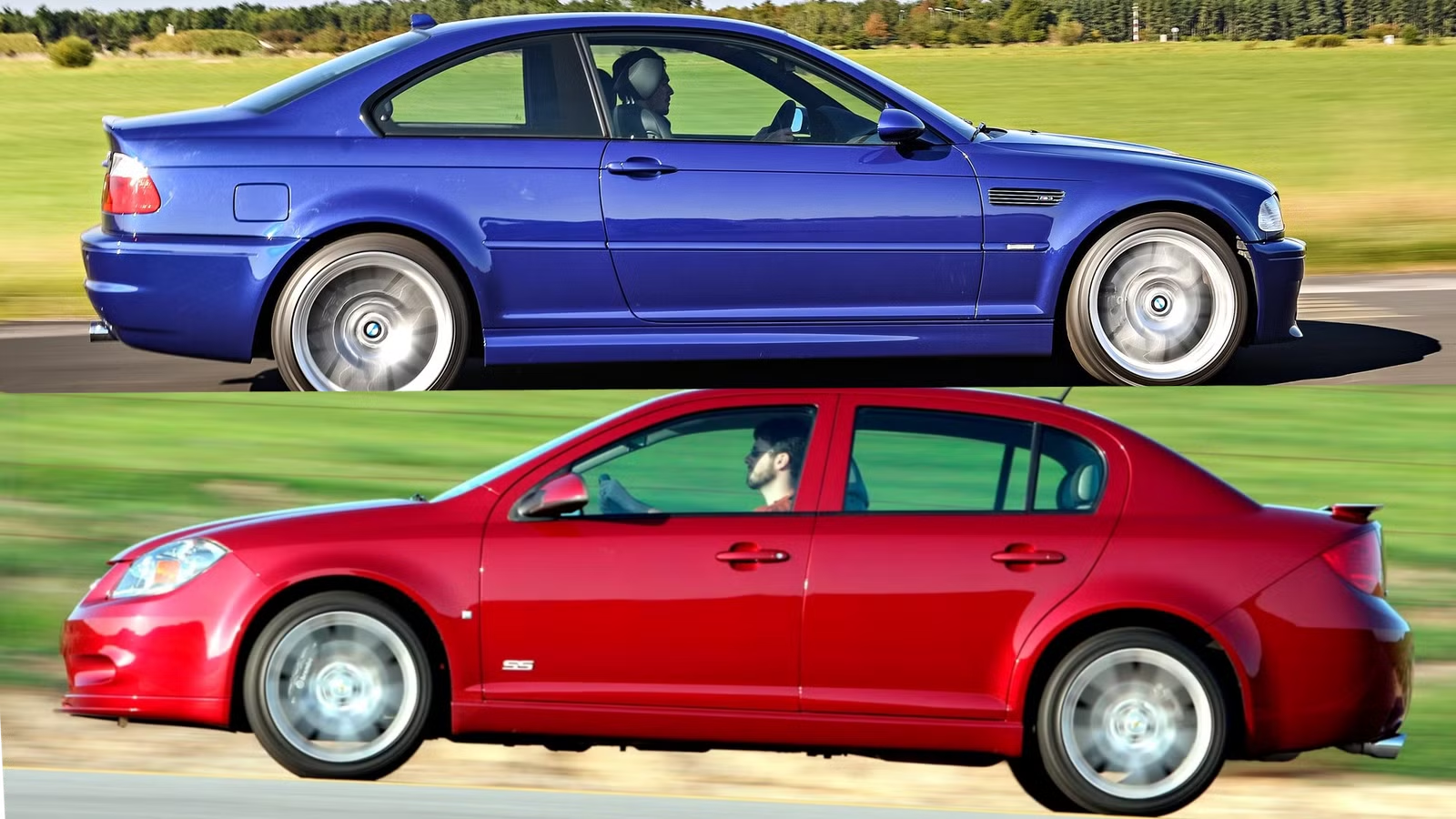
It sounds like the setup to a bar bet: a front-wheel-drive compact sedan built on a budget platform — the kind of car you’d find in a rental lot between a minivan and a crossover — posting a Nürburgring lap time on par with one of BMW’s most celebrated M3s. Yet that’s exactly what the Chevrolet Cobalt SS did, and the story of how it got there is worth revisiting.
The Chevrolet Cobalt’s reputation as a no-frills commuter and rental-fleet staple made it easy to overlook what was happening at the performance end of the range. The SS models were a different breed entirely, and the turbocharged variant in particular proved capable of matching the lap time of one of BMW’s greatest M3 models.
Souped-Up Chevy
Model
2005 Chevrolet Cobalt SS SC
2008 Chevrolet Cobalt SS TC
Engine
2.0-liter inline four-cylinder
2.0-liter inline four-cylinder
Induction System
Supercharged
Turbocharged
Horsepower
202 hp @ 5,600 rpm
260 hp @ 5,300 rpm
Torque
200 lb-ft @ 4,400 rpm
260 lb-ft @ 2,000 rpm
Top speed
140 mph
160 mph
Five derivatives of the Chevrolet Cobalt were produced during the nameplate’s lifetime, from 2005 to 2010. Three of those derivatives were distinguished by their powertrains — two featuring forced induction and one powered by a naturally aspirated engine — and all three carried the Super Sport badge. The first entry in this lineup was a supercharged coupe that debuted at the tail end of 2004. A year later, the naturally aspirated offshoot, dubbed the 1SS, arrived with roughly 171 hp drawn from a 2.4-liter inline four-cylinder — the largest engine used across any of the SS variants.
However, the model that matched the lap times of one of Bavaria’s greatest machines was the turbocharged variant that debuted in the first half of 2008. The supercharged Cobalt SS had relied on the General Motors LSJ variant of the Ecotec engine family, but the LSJ could not meet 2008 emissions requirements, so the turbocharged Chevrolet Cobalt SS was born. Chevrolet replaced the LSJ with the LNF Ecotec, the second-generation version of the Ecotec engine. Mounted longitudinally, the LNF featured a square bore and stroke — meaning both dimensions measured the same — of 3.4 inches, a 9.2:1 compression ratio, a cam-driven direct fuel injection system, dual camshafts with variable valve timing, a forged steel rotating assembly, and a twin-scroll turbocharger.
The turbocharged model was the quickest option in the Cobalt SS range. It also employed features like a No-Lift Shift system that allowed the driver to maintain turbocharger boost pressure while rowing through the gears, along with a new Launch Control system. That improved performance over both the naturally aspirated and supercharged models enabled the turbocharged Chevrolet Cobalt SS to set a new record for the front-wheel-drive sports compact class, a title previously held by the Opel Astra OPC.
The Controversial ‘Ring Time
Eight minutes and a hair over twenty-two seconds allowed the Cobalt SS to claim the title of the quickest front-wheel-drive sports compact at the hallowed Nürburgring. The Chevrolet Cobalt SS does not wear its performance capabilities on its sleeve. It lacks hood scoops, flared wheel arches, and the boisterous aerodynamic elements that typically signal a hot hatch, although it does sport a rear wing that dominates the Cobalt’s tail. To conquer the 170 turns of the famed circuit, the Cobalt SS relies on an FE5 sport suspension system and a series of chassis revisions aimed at sharpening its handling.
Chevrolet’s efforts to extract performance from the Cobalt SS allowed the FWD sedan to match the lap time of the venerated BMW E46 M3. Debuting in 2000 and carrying on the M3 legacy of the E36, this celebrated model is widely regarded as a quintessential sports car, drawing its power from the S54B32 six-cylinder engine. In base configuration, the E46 M3 lapped the Nürburgring in eight minutes and twenty-two seconds flat. That means the SS is the rental car that beat the E46 M3.
The two cars are completely different offerings, but they share the common thread of being purpose-built performance machines. The E46 M3 has a larger engine with more cylinders, more displacement, and a higher power output. On paper, the Bavarian coupe holds the edge across every performance metric, from top speed to 0-60 mph. The E46 M3 was also engineered from the ground up as a sports car, with a far more extensive development program dedicated to extracting maximum performance from its engine and chassis.
Comparing Apples To Apples
Although the Chevrolet Cobalt SS matches the time set by the BMW E46 M3, the M3 debuted eight years before the turbocharged Cobalt SS. Comparing the Cobalt SS to an M3 from the same era tells a different story. A year before the turbocharged Cobalt SS arrived, BMW had already retired the E46 M3 and introduced its successor, the BMW E92 M3.
The BMW E92 M3 abandoned the formula of a rev-happy six-cylinder in favor of an equally rev-happy 4.0-liter V8 producing 414 hp and 296 lb-ft of torque. That output was enough to push the 3,704-lb sedan from a standstill to 60 mph in 4.6 seconds when paired with a dual-clutch transmission. The BMW E92 M3 lapped the Nürburgring Nordschleife in eight minutes and five seconds — quicker than the BMW E60 M5 and on par with the BMW F10 M5.
Unsurprisingly, the BMW E92 M3 posts a quicker lap around the famous German circuit. The gap comes down to a significant disparity in power outputs and chassis dynamics — the E92 M3, like the E46 before it, was conceived from day one as a high-performance machine. Even so, the difference in power and performance between the BMW E92 M3 and the Chevrolet Cobalt SS doesn’t diminish what Chevy achieved; the Cobalt SS remains a commendable entry into the late-2000s performance segment.
Here’s How Much You’ll Pay On The Used Market
The level of performance Chevrolet extracted from the Cobalt SS’s 2.0-liter inline four-cylinder is genuinely impressive. Pair that engine with a comprehensive suite of chassis enhancements and the SS stands as the clear performance leader of the Cobalt range. What makes the achievement even more remarkable is that the Cobalt SS represented the American automaker’s first serious foray into the performance compact segment — and it remains an appealing platform for tuners to this day, thanks to the strong potential of both the supercharged LSJ and turbocharged LNF four-cylinder engines.
In retrospect, the Chevrolet Cobalt SS is one of the most noteworthy front-wheel-drive sports cars of the 2000s and a standout entry in the automaker’s history.
In 2026, the Chevrolet Cobalt SS occupies an intriguing space in the enthusiast market, with values dictated heavily by condition, mileage, and forced-induction setups. High-mileage or track-abused examples typically fetch between $4,000 and $6,000, presenting an affordable entry point for project-car builders. Well-maintained drivers—most commonly the early 2005 to 2007 supercharged LSJ models—hover reliably in the $6,500 to $9,500 range, offering impressive bang-for-your-buck performance.
At the top of the spectrum, the rare 2008 to 2010 turbocharged LNF variants command a distinct collector premium. Thanks to their factory 260-horsepower output, aggressive no-lift shift feature, and legitimate Nürburgring pedigree, clean low-mileage Turbo models easily reach $10,000 to $15,000+ on auction sites. Unmodified examples of the ultra-scarce four-door Cobalt SS Turbo sedan sit right at the peak of that range, solidifying its place as a rising modern classic among 2000s front-wheel-drive performance icons.
Sources: Chevrolet
