

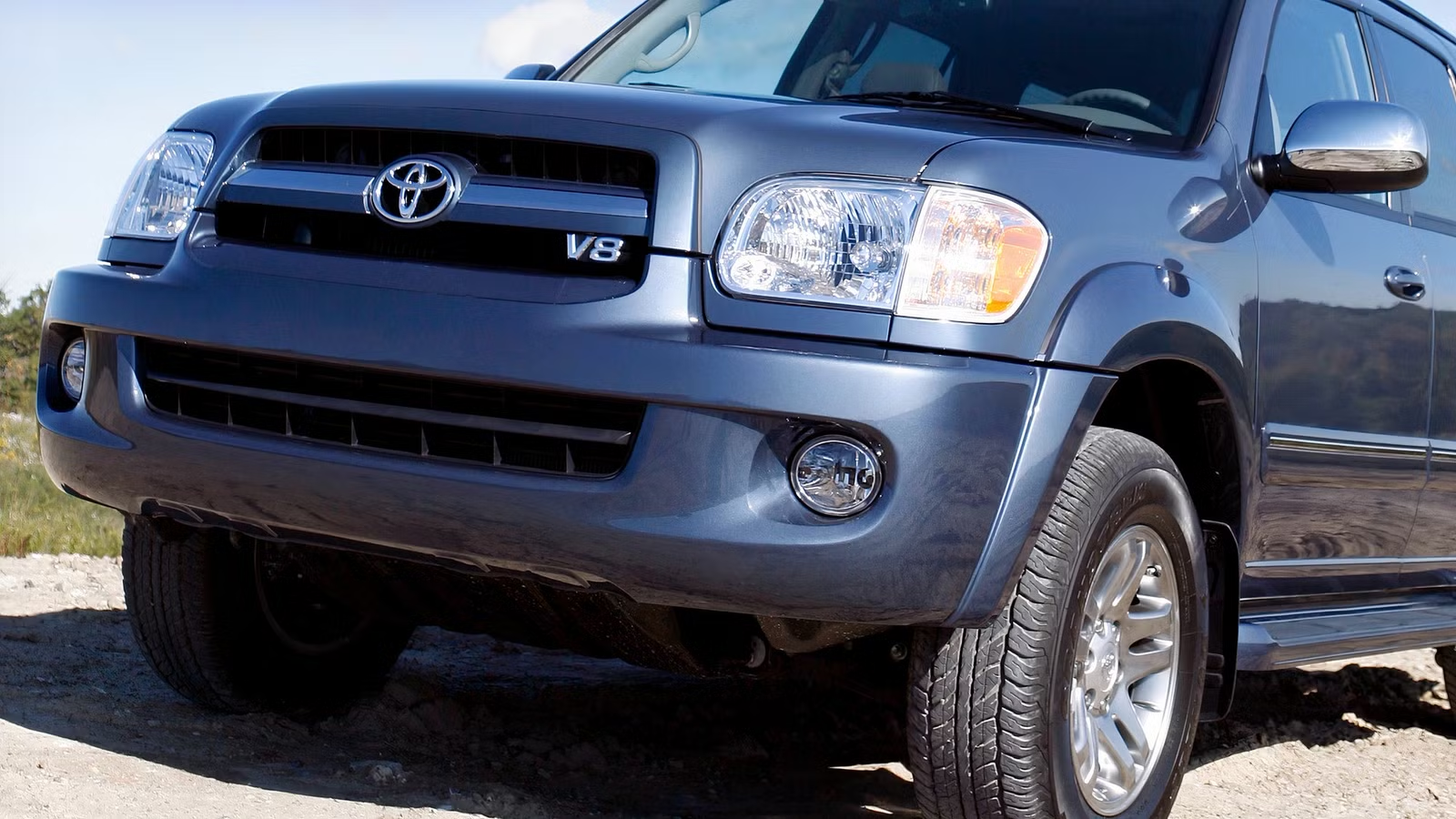
The most reliable SUV on the market – and the most reliable vehicle overall in terms of longevity – is theToyota Sequoia. This is according to recent rankings from iSeeCars, which sees Toyota and Lexus dominating the top 10, with the full-size family SUV at the top.
For Toyota fans, this is just confirming what we already knew. But it’s somewhat startling to put the numbers into perspective and see just how much more reliable the Sequoia is than its competitors.
The Sequoia Is Eight Times As Likely To Reach 250,000 Miles Than Most Cars
iSeeCars’ latest roundup of longest-lasting cars, across all segments, saw Toyota claiming six spots, Lexus claiming three, and the Honda Accord Hybrid rounding out the list in 10th place. This comes in light of Toyota actually slipping a few notches in the latest JD Power survey, even as Lexus continues to hold its top spot.
Combined, Toyota, Honda, and Lexus account for 25 vehicles on a list of 27 in total. For reference, a typical vehicle has a 5.4% chance of reaching 250,000 miles.
The Lexus LS takes the second spot, with a 38.8% chance of reaching a quarter-million miles. This is despite the fact that the V35A engine found in the 2026 LS has been plagued with recalls for metal debris. This should help to illustrate that iSeeCars’ data is not based strictly on the most recent version of a car, but on previous model years, as well.
Toyota And Honda Drivers Play Their Part, Too
2008-2017 Toyota SequoiaToyota
It should be noted that data is skewed in part by who’s buying the cars. A typical driver will keep a new car for up to eight years before trading it in, putting 15,000 miles on the car each year. That comes out to just 120,000 miles. If the next driver puts the exact same mileage on the car, it still won’t have reached a quarter-million in 16 years.
Building a reliable car is one thing, but selling it to someone who’s actually shooting for 250,000 miles on the odometer is another matter entirely. To a typical car buyer, a quarter-million miles is more than twice what they need. Others will drive a car until the wheels fall off. Toyota and Honda are especially popular among diligent, maintenance-focused owners.
Which Version Of The Sequoia Really Makes The List?
The 2026 Toyota Sequoia runs on the same 3.4-liter V6 engine that’s been creating so many problems for the Toyota Tundra. It should be noted that the engine itself isn’t unproven, as the recalls affecting the Tundra come down to machining debris resulting from the manufacturing process, and not anything wrong with the engine at a design level.
All the same, the car’s V35A engine is, at best, unproven, which tells us that the Sequoia earned the top spot thanks to previous iterations of the SUV. So which version of this car is most likely to get you to 250,000 miles?
Second-Gen Models Ran Some Legendary Toyota V8s
The second-gen Toyota Sequoias, from model years 2008 to 2022, were powered by a storied lineup of reliable eight-cylinder power plants.
1UR (2010-2012)
2UZ (2008-2009)
3UR (2008+)
Displacement
4.6-Liter NA 8-Cylinder
4.7-Liter NA 8-Cylinder
5.7-Liter NA 8-Cylinder
Power
310 hp
276 hp
381 hp
Torque
327 lb-ft
314 lb-ft
401 lb-ft
All three of these engines can be found on lists of the most reliable engines ever built. The most famous of these stories may be that of Vic Sheppard, who ran a 3UR-powered 2007 Toyota Tundra to a million miles, replaced it with a 2014 model, and then drove that one to another million miles. He did this while averaging 125,000 miles a year.
The engine is the star attraction here, but it doesn’t hurt that the second-gen Sequoia ran exclusively on five- and six-speed automatic transmissions. No CVTs, and no mechanically-complicated 10-speeds.
The Tundra ranks in fifth place, by the way, with a 28.2% chance of reaching 250,000 miles. This likely owes to the fact that the Sequoia will accumulate a lot of road-trip and daily commute miles as a family SUV, while many Tundras may be devoted exclusively to short-haul work-truck duties.
It’s Hard To Find A Dissatisfied Sequoia Buyer
2008-2017 Toyota SequoiaToyota
According to CarComplaints, the 2009 Sequoia is difficult to beat on reliability, showing zero complaints on file. The 2008 model is the most troubled of the second generation, with 15 complaints on file. The only powertrain complaint among those 15 is a single report of automatic transmission failure at 205,350 miles, meaning it does not develop serious mechanical issues until it has already outlasted almost every car on the road.
The Second-Gen Sequoia Is Cheap To Maintain
According to RepairPal, a 2010 Sequoia should cost only around $573 a year to maintain, with the following representing the most expensive common repairs.
- Sunroof motor replacement $1,490 – $1,736
- Air conditioning refrigerant line replacement $1,150 – $1,246
- Power seat switch replacement – $581 – $625
- Alternator voltage regulator replacement $541 – $666
- Axle shaft replacement $514 – $641
Like any 16-year-old SUV, the Sequoia has its share of issues, but it’s worth noting that none of these problems have anything to do with the engine or transmission. In a well-kept Sequoia, you’re going to see the seats deteriorating, the electrical systems burning out, and the air conditioning failing long before you have your first engine breakdown.
The most concerning powertrain problems for the 3UR include oil leaks and coolant leaks at high mileages. You don’t need to worry about that just yet. If you’re buying something with fewer than 200,000 miles on the odometer, you’re nowhere near that point.
What Will A Second-Gen Sequoia Cost You Today?
2008-2017 Toyota SequoiaToyota
The brand-new Sequoia produces 437 hp, and the 3.4-liter twin-turbo V6 seems to have come through its teething pains just fine. But, it’s a twin-turbo engine paired to a 10-speed automatic transmission. Smart money does not have this powertrain outlasting the naturally-aspirated V8s and six-speed automatics found in the second-gen Sequoia.
Looking back just five years, our price-tracking tool has an entry-level Sequoia SR5 trending at $46,653 from an MSRP of $50,400. That’s not exactly the deal of the century, but we’re not shopping for an older model just to save on the sticker price – we’re looking to save money in the long run with an SUV that will outlast most strains of cockroach.
100,000 Miles Is Technically “Low Mileage” For A Second-Gen Sequoia
2008-2017 Toyota SequoiaToyota
Checking some listings on our own marketplace, here’s what we were able to find.
- A 94,900-mile 2016 Limited is selling for $31,995 in California.
- A 105,199-mile 2011 SR5 is selling for $19,995 in Hawaii.
- A 109,508-mile 2017 Limited is selling for $32,995 in Oregon.
- A 106,110-mile 2016 Platinum is selling for $33,795 in Georgia.
- A 110,037-mile 2018 Limited is selling for $28,900 in Pennsylvania.
These numbers should give you an idea of what’s out there in the 100,000-mile range, but there’s no telling what will be available in your area, and in your price range, when you’re ready to buy.
Normally, we’d advise against spending anywhere close to $20,000 on a 10-year-old family car with 100,000 miles on the odometer, but as we’ve seen, these SUVs are just getting started at 100,000 miles. As long as you kick the tires and the Sequoia passes the test drive, routine maintenance should be all it takes to keep these cars going on their way to 250,000 miles or more.
The Sequoia is a very popular used vehicle, given its tremendous reliability, but it’s also a fairly common SUV, typically selling more than 10,000 units a year throughout its second generation. This means you should have no trouble finding a fairly priced 2008-2022 model in your area.
All that being said, if you’d rather not drive a Toyota, Lexus, or Honda, the Chevy Suburban ranks as the 24th longest-running SUV, with an 11.6% chance of hitting a quarter-million miles. This makes it twice as dependable as a typical car.
Sources: Toyota, iSeeCars, RepairPal, CarComplaints.
