

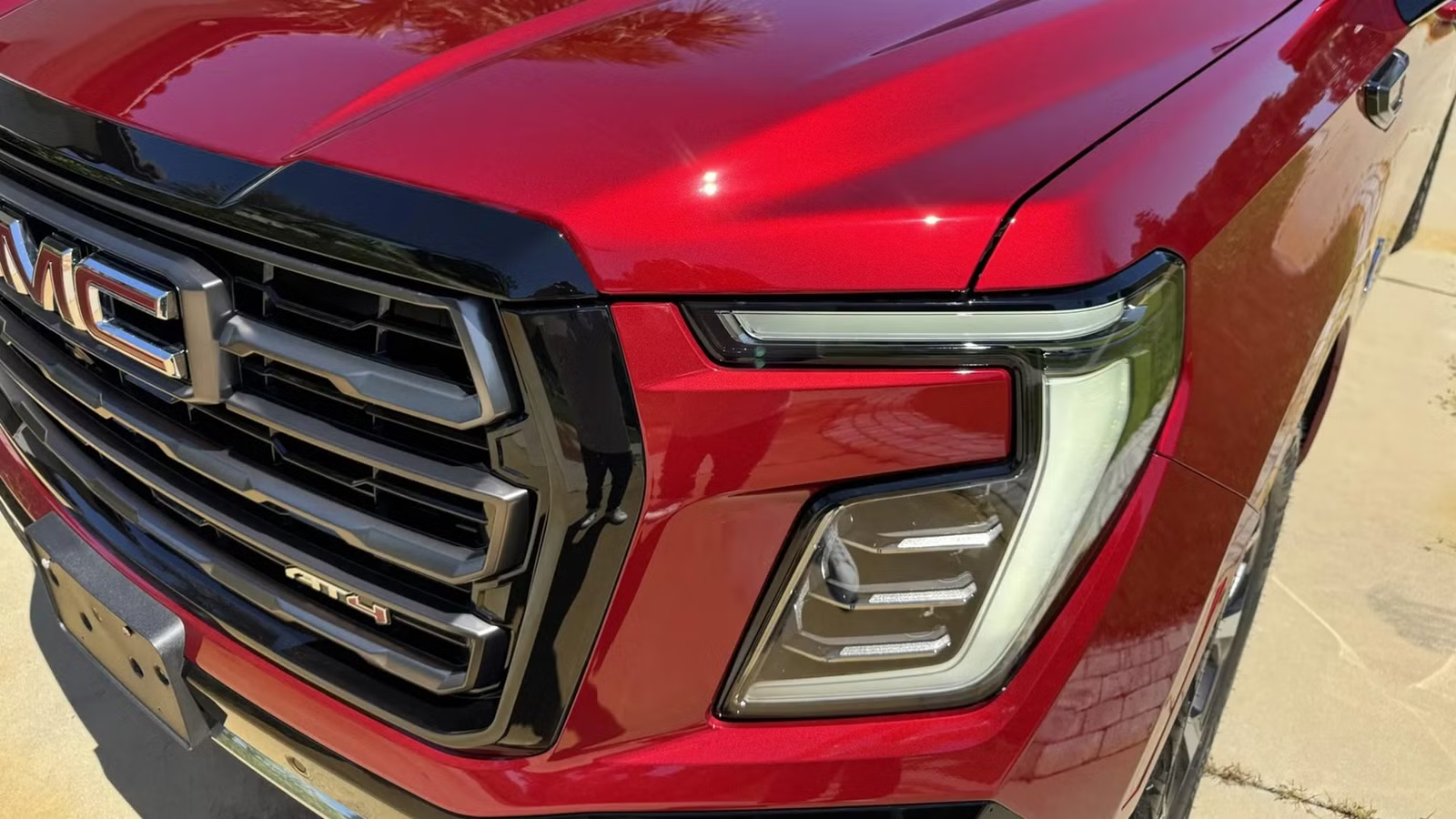
You can barely find a diesel passenger vehicle in America anymore, yet one exists that costs more than most people’s homes. While commercial vehicles like Super Duty trucks and vans still run on the fuel, conventional passenger machines have largely moved away from it, moving toward gas and electricity instead. Still, if you crave having a bit of diesel in your life, there are some options.
They can snatch a fair chunk of cash from your bank account though, as illustrated by one of General Motors’ largest and most luxurious SUVs.
The Efficiency And Torque Case For Putting A Diesel In America’s Biggest SUV
GM 3.0L Duramax EngineGMC
Despite being pretty unpopular in the US, with the last normal car to run on the fuel disappearing in 2019, diesels have several plus points that make them appealing for a certain breed of vehicle owner. Thanks to diesel holding between 11–15% more energy per equal volume compared to regular gasoline, it can run at a leaner air/fuel mixture than gas, which ensures that less fuel is needed to create the same amount of power. This affords greater fuel efficiency, meaning you can go longer between fill-ups.
Diesel’s efficiency and torque advantages are well-documented – but they take on a different meaning when the engine in question is mounted under a 6,000-pound luxury SUV with a $108,000 price tag. Here’s why that combination makes the Yukon XL unlike anything else on the market.
The GMC Yukon XL Makes You Feel Like Royalty
2025 GMC Yukon XL interior render of all three rows of seats from the side angleGMC
If you’re looking for a new diesel car and you have a hefty budget to work with, the GMC Yukon XL is the priciest such machine currently on sale in the US. Being the XL model, you’ll have an additional 15 inches of total length to work with versus a standard Yukon, which primarily goes into greatly enhancing third row and trunk space. Within this figure is a wheelbase that is a full 13 inches longer, a design that not only improves stability but also weight distribution.
The range-topping model is the Yukon XL Denali Ultimate 4WD, which comes packing a turbocharged 3.0-liter inline-six Duramax diesel engine. Alongside the powerful engine, you’ll get all the usual refinements that you’d anticipate getting on such an expensive SUV. Heated and ventilated leather seats that massage you are included for the price of admission, as are Automatic Parking, Adaptive Cruise Control, and a plush tri-zone Climate Control system.
GM’s high-end adaptive Air Ride suspension system is also included, alongside the futuristic Super Cruise setup, which allows for hands-free driving. Alongside the sumptuous leather seating you’ll be able to sink into, the feeling of class within the cabin is further heightened by real paldao wood trim that nicely complements it. To ensure your music sounds as pure as possible, a Bose sound system is present.
All of this comfort and technology comes together beautifully – but the question is whether the sticker price to access it is equally impressive, or simply jaw-dropping.
The Most Expensive Diesel Car On Sale Will Empty Your Bank Account
2025 GMC Yukon XL SUVGMC
Of course, having all of this high-end equipment will come at a cost. Calling it an expensive beast is an understatement, as you’ll have to part with $108,195 even if you choose not to tick any boxes on the options menu. This includes the traditional $2,795 destination charge. Add in some extras, and you’ll soon find yourself needing to find a fair chunk of extra dollars down the back of the couch.
Having the vehicle’s boxy body finished in anything other than white will set you back $495, with some more premium colors demanding even more than that. There are also special chrome 24-inch wheels, which will come packing a bill of $4,695. By the time you’ve ticked all the other boxes presented to you, such as the Illumination Package that brings cargo and door sills that light up, and roof rails, you’ll be left with a bill of $122,193. That’s roughly $3,000 cheaper than a brand-new BMW M5 Touring.
It’s fortunate that the commanding diesel unit found lurking beneath the hood has some real claws.
Whether at $122,193 or $108,195 before options, you’d expect the engine under that hood to be extraordinary — and in one key metric, it absolutely is. It just might not be the metric you expected.
The Duramax Beats The V8 In Torque And Efficiency – But Not In Every Way
2025 GMC Yukon XL front 3/4 angle while climbing rocksGMC
While all the premium features are impressive, arguably the part you’re most interested in is the 3.0-liter Duramax engine. While it’s not the most powerful engine option available for the Yukon – that accolade goes to the 6.2-liter V8 that pumps out 420 horsepower – it’s easily the torquiest. While the 6.2-liter gas V8 throws out 460 lb-ft of torque to the four wheels, the Duramax engine has a monstrous 495 lb-ft. From a power standpoint, the diesel lags far behind the gas V8 with just 305 hp on offer, which means the latter is the better option if you’re looking for on-road performance.
Expect a 0-60 mph effort around a second quicker with the 6.2-liter V8 than the 3.0-liter I6, but if you need to tow, the diesel easily beats its gasoline alternative. There are other key benefits, too. Being a diesel, the Duramax will likely remain strong long after the 6.2-liter unit calls it a day, which is key if completing heavy-duty tasks with your SUV is non-negotiable.
Then there’s the small subject of fuel efficiency. Despite having considerably less torque on hand, the larger gas V8-equipped Yukon XL will do well to achieve 16 MPG on average, while the diesel alternative can achieve 21 MPG on the combined cycle. This will make it considerably cheaper to keep filled up over time, not to mention giving you more margin for error if you’re towing something particularly heavy.
Why The Diesel Yukon’s Fuel Savings Don’t Add Up A The Pump
BMW Factory Renewable Diesel Fuel PumpBMW
That said, being fuel efficient isn’t the be-all and end-all. One of the primary reasons that diesel technology isn’t a big seller in the US – and has only been getting rarer in the US over the last several years – is that it isn’t very environmentally friendly. Manufacturers began running afoul of stricter emissions regulations due to their diesel engines, which emit significant amounts of CO2 into the atmosphere. It’s not just emissions enforcement that has led to the slow death of the diesel in the US though, as fuel prices remain exorbitant right now.
Thanks to conflicts such as the Iran War, the price of diesel has rocketed considerably, compounded by weak demand from the commercial sector. Whereas the average price per gallon for gas currently stands at around $4 in the US, an equal volume of diesel costs just shy of $5.50. As a result, filling the Yukon XL’s 28-gallon tank would cost an extra $42 if you opted for a diesel over a gas model, which rather undermines its efficiency advantage. Over 10,000 miles, you’d save $154 on fuel with the gas Yukon over the diesel, despite having to fill up an extra five times during that period.
These shortcomings have led other brands to discontinue their diesel offerings, at least on the general consumer side of the market, in recent years. The ultra-popular F-150 saw its diesel offerings killed off following the 2022 model year, while the likes of the Chevy Colorado and Ram 1500 saw their similar diesel engines axed around a similar time. The Yukon’s cousin, the Cadillac Escalade, also lost the use of the 3.0-liter Duramax following 2025, since just 5% of buyers were opting for it.
The diesel has had a solid run overall, but at least in consumer vehicles, it seems the clock is running out. Its usefulness in larger machinery such as excavators and semi-trucks means it won’t be going anywhere anytime soon, but cleaner and more efficient options like hybrids are, for the most part, the superior choices for conventional production vehicles in 2026. If you’re not ready to let go yet though, options like the Yukon XL remain waiting for you to explore.
Sources: GMC
