

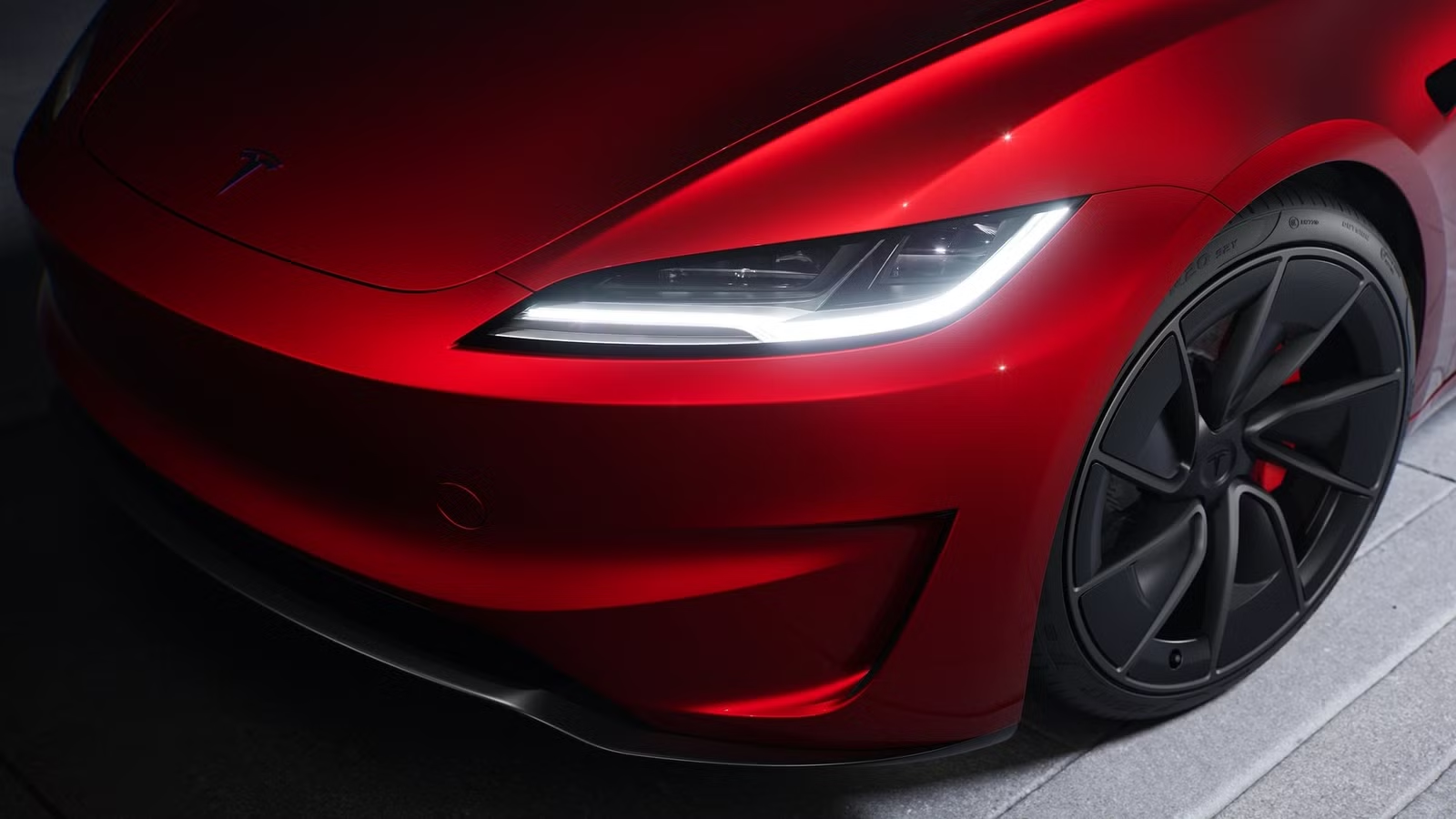
America is celebrating its 250th birthday this year, and that had us thinking: just what is the most American car? Based purely on character and styling, it’s easy to imagine a big muscle car or pickup truck, and either way, it would surely be powered by a V8. However, if you dig into where a car is made and where its parts come from, you come up with some dramatically different results.
We looked at some rankings from a couple of different organizations, and while they don’t come up with the exact same answers, one thing is clear: if you’re looking for the most American automobile on sale today, it’s an EV. Made by Tesla.
2026 Tesla Model 3 Standard front 3/4 angle in white while drivingTesla
The Most Basic Breakdown
The US government actually publishes the basic information about where cars are built and how much of the parts come from America and other countries. This is required by the American Automobile Labeling Act. The most pertinent of that information appears on a car’s window sticker. That information includes the percentage of domestic content, which is classified as parts from the US and Canada, the percentage of parts from other countries, as well as the country where the car was finally assembled.
Looking at the information for 2026 model year cars, only four vehicles had a domestic parts percentage of 75%, and only one of them was from a car company based in the US. Even more surprising is the fact that only one of these four has a combustion engine.
Model
Domestic Content (US/Canada)
Foreign Content
Final Assembly
Tesla Model 3 (excl. Performance)
75%
25%
US
Kia EV6 (excl. GT)
75%
25%
US
VW ID.4
75%
25%
US
Honda Ridgeline
75%
25%
US
2025 Kia EV6 hero shotKia
Going further down the list reveals far more vehicles from American automakers, as well as vehicles with combustion engines. At 74% domestic content is the Jeep Gladiator, which is built in Toledo, Ohio. It actually has a fair bit more domestic parts content than its close sibling, the Wrangler, which has just 68% domestic parts content. Tied at 73% are the Jeep Grand Cherokee and Dodge Durango, and both are produced in the US.
Tied at 70% are six other models including the Ford Mustang GTD, Acura MDX, Honda Odyssey, Honda Pilot, Tesla Model 3 Performance, and Tesla Model Y. All of those are assembled in the US except for the Mustang GTD. The GTD is actually built in Canada by Multimatic. The Mustangs that are built at the Flat Rock, Michigan, factory use fewer domestic parts at just 55%. The Mustang and the Model 3 aren’t the only models to have closely-related models with differing parts contents, either. The Kia EV6’s twin from Hyundai, the Ioniq 5, is also built in America, but only 58% of its parts came from the US or Canada. Additionally, the high-performance versions of both cars, the EV6 GT and Ioniq 5 N, were entirely built in Korea.
Ford Mustang GTD Spirit of AmericaFord
Other Organizations Have More Detailed Criteria
As useful as the government’s statistics are for evaluating how American a car is, they mostly stop at where the parts and car are made. It’s possible to dig deeper, and two organizations have: Cars.com and American University’s Kogod School of Business. You’re probably somewhat familiar with Cars.com, which features online listings for new and used cars for sale, along with resources such as car reviews and buying advice. Its 2026 analysis of American-made cars is also its 21st. According to Cars.com, the organization takes into account government data such as final assembly location, where parts come from, and where the engine and transmission come from. Cars.com also factors in what it calls “factory employment relative to vehicle production.” You can find its top ten in the list below.
- Tesla Model 3
- Tesla Model Y
- Jeep Gladiator
- Jeep Grand Cherokee
- Honda Ridgeline
- Honda Odyssey
- Lexus TX 350
- Honda Accord
- Acura MDX
- Honda Passport
Unsurprisingly, the Cars.com results are similar to the basic rankings from government data. Tesla once again tops the charts, closely followed by the aforementioned Jeeps and a bunch of American-assembled cars from Honda. One newcomer is the Lexus TX, the luxury version of the Toyota Grand Highlander. The VW ID.4 is absent due to it being recently discontinued. We can’t explain why the Kia EV6 doesn’t appear on the list at all, even though the Hyundai Ioniq 5 shows up in 21st position, and the EV9 SUV is 17th.
2025 Jeep Gladiator Rubicon X from the front three-quarter angleJeep
As for the Kogod School of Business, it’s a part of American University, and it formed in 1924. It became large enough to operate somewhat independently starting in 1955. It hasn’t been evaluating how American cars are for quite as long as Cars.com, but it still has a lengthy history of doing so, going back to 2013. Once again, the same info disclosed to and disseminated by the government is factored in, but Kogod also considers factors such as where the car’s manufacturer is based and where much of the research and development is done. It then rates each car out of 100 possible points. Like with the simple parts percentages, many of these vehicles are tied, so we’ve listed them in the chart with their respective scores.
Model
Rank
Score
Tesla Model 3
1
87.5
Tesla Model 3 Performance
2 (Tie)
85
Tesla Cybertruck
4 (Tie)
82.5
Tesla Model S
4 (Tie)
82.5
Jeep Gladiator
6 (Tie)
81
Jeep Wrangler
6 (Tie)
81
Dodge Durango
8 (Tie)
80.5
Jeep Grand Cherokee
8 (Tie)
80.5
Ford Bronco (V6 models)
10 (Tie)
80
Ford Ranger
10 (Tie)
80
Tesla Model X
10 (Tie)
80
2026 Dodge Durango R/T 392 Launch Edition from the front three-quarter angleDodge
Again, the rankings mirror both the government data and the Cars.com rankings, but with some notable changes. Tesla once again ranks quite high, taking the top positions (even though two of those models have been discontinued), followed closely by Jeep’s Toledo-built vehicles. It’s clear, though, that Kogod’s inclusion of automakers’ home countries has a significant effect on elevating some Stellantis and Ford products higher on the list than those from Honda and Toyota.
!!!MODEL TAG!!! Listing Carousel 2026 Tesla Model 3
/cars/tesla/model-3/2026/
The Kogod school also looked at automakers and their vehicles as a whole to determine which has the highest overall average domestic parts content. Naturally, Tesla ranked the highest with an average of 84% followed by Ford at 63% and Stellantis at 60%.
2024 Tesla Model 3 Exterior
Tesla
If American Content Matters Over Everything Else, There’s One Clear Winner
Even though we’ve looked at three different ways to evaluate how American a car is, they’ve all resulted in one clear winner: Tesla Model 3. Not only that, but Tesla is generally the most American car company. Every car it builds mostly uses parts made in the US and Canada, and final assembly for all its cars sold in the US are assembled in the US. Tesla does build some of its cars in other countries, such as China, but it does not sell those in the US. And, of course, the company is based in America, too.
We certainly wouldn’t say that you should only buy a car based on how much of it came from this continent, though. Taking Tesla as an example, a full EV may not fit your lifestyle yet. You may want a car built at an American plant that’s unionized. You may have qualms with the owner of the company. You may not like the styling or even some of the features — or lack thereof — of some of the company’s vehicles (they don’t have Apple CarPlay or Android Auto, for instance). So it is good to see that there are plenty of other very American options that might solve some of those issues.
Related
What You Really Need To Know About Leasing Vs Buying A Car
Both can involve monthly payments, but what’s the difference between lease vs finance?
Even then, though, we still would recommend that you pick a car based on how well it fits your wants and needs on a daily basis. Make sure you’re buying a car that you’re comfortable in, that you can afford, that goes where you need it to without being too thirsty, and that just generally makes you happy. When you’re spending so much money on a vehicle that you’ll have for years, those are the most important factors, and vehicle nationality can come after.
Source: National Highway Traffic Safety Administration, Cars.com, Kogod School of Business
