

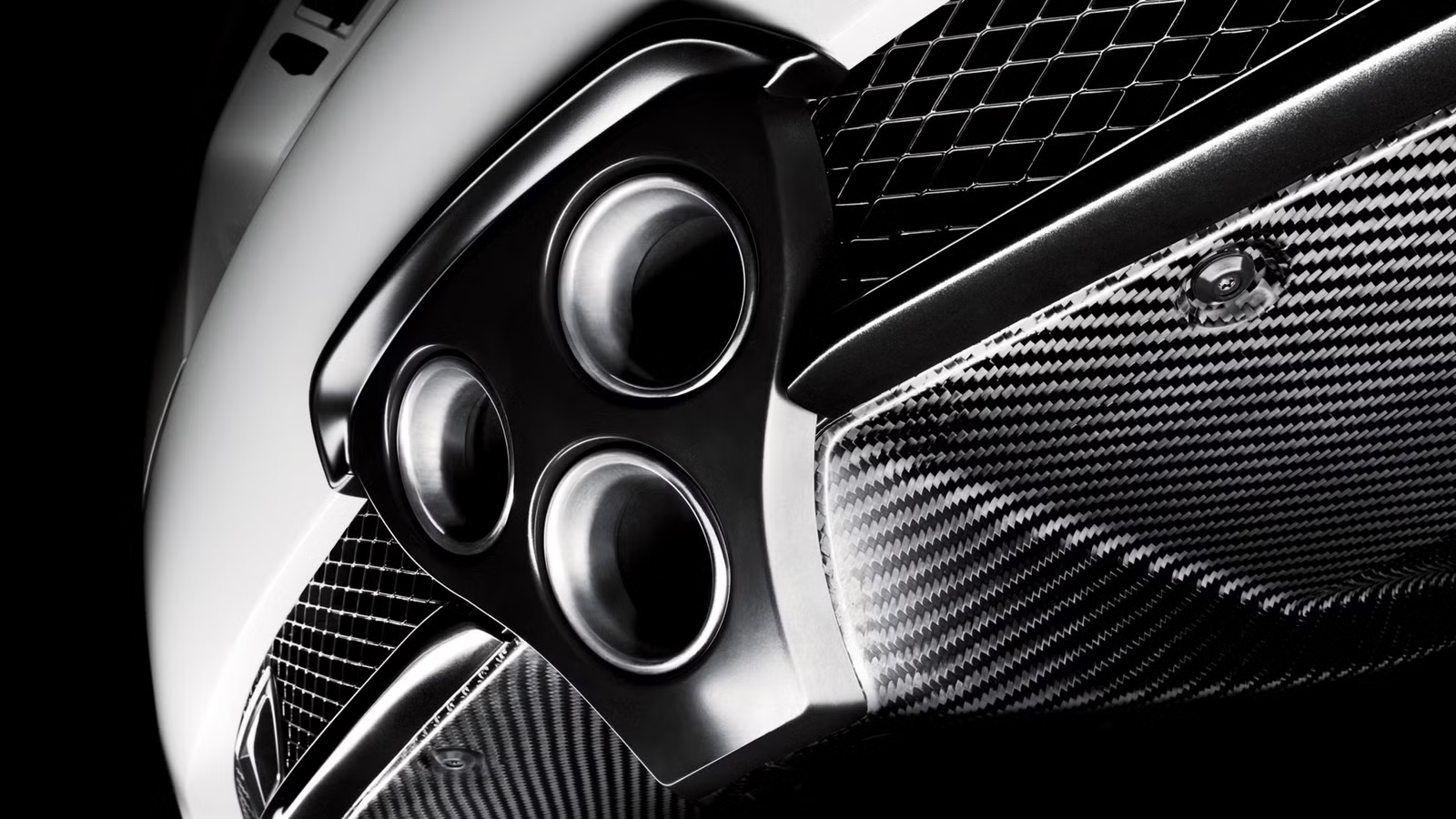
Generally, if you want a top-tier supercar, you turn to the usual suspects like Ferrari, Lamborghini, or Bugatti. You wouldn’t expect a more mainstream manufacturer to come up with something as spectacular as these specialists, but that was exactly what Lexus did when it introduced its bold LFA in 2011.
Lexus wanted people to believe in an exotic car powered by a bespoke V10 and built in tiny numbers. The company priced the LFA at $375,000 before delivery charges and made headlines with the bold project, even if the vehicle’s positioning was a little awkward.
However, today, the LFA has almost mythical status, as one of the last truly remarkable, naturally aspirated V10 road cars ever. A 2012 version with 748 miles on the clock recently sold for more than $1.8 million, pushing the car’s legacy to the next level.
The Lexus That Took Years To Be Fully Understood
2012 Lexus LFA front 3/4 angle in white while driving on a wet trackLexus
2012 Lexus LFA Specifications
Engine
4.8-liter naturally aspirated 1LR-GUE V10
Transmission
Six-speed automated sequential
Drivetrain
Rear-wheel drive
Power
552 hp
Torque
354 lb-ft
Lexus presented the LFA as the top of its F performance line and began production at the tail end of 2010. The vehicle was a proper supercar, featuring a carbon-fiber-intensive structure, a front-mounted V10 and a rear-mounted six-speed automated sequential gearbox. It also had carbon-ceramic brakes and rear-wheel drive, and could potentially reach 202 mph. The company only produced 500 of them.
For all the fanfare the LFA produced at launch, the motoring world didn’t really know what to do with it. The model was expensive enough to justify calling it a supercar, but the machine seemed to focus more on the Japanese company’s engineering discipline than on outright theater. The exterior was clean and technical rather than wild, like an exotic. The cabin focused on the precision and finish you’d expect from the brand itself.
There was no doubt that Lexus put a great deal of thought and effort into the vehicle and had certainly built a strong halo car. It was far more than just a badge exercise or a short-lived marketing stunt. A decade and a half later, people are starting to look at the LFA very differently, as collectors are finally rewarding the Japanese company’s efforts.
Lexus Engineered The V10 Like A Mechanical Instrument
Silver 2011 Lexus LFA V10 engineBring a Trailer
At the heart of the LFA is the 4.8-liter 1LR-GUE V10, which Lexus developed with Yamaha. The official US ratings are 552 horsepower at 8,700 rpm and 354 pound-feet of torque at 6,800 rpm. Lexus said the LFA could get to 60 mph in 3.6 seconds.
The V10 was roughly the same size as a conventional V8 but about the same weight as a standard V6. To maximize output, the engine featured a 72-degree bank angle, individually electronically controlled throttle bodies, dual VVT-i, and equal-length exhaust manifolds. Other features included high-volume 12-hole fuel injectors, a 12.0:1 compression ratio, and low-friction internals. Engineers also claimed that 90% of peak torque was available to drivers from 3,700 rpm up to the 9,000-rpm redline. Perhaps the most impressive part of the LFA was auditory, and its sound has helped to make the car immortal.
Lexus called the induction and exhaust sound engineering “Octave Harmony,” and its engineers worked hard to deliver a soundtrack both inside and outside the cabin. The result was not simply an exotic car that sounded good but something that was more like a musical instrument that happened to have ten cylinders.
The Driving Experience Generally Stands The Test Of Time
Lexus created a bespoke V10 engine for its LFA halo car. It remains one of the best-sounding engines ever made.Lexus
Today the LFA’s raw performance figures are not particularly spectacular, and modern turbo or hybrid supercars can certainly accelerate harder, shift faster, and deliver more accessible speed with less effort. But that hasn’t dampened the appeal of the Lexus, and the on-board experience of traveling down that favorite back road has remained especially vivid.
Reviewers report an engine that dominates, providing the necessary power from early doors all the way to the upper reaches of the tachometer. Each full-throttle run feels like a chase for the next shift, and the soundtrack certainly amplifies the feel. The sound starts sharp, then hardens further and climbs to full resonance, allowing the driver to experience the LFA through all their senses. The experience becomes even more intense as the engine approaches the redline.
Related
Toyota’s Entry Exam For GR GT Ownership Is For Real Drivers Only
The automaker wants to prevent poseurs, flippers, and reckless drivers from buying its flagship supercar.
Meanwhile, the instrument cluster on board the LFA has become part of the car’s legend and has its own place in the story. That legend says a conventional analog needle couldn’t handle the V10’s rate of climb, so the system required bespoke digital instrumentation.
If there’s one particular area that struggles to play its part, it’s the gearbox because the unit is the most obviously dated part of the car. After all, a six-speed ASG can feel quite abrupt compared to modern dual-clutch transmissions, and especially at low speeds. Even then, the component is still part of the car’s general appeal, and that final bridge between the raw feeling of combustion supercars and the more refined versions today.
The Auction Spread Needs Some Honest Context
2012 Lexus LFA that sold for $1.8mBring a Trailer
In April 2026, that exceptional 748-mile LFA changed hands for $1,810,000 on Bring a Trailer, making it the highest recorded public sale for a base model LFA. However, it’s important to look at that result in context, and online resources suggest that an adjusted average benchmark for a 2012 base model should be just under $800,000 at current estimates. Of course, the actual values depend entirely on factors like condition, mileage, and provenance.
Related
The Lexus LFA Is Back, But It’s Not What We Were Expecting
The LFA Concept ditches its predecessor’s V10 in favor of an all-electric drivetrain and Toyota GR GT architecture.
For now, it’s still possible to find a used LFA with a six-figure price. One 2012 LFA sold for just $676,000 in late 2025, even though it had relatively low mileage. The caveat was that this one didn’t come with a clear vehicle history. Further analysis revealed flood damage and evidence of rebuilding, making its sales price more of an outlier than a clean market indicator.
Market records show that several clean examples of the 2012 LFA selling for around $800,000 between 2024 and 2025, with a 6,000-mile example going for $830,000 in October 2025. This should label that April 2026 $1.8 million result as extraordinary, even though median prices may be inexorably creeping up towards the million mark.
A Million-Dollar LFA Is Really About What Can’t Be Repeated
Lexus LFA Concept EVLexus
There’s no doubt that the LFA is rare, with only 500 units part of its original production run. But rarity alone doesn’t necessarily guarantee collectible value. Plenty of limited-production cars never reach million-dollar values. The LFA crosses the line into collectability, though, because it also represents a set of conditions the market is unlikely to see again. After all, the model is the result of a major manufacturer spending a lot of time and effort to create a bespoke carbon-body supercar, fitting a naturally aspirated V10, and then tuning the sound as a central part of the experience.
The history and positioning of the original LFA also make the new LFA concept even more interesting. Toyota and Lexus revealed the potential newcomer alongside the GR GT and GR GT3 in early December 2025, as part of the parent company’s push to preserve driving excitement. But if the LFA concept makes it into production, the model would be very different from the original.
Lexus LFA Concept EV Exterior Front QuarterLexus
Toyota’s new performance story now involves hybrid systems, race-bred platforms, and electric possibilities, with intriguing potential ways to think about sound. So, what comes next may be faster, more on point, and more clearly relevant to the next era of performance cars.
The situation might strengthen the appeal of the original LFA while recognizing Lexus’ bold aspirations. After all, the company didn’t hold back in creating its first supercar, and the result was a different take on the supercar from the norm of that era. The market struggled to understand it.
At least one example shows that the Lexus LFA is now reaching seven-figure status as the supercar completes its delayed recognition process. And while most examples may still sit below that number, there’s no doubt that the LFA is now a collector’s landmark. Enthusiasts value its V10 scream, Yamaha-tuned acoustic character, and carbon-intensive construction, and they also recognize that the LFA is indeed a product of a vanished moment.
Sources: Lexus, Toyota, Bring a Trailer, Classic.com.
