

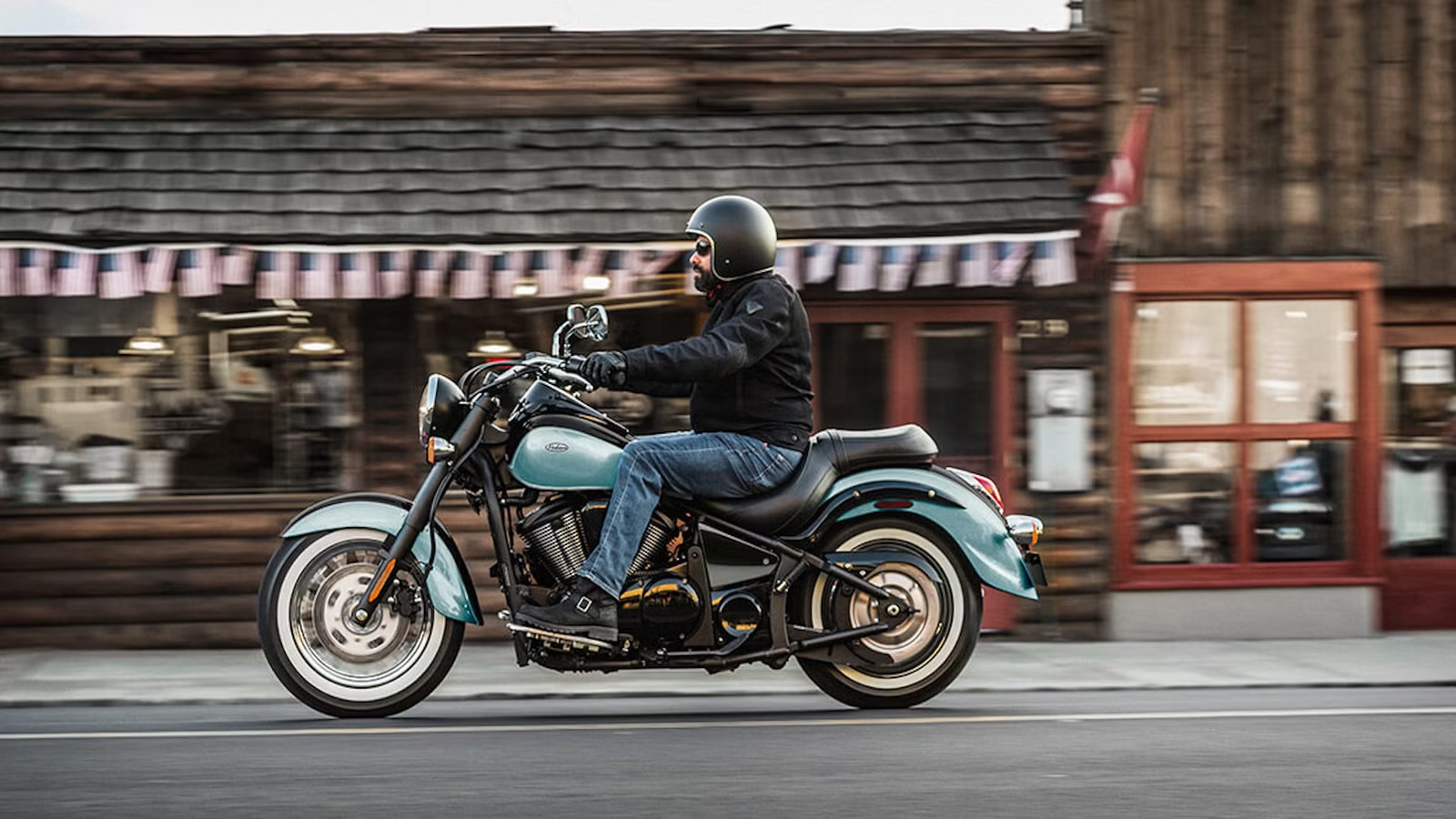
Kawasaki usually makes headlines with products that have quite insane power figures and performance. It has always been the wild child of the four well-known Japanese manufacturers. However, when Kawasaki puts its mind to making a product that beats the competition on refinement and comfort, it has the engineering capability to pull it off successfully. Although not a usual occurrence, Team Green does come out with a motorcycle that appeals to those who prefer a quiet ride rather than an exciting one every now and then. We’re talking about one such bike today and it exists in the old-school cruiser department.
Things Gets Even More Surprising When You Look At The Cruiser Segment It Exists In
Harley-Davidson Softail cruiser lineup 2026 posing in front of shipping containersHarley-Davidson
The traditional cruiser segment demands, if not an actual V-twin engine, at least an engine that has the characteristics of one, and that character usually involves vibrations both at idle and at cruising speeds. There is a fine line between an engine that feels boring because it is too smooth and an engine that tires you out because it has too many vibrations. On that fine line lie engines that have gone down in history as being both smooth enough to be usable and yet characterful enough to endear themselves to the enthusiast.
A rider accelerating the Yamaha Bolt R-Spec along a beautiful road, front third quarter viewYamaha Motorsports
While American bikemakers usually chase riding appeal and vibes (pun intended), the Japanese have always craved refinement. Sure, each of the Big Four has tried its hand at traditional V-twins with several things in common with American examples. But they all slowly realized that they needed to do their own things in certain areas. That brings us to this Kawasaki cruiser. It is built to a budget, offers variety within the scope of its segment, and it definitely feels more refined than you’d expect for the price.
The Vulcan 900 Is The Kawasaki That Feels More Refined Than Expected
Kawasaki Vulcan 900 Classic casually being ridden on a winding mountain road, front third-quarter viewKawasaki
The Vulcan 900 is one of the old guard, along with the Suzuki Boulevard C50 and the Honda Shadow Phantom. All three of these motorcycles were developed to compete with Harley on its own ground, which is why you’ll find they all have a lot of the characteristics of a Harley-Davidson cruiser: a downtube cradle frame, a V-twin engine, and great gobs of torque. In fact, it is comparable to a Harley but costs less.
Now two decades old, it is still relevant today and has quite a few features that have stood the test of time. The engine, in particular, is fuel-injected, liquid-cooled, has counterbalancers, and is rubber-mounted, so it never gets harsh, no matter what you’re doing. Even the chassis has a rear disc brake and a hidden Uni-Trak monoshock at the rear. Because of all these modern design components, the Vulcan 900 is the Kawasaki bike that feels more refined than expected.
The Cheapest V-Twin Belt-Drive Cruiser From A Legacy Manufacturer
Rider and passenger on a Kawasaki Vulcan 900 Classic LT cruising through the countrysideKawasaki
The Vulcan 900 retails at $9,599 for the base Classic variant. Then, there’s the $9,999 Vulcan 900 Custom, a drag-bike-style cruiser that has the most aggressive looks of any of the Japanese V-twin cruisers today. The Vulcan 900 Classic LT, as the name suggests, has more comfort for touring with the addition of soft luggage, a bolt-on windshield, and a pillion backrest. Kawasaki asks for $10,599 for this.
Looking at just the base model, though, this is the most affordable cruiser equipped with a V-twin engine and a belt drive from a legacy manufacturer. In the last few years, Chinese manufacturers like Benda and Keeway have also launched products with these two features, but they sit in a much lower displacement class.
Related
10 Bulletproof Bikes Known For Legendary Reliability
These bikes aren’t legends because of how quick they are or how great they look; they’re here because they never break down.
The Engine Is As Modern As Any Other V-Twin Today
Shot of Kawasaki Vulcan 900 Classic LT engineKawasaki
The Vulcan 900’s V-twin engine is 20 years old now, but from the specs, you wouldn’t realize it at all. This is a 55-degree V-twin, but it has features like fuel injection, liquid cooling, overhead camshafts, and even a short-stroke design. It has a low-ish compression ratio of 9.5:1, helping put out 51 horsepower at 5,500 RPM and 58.3 pound-feet of torque at 3,500 RPM. That goes through a five-speed wide-ratio gearbox and a belt final drive to the wheel.
While the power figure isn’t much by today’s standards, it does focus a lot on delivering torque at low revs. It succeeds in this quite admirably. Kawasaki also has a second set of computer-controlled throttle valves set in line with the main cable-actuated ones. These secondary ECU-activated valves perform the function of smoothing out throttle response, especially for on-off transitions. The result is Honda reliability, Harley-level comfort, a very refined experience for the layout, and a surprising willingness to go to the upper reaches of the rev range.
Traditional Chassis Matches The Engine’s Energy
Front shot of a Kawasaki Vulcan 900 Classic corneringKawasaki
The Vulcan 900 chassis is a conventional semi-double cradle frame, but it has Japanese engineering and long-haul comfort. The front suspension has forks provided by Showa, and the rear has a preload-adjustable monoshock hidden under the seat, which makes the Vulcan look like a hardtail. There is 5.9 inches of travel available at the front and 4.1 inches at the rear.
Shot of Kawasaki Vulcan 900 Classic LT rear brakeKawasaki
The brakes are also quite modern. There is a 300 mm disc at the front and a 270 mm disc at the rear. Both ends have a two-piston floating caliper mounted. Kawasaki has not added ABS in the two decades that the Vulcan 900 has been on sale, which is a definite miss. Get the Classic, and you get a 16- and 15-inch spoke wheel combination, whereas the Vulcan 900 Custom has a set of alloy wheels with a 21-inch front wheel.
Related
10 Cruisers That Will Run Forever With Basic Care
These bikes will give the Energizer Bunny a run for its money – and all they need is basic preventive maintenance done on time.
The Size Is Harley-Like
A Kawasaki Vulcan 900 Custom on the side of the roadKawasaki
The Vulcan 900 is so large, in fact, that it could almost qualify as a full-size American cruiser. It is 97 inches long, 39.6 inches wide, and has a seat height of 26.8 inches. The Vulcan 900 Custom has a slightly different set of dimensions thanks to its aggressive looks. It is shorter and narrower at 94.7 inches and 35.2 inches, but it has a slightly higher seat height of 27 inches. Finally, the standard Vulcan 900 has a 5.3-inch ground clearance, while the Custom has a figure of 5.5 inches. They have identical fuel tank sizes. The final surprise is that the Custom is lighter than the standard variant, with a figure of 610.8 pounds versus 619.6 pounds.
The 20-Year-Old Features List Hasn’t Been Updated
Shot of Kawasaki Vulcan 900 Classic LT instrument clusterKawasaki
The Vulcan’s 20-year-old design comes through in its feature list. It has a tank-mounted instrument cluster with an analog speedometer and fuel gauge. There is a small LCD on it that gives you information like the time, odometer, and trip meters. It also has LED warning lamps housed in it. Elsewhere, the electronics consist of the injection, ignition, and the secondary throttle valves. Kawasaki would do well to add ABS to it, as Honda did with the Shadow – this already has the rear disc brake. However, it will add to the sticker price, which might make it get too close to the American competition.
Related
10 Best Cruiser Motorcycles For Relaxed Weekend Rides
The most powerful cruiser bike here is a torque monster, packing the biggest displacement engine and the widest rear tire among production bikes.
More Modern Competition Is Available At A Slight Premium
A rider accelerating the Yamaha Bolt R-Spec along a beautiful road, front third quarter viewYamaha Motorsports
There’s a surprisingly wide range of competitors to choose from when it comes to the Vulcan 900, and it makes for a very interesting proposition. There are the old guards: the Yamaha Bolt R-Spec and the Suzuki Boulevard C50. The Bolt is modeled after the old Harley-Davidson Sportster (which makes it feel like a Harley without the hassle) and has an air-cooled engine. Whereas, the Boulevard is extremely comfortable and has shaft drive. Both these models retail at roughly the same price as the Vulcan 900, with the Yamaha being the cheapest of the lot at under $9,000.
Honda
Among the modern competition, there is the Honda Rebel 1100, which uses the Africa Twin’s parallel-twin driveline to great effect. It is, in many ways, a better cruiser than most of the world manages. However, it might not be to the cruiser enthusiast’s preference to have a cruiser with a chain final drive, but the Rebel 1100 does offer an automatic gearbox—something as rare as a unicorn in the cruiser segment. It is also the only product here with cruise control and a TFT display that has Bluetooth and navigation capabilities, too.
Front 3/4 quarter shot of Harley Davidson Nightster parked on a streetHarley-Davidson
Finally, there are the entry-level American V-twin cruisers. Both the Harley-Davidson Nightster and the Indian Scout Sixty Bobber cost a dollar less than $10,000, but they approach the segment quite differently. The Nightster has a modern chassis that uses the engine as a stressed member, and it offers ride modes, traction control, ABS, and a six-speed gearbox. The Scout Sixty Bobber, on the other hand, uses Indian’s smallest liquid-cooled engine, but it is mated with a five-speed gearbox and uses a traditional cradle frame. It also doesn’t offer any ride modes or traction control, but has ABS.
Source: Kawasaki USA
