

UPDATE: 2026/05/26
This article has been updated to include more information about the K Series engine’s life beyond the streets.
Related
The Fastest Honda Sports Cars Ever Made
What names come to mind when you think of the fastest Honda sports cars ever made? Here are ten that stand out and top the list.
K Series History And How It Came To Be
A studio shot of the Honda Stream’s K-Series engineHonda
Honda created the first-generation K series engine in 2001 as an official replacement for the aging but highly successful B and H series families in a bid to meet tighter emissions rules while increasing thermal efficiency and real-world flexibility. Honda engineers focused on a clean sheet aluminum block with a deep skirt layout that increased rigidity and supported higher operating speeds without unwanted vibration. They also applied a forged crankshaft and lightweight pistons to cut reciprocating mass and improve throttle response.
Replacing the old belt-driven system is a modern chain-driven dual overhead camshaft setup that allows for a more accurate timing control under high load conditions. The advanced i-VTEC system is the cornerstone of the K-Series, blending variable valve timing, variable lift control, and variable cam phasing. This system gives the engine a wide torque spread at low and mid-RPM and allows strong breathing at higher RPM without the sharp changeover, compared to how the older VTEC systems operate.
A studio front-quarter shot of a Honda StreamHonda
Honda also rotated the engine orientation compared to the B series family, allowing the configuration to pack the intake and exhaust layout more efficiently. This results in improved airflow and easier service access. The engineers designed a tall intake plenum with long runners that improved cylinder filling during everyday driving, and paired it with a free-flowing exhaust manifold that supported consistent scavenging.
The K series also introduced coil-on-plug ignition and a modern electronic throttle, helping the engine management system fine-tune spark and airflow for better drivability and fuel control. Honda debuted the first K-Series K20A in the JDM-exclusive 2001 Honda Stream. This was an ideal compact platform to showcase the new engine architecture before rolling it out to performance models like the Integra Type R and mainstream options like the Civic and Accord. Edmunds consumer reviews of these models consistently award K-Series-powered models with high ratings for maintenance and reliability.
Related
10 Turbocharged Four-Cylinder Cars That Punch Above Their Weight
Turbocharged four-cylinder engines have proven that big performance doesn’t always require big displacement.
The Engineering Decision That Saved Honda’s Future
2025 Honda Civic Type R and Acura Integra Type S front driving shotGuillaume Fournier | TopSpeed
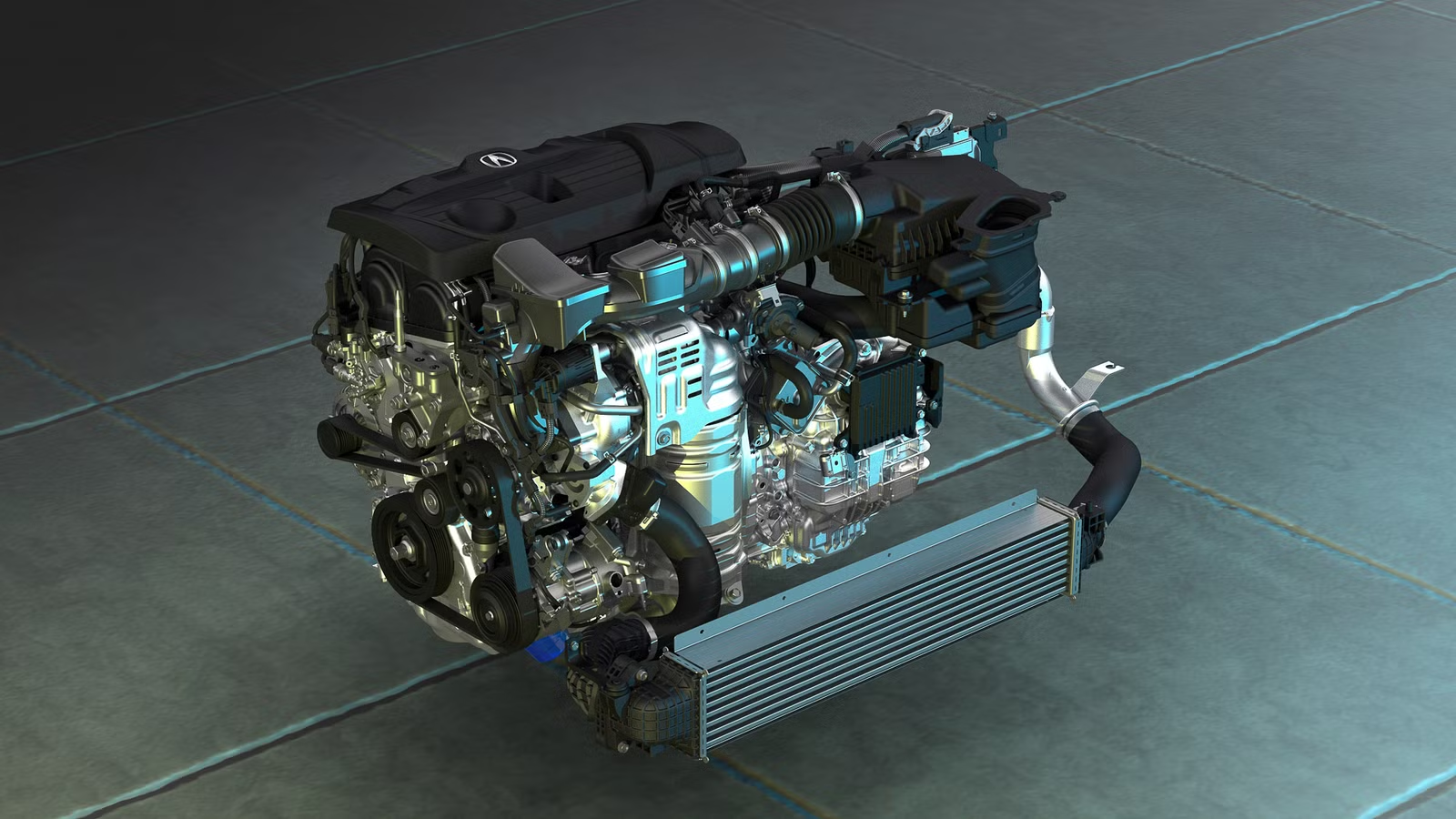
Key design elements include a reinforced aluminum block with a closed-deck layout, which improves cylinder stability under high combustion pressure and helps control distortion during long, high-load cycles. The engine also uses a low-friction rotating assembly with coated pistons and balanced rods to reduce heat buildup and wear. Its direct injection system features precise multi-hole injectors that improve fuel atomization, resulting in cleaner combustion, better efficiency, and less soot buildup inside the chambers.
Engineers also optimized the cylinder head ports through extensive fluid modeling to create fast, consistent airflow even at lower boost pressures. The turbocharger setup uses a compact, low-inertia unit that spools quickly without creating excessive thermal strain. To maintain stable temperatures during demanding driving, the cooling system routes coolant through critical areas of the engine. Honda also uses a high-flow intercooler to lower intake temperatures, improve knock resistance, and protect the engine during long climbs or extended highway driving.
Engine bay of a 2020 Honda Civic Type RIsaac Atienza
The K20C design further includes integrated exhaust passages within the cylinder head, reducing the distance between the valves and the turbine to improve turbo response and emissions control while minimizing heat loss. Honda tuned the valve timing system to focus on strong mid-range torque and smooth real-world drivability rather than chasing peak output numbers. This approach also reduces stress on internal components.
Honda validated the engine through extensive endurance testing, including prolonged full-load operation and extreme temperature changes. As a result, Honda and Acura models powered by the K20C are known for predictable performance, low maintenance demands, and consistent efficiency. The engine is able to handle high-pressure turbo operation without unusual wear while maintaining stable performance over long ownership cycles.
Related
10 Ridiculously Powerful Four-Cylinder Cars That Are Surprisingly Affordable
Can you get great power from a four-cylinder engine? Can that car be affordable? Here are ten cars that answer both questions with a resounding “yes.”
The Current Breed Of K Series Engines In 2026
Engine bay of a 2024 Acura TLXAcura
Honda’s K Series engine first hit the market in 2001, quickly finding its way into pretty much every iconic Honda car of the time, including Odysseys, CR-Vs, Civics, Accords, and more. Over the next quarter of a century, the K-Series became an integral part of Honda’s lineup, earning a reputation as an engine that was hard to kill. While the inline-four powerplant may not be as common these days as it was in the past, you can still find multiple Honda engines running the iconic four-banger engine.
Low angle action shot of 2025 Acura RDX driving over bridgeAcura
Case in point, the K20C engine. It is Honda’s current-generation of the K-Series range, upgraded to deliver strong real-world efficiency and long-term reliability across the Honda and Acura catalogs. It’s also a redesign that meets stricter global emissions rules and tighter thermal demands that come with modern turbocharging. Today, the K20C engine powers the current-generation Honda Civic Type R, Acura RDX, Acura TLX, and Acura Integra Type S.
The K20C Does Incredible Work In High-Performance Hondas
As mentioned, the K20C sits under the hood of both the Civic Type R and Acura Type S, delivering 315 horsepower and 310 pound-feet of torque to the Type R’s K20C1 and 320 horsepower and 310 pound-feet of torque to the Type S’s K20C8. This is enough to give the 2026 Honda Civic Type R and 2026 Acura Integra Type S the number-one and number-two spots, respectively, in terms of torque-to-weight ratio among front-wheel-drive sports cars. From the factory, the Civic Type R’s torque-to-weight ratio is 0.097 pound-feet per pound, while the Integra Type S sits at 0.096 pound-feet per pound. For reference, the Hyundai Elantra N (0.088), the Mini Cooper JCW (0.087), and Volkswagen Golf GTI (0.087) deliver lower torque-to-weight ratios than the K20C-powered Honda and Acura.
Related
The Hybrid Car With The Best Fuel Economy In 2026
This full hybrid is the fuel-economy champion among cars that require no special charging routine from the driver to attain maximum efficiency.
The K Series Is The Reason Behind Many Million-Mile Hondas Today
Front 3/4 view of a 2020 Honda Civic Type RIsaac Atienza
The secret isn’t just build quality—it’s a design that Honda developed in 2001 and has refined across 25 years. The K Series has had a major role in earning the manufacturer its reputation. It’s the powerplant that has taken many Honda and Acura models to the million-mile club, with many owners claiming nothing but routine maintenance along the way. Perhaps the best example of this is the 2007 Honda CR-V driven by a family in Louisville, Kentucky. Powered by a K24 engine, this CR-V has clocked over a million miles on its odometer.
A YouTube user, ‘Reviewed by Tim’, also uploaded a short video of an eight-gen K20-powered Honda Civic Si, with over 986,000 miles on it, starting right up after sitting for three years. It still had the original powertrain. Even a quick scroll on the Facebook group Mileage Impossible will show you many more Hondas with the K Series engine with six-digit mileage on their odometers. That’s how reliable this powerplant is, and the reason why one owner even decided to K-swap a Porsche 911, so they could throw it around the track without having to wait for replacement parts to ship from Germany.
Custom Builders Respect It Due To Its Versatile Packaging And Tuning Potential
K24-swapped 2007 Porsche 911 engineBring a Trailer
As mentioned, owners of more expensive, delicate sports cars like the Porsche 911 turn to the K-Series engines when they need a tunable powerplant that can handle abuse. That said, the 911 isn’t the only non-Honda home the K-Series has found, as it’s been the heart of some fascinating builds. From a 645-horsepower Nissan R34 Skyline dubbed “Frankenstein,” to a Lotus Elise, builders worldwide have recognized the K-Series as a go-to option when they want near-endless tuning potential with the guarantee of low-cost reliability and upgradability.
There’s even a Toyota Prius that had its hybrid engine replaced with a turbocharged Honda K24. And if that wasn’t enough, a man named Mark Burroughs of the YouTube Channel and custom shop StanceWorks swapped a Ferrari 308 GTBi’s 2.9-liter Tipo V8 for a turbocharged K24. Dubbed the Ferrari 244 GTK, the 2.4-liter K24 at its heart was custom-built by 4Piston Racing and is capable of around 1,200 horsepower, with Mike hoping to get 1,000 horsepower to the wheels by the end of the build. These are just a few examples of the versatility, aftermarket, and community support that helped the K-Series cement its place in history.
The K Series Has Proven Itself On The Track As Well
Honda S2000 with K24 engine swapGrassroots Motorsports via YouTube
Honda’s reliability claims for the K-Series aren’t just the product of controlled factory testing. The engine earned its reputation the hard way, through sustained competition in some of the most demanding amateur and professional motorsport categories in the world. In time attack, the K20 and K24 became so dominant that Gridlife — one of North America’s most prominent time attack series — now imposes specific weight penalties on K-Series builds regardless of tuning level, a distinction the series reserves for only a handful of engines including BMW’s S54 and Porsche’s flat-six. That kind of regulatory acknowledgment is a form of competitive respect that marketing copy can’t manufacture.
Endurance racing told a similar story at longer distances. K-Series engines have become a common choice for amateur and club-level endurance competitors precisely because they tolerate the kind of sustained high-RPM punishment that exposes weak architecture far more honestly than street driving ever could. Builders repeatedly find that K-Series engines can complete full race weekends, including multi-hour and overnight events, with nothing beyond routine maintenance between stints. That reputation wasn’t handed to the engine by a marketing department. It was built lap by lap, by racers who kept coming back to the same platform because it simply didn’t let them down.
Related
The Sports Car That Proves 228 Horsepower Is All You Actually Need
One Japanese sports car is defying the horsepower war in favor of balance, throttle response, and lightweight construction.
Why The K-Series Is Here To Stay
2025 Acura Integra Type S Versus 2025 Honda Civic Type R Guillaume Fournier | TopSpeed
Honda continues to use the K series engine family because the architecture supports modern efficiency targets, strong durability expectations, and flexible integration with hybrid systems, which gives the company a stable foundation for future models across global segments. Honda engineers designed the K layout with a rigid aluminum block, efficient cooling circuits, and low-friction internals, which gives them room to meet tougher emissions rules without redesigning the core structure.
The engine handles high compression ratios, turbocharging, and extended thermal loads with consistent reliability, which helps Honda control warranty exposure and maintain brand trust. The K platform also scales well because Honda can adjust bore and stroke dimensions of intake and exhaust routing, and combustion chamber design to match everything from compact cars to performance-oriented Acura models without creating incompatible parts.
2025 Acura RDX engineAcura
Honda doesn’t currently apply its K Series engine to its hybrid portfolio, but this is a factor that can easily change as the brand takes a more aggressive approach to hybridization. Although unconfirmed, it has already expressed a desire to electrify the likes of future Civic Type R and Integra Type S models. The engine supports efficient Atkinson cycle tuning for hybrid configurations, which boosts fuel economy without harming long-term durability. Honda also values the deep supply chain that supports K series production because it reduces cost and improves manufacturing consistency across multiple regions.
The engine responds well to continuous improvement, so Honda updates injectors, turbo hardware, valve timing control, and cooling strategies without major structural changes. This approach helps Honda limit development time while raising efficiency and performance for each new generation. Engineers also appreciate the serviceability of the layout because it simplifies maintenance for dealers. Ultimately, the L-Series will be the cornerstone of its future strategies, as it has proven to be a better fit for both hybridization and turbocharging, but the K range’s impressive performance abilities, resilience, and market appeal make it too good an engine for the brand to just ignore.
Sources: MotorTrend, RepairPal, Kelley Blue Book, CarBuzz, Honda, Edmunds, Gridlife, and Engine Builder Magazine
