

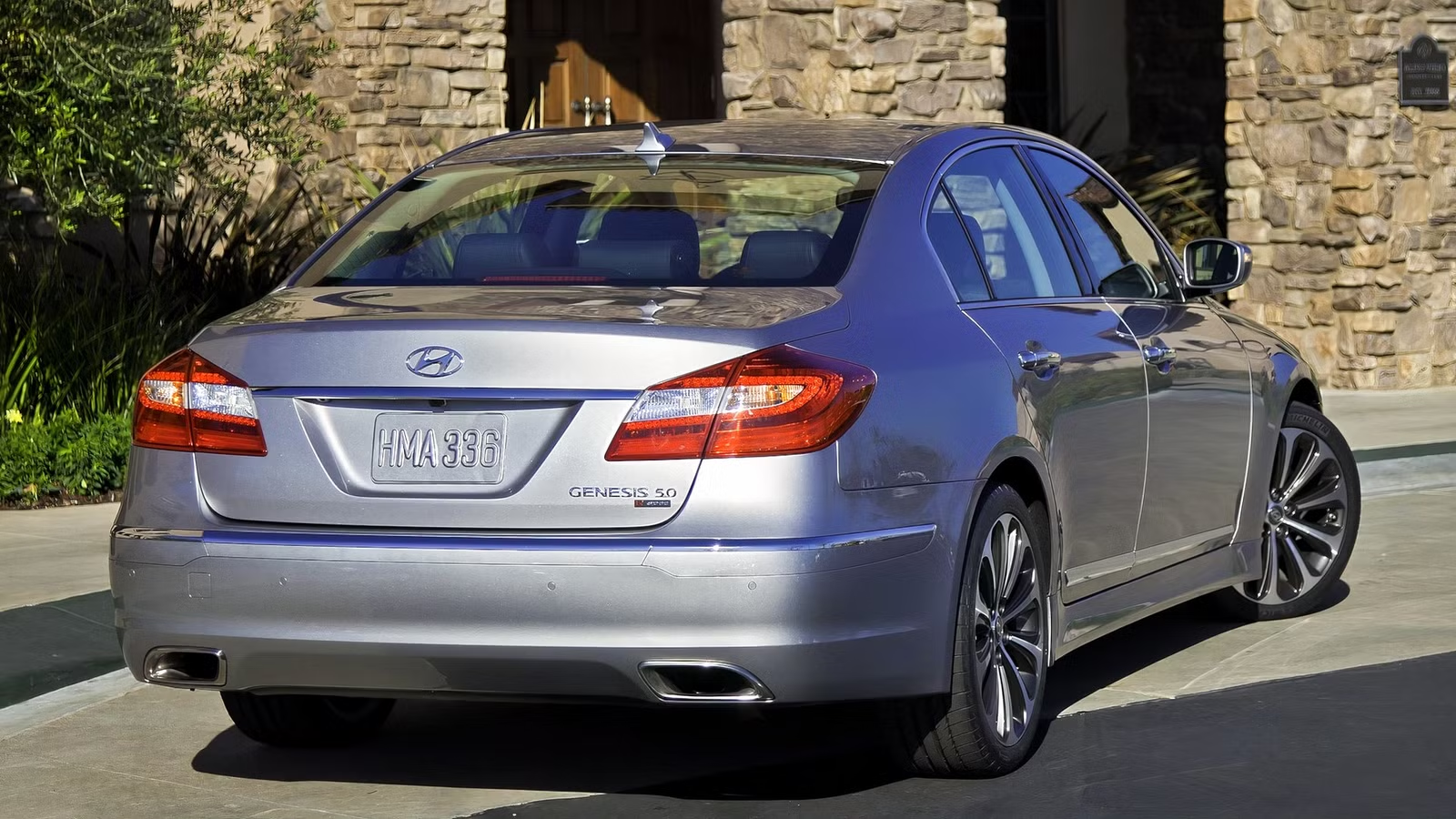
Sleeper cars reward those who know where to look, and few prove it better than the original Hyundai Genesis sedan. Long before Genesis became a standalone brand in 2015—following the path forged decades earlier by Lexus and Infiniti—Hyundai quietly slipped a rear-wheel-drive luxury sedan into showrooms. It looked like a sensible executive cruiser, but it packed a muscle car soul.
Much like the 2003 Mercury Marauder, the 2009 Genesis hid serious heat behind a modest badge. Equipped with the optional 4.6-liter Tau V8 sending power to the rear wheels, it delivered shocking off-the-line acceleration. It was Hyundai’s calculated first shot at the luxury segment—and one of the most underrated performance bargains of its era.
A Muscle Car Disguised As A Luxury Sedan
2009 Hyundai Genesis – front 3/4 angleHyundai
The entry-level Genesis was no wimp. The base engine was a 290-horsepower V6 that had no trouble passing and merging in heavy traffic. If you can find one for a good price, we can happily recommend any version of the car. However, we’re here to discuss the Tau-powered V8 model.
2009 Hyundai Genesis V8 Performance Specs
Engine
4.6-Liter NA Tau 8-Cylinder
Power
375 hp
Torque
324 lb-ft
Transmission
6-Speed Automatic
Drivetrain
Rear-Wheel Drive
0-60
5.7 Seconds
Note that these numbers are based on the assumption that owners follow Hyundai’s recommendation and use premium fuel. The Genesis can run on regular-grade gas, but output drops to 368 hp rather than the 375 hp you get on the highest-grade fuel. Just like the people who drive it, the Genesis has a taste for the good stuff.
The V8 engine found in the 2009 Hyundai Genesis belongs to the Tau family, which was the eight-cylinder lineup the brand introduced in 2008 to succeed the Omega series. Here are some technical details about the initial 4.6-liter version of the engine:
- 3.62 x 3.43 inch bore and stroke
- Aluminum cylinder head
- High-pressure die-cast aluminum cylinder block
- Variable induction system
- Multi-port fuel injection
- Dual overhead cam valvetrain
- 10.4:1 compression ratio
The 4.6 Tau also found a home in the Equus and the Kia Borrego. Later iterations of the Hyundai Genesis came with a range of meaningful engine upgrades. For 2010, the 4.6-liter Tau was tuned to produce a whopping 385 hp on premium fuel. An optional 5.0-liter V8 arrived in 2011, delivering up to 429 hp.
Does It Drive Like A Muscle Car?
2009 Hyundai Genesis – gear shiftHyundai
We actually reviewed the 2009 Genesis when it was first launched and had a lot of nice things to say about it. We found the rear-wheel drive to feel much sportier than a typical front-wheel-drive Hyundai. We were impressed by the car’s sub-six-second 0-60 mph time. Most of all, we really liked how the engine delivered its power in a refined, smoothly accelerating driving experience.
The Genesis delivers as a luxury car, both inside and out. It features standard leather upholstery, an 11-speaker stereo, and premium-grade materials throughout the cabin, creating a vibe reminiscent of a cigar lounge on wheels.
That’s basically the same recipe as the Chrysler 300C. Take a big V8 and wrap a sedan filled with luxuries around it.
Muscle Cars Were Scarce In The 2000s, Unless You Knew Where To Look
2009 Hyundai Genesis – side profileHyundai
We recently took a look at the muscle car market in the US during the 2000s and discovered that the Ford Mustang essentially controlled the segment. It averaged 127,148 sales a year and moved 1,271,483 units across the entire decade. The main thing Ford did right during that period was simply sticking it out while the Chevy Camaro took a long hiatus following the 2002 model year. Additionally, the Dodge Charger was absent until its 2006 relaunch, and the Challenger didn’t return until 2008.
While muscle cars seemed scarce in the 2000s, it was actually a golden age for sleepers such as the 2003 Mercury Marauder. That sedan looked unassuming but packed a 4.6-liter V8 delivering 302 hp and could hit 60 mph in just under seven seconds.
There was also the first-gen Cadillac CTS-V, which launched for the 2004 model year. It had a 5.7-liter V8 delivering 400 hp and hit 60 mph in just 5.3 seconds, despite the car’s bulky size and retiree-friendly styling. Muscle cars were still around in the 2000s, but automakers didn’t market them that way. The Hyundai Genesis might seem like an outlier — a luxury sedan that drives like it wants to dominate at the drag strip. However, this arrangement was more or less the norm back in the day. You could sell the V6 models to middle-management types who wanted something cushy and elegant to drive to work, and you could sell the V8s to gearheads, thereby covering a much broader range of demographics.
What Will A Hyundai Genesis Cost You Today?
2009 Hyundai Genesis – front and back seatsHyundai
In the pre-owned market, a V8-powered 2012 Hyundai Genesis typically trades between $5,500 and $11,000, depending on the specific engine variant, mileage, and overall condition. For the 2012 model year, Hyundai offered two distinct V8 configurations: the standard 4.6-liter Tau V8 pushing 385 horsepower and the higher-performance 5.0-liter R-Spec V8 outputting 429 horsepower. Higher-mileage or fair-condition 4.6L models generally sell on the lower end between $5,500 and $7,500.
Meanwhile, the more desirable 5.0 R-Spec commands a notable enthusiast premium, with clean, average-mileage units (100,000–130,000 miles) priced from $7,500 to $10,000, while exceptional low-mileage examples can still touch $11,000 to $13,500+. Heavy initial brand depreciation keeps entry costs remarkably low, making well-maintained V8 Genesis sedans one of the best rear-wheel-drive performance values on the secondary market.
Sources: Hyundai
