

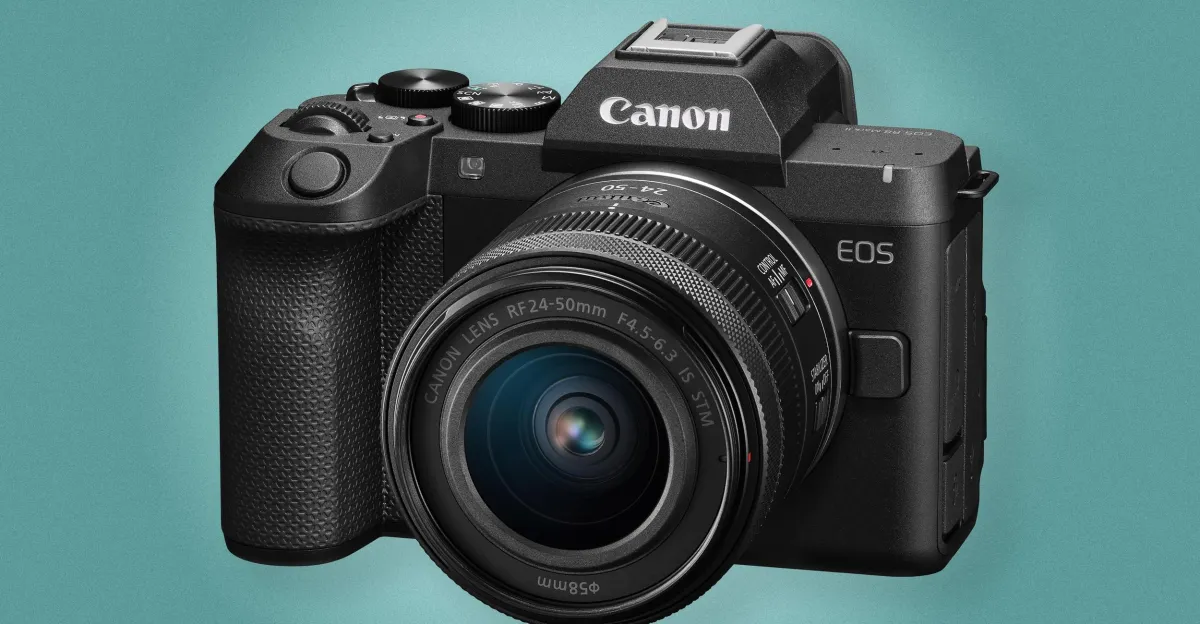
Canon announced the second-generation of its EOS R8 with a new retro-inspired redesign and the addition of in-body stabilization. That feature was one of the most notable omissions from the original R8 that launched in 2023 as a smaller, cheaper, and more accessible alternative to the Canon R6 Mark II for photographers wanting a larger full-frame shooter. While the new EOS R8 Mark II is slightly heavier than its predecessor at 1.2 pounds thanks to the additional stabilization functionality, it’s lighter and cheaper than last year’s EOS R6 Mark III.
The Canon EOS R8 Mark II is expected to be available sometime in late October for $1,899 for the body only, or $2,099 bundled with a Canon 24-50mm stabilized lens. That’s more expensive than the original R8 that launched at $1,499, but more accessible than the $2,799 EOS R6 Mark III thanks to some lower specs and omitted features.
Like its predecessor, the R8 Mark II features the same 24.2-megapixel full-frame CMOS sensor as the R6 Mark II, while the R6 Mark III got a bump to a 32.5-megapixel sensor. The new R8 Mark II still exclusively uses an electronic shutter instead of an additional mechanical one, with high-speed captures maxing out at 40fps again. To ensure you’re not too late to a critical moment, a pre-continuous shooting mode captures up to an additional 20 shots before you press the shutter button.
The new five-axis in-body stabilization offers up to 7.5 stops of shake correction that can be expanded by pairing the camera with a lens featuring its own stabilization. The R8 Mark II also features Canon’s Dual Pixel CMOS AF II system with what the company describes as “more tenacious tracking” than what the R8 offered. The autofocus system can also recognize animals, vehicles, and people, with the option to register up to 10 different people by their faces and rank their priority.
Video capabilities max out at 4K/60fps, but frame rates can be boosted to up to 180fps by dropping the resolution to 1080p. As Canon is targeting the R8 Mark II as a potential full-frame option for amateur photographers, the camera includes 16 different color filters, an easy to way to increase or decrease depth of blur that handles settings like f-stop and shutter speed automatically, and creative bracketing that takes three photos with different brightness and color tones.
Following other companies drawing inspiration from older film cameras for the design of new digital shooters, the R8 Mark II eschews the curves of the original R8 for a more boxy and angular body. Canon credits the nearly 40-year-old EOS 650 and its pentaprism housing on top as the inspiration for the R8 Mark II. Other hardware upgrades include a new multi-controller joystick above the camera’s screen, which makes it easier to select focal points, and its single SD card slot repositioned on the side of the camera so it’s still accessible when using a tripod. Canon will also sell a matching $99.99 accessory that extends the R8 Mark II’s grip, making it easier to hold when using larger lenses.
In October Canon is also releasing a free new Windows app called Dual Pixel 3D Converter that leverages additional info captured by Canon’s dual-pixel autofocus system to generate 3D imagery from the 2D photos the camera takes. You can use the app to create a 3D photo with a background you can move around, a 3D model with the background completely removed, or short 3D videos demonstrating an animated perspective adjustment of close-up subjects.
