

GM’s 3.6-liter V6 has quietly become one of the most consequential engines in recent American automotive history — and its story starts at a fascinating crossroads moment for the industry. Cast your mind back to 2004: Pontiac was still very much alive, the Honda Element was a quirky fixture in every college parking lot, the Subaru Baja was still hauling light loads, Mercury and Saturn were open for business, and Bluetooth connectivity in a car was a genuine luxury.
Chrysler had just launched its LX-platform rear-drive lineup to bring the HEMI V8 to the masses, and the last car ever to wear an Oldsmobile badge was rolling off the line as that storied brand wound down for good. That final car was a 2004 Oldsmobile Alero, fitted with a 3.4-liter V6 producing 170 horsepower and 200 lb-ft of torque, backed by a four-speed automatic. The V6 under its hood had served GM faithfully, powering vehicles across numerous brands as part of a family of compact, narrow-angle sixes that also spanned 2.8, 3.1, 3.5, and 3.9-liter displacements over the years. The popular 3.8-liter V6 was also on the scene at the time, though it hailed from an entirely separate engine family.
The answer to GM’s next-generation needs arrived in 2004, coinciding with the Alero’s exit and the retirement of those older V6 families. The resulting engine — initially called the “high feature” V6 — was engineered to deliver competitive power while embracing the latest fuel-saving technologies of the era. Below, we trace the evolution and key iterations of one of the most widely used V6 engines in recent memory, a powerplant that ultimately found its way into some of the fastest Cadillacs ever built.
The Cadillac CTS Brings GM’s Modern V6 Online For 2004, Reliability Problems Begin
2005 Cadillac CTS Euro Spec Silver Rear Angled ViewCadillac
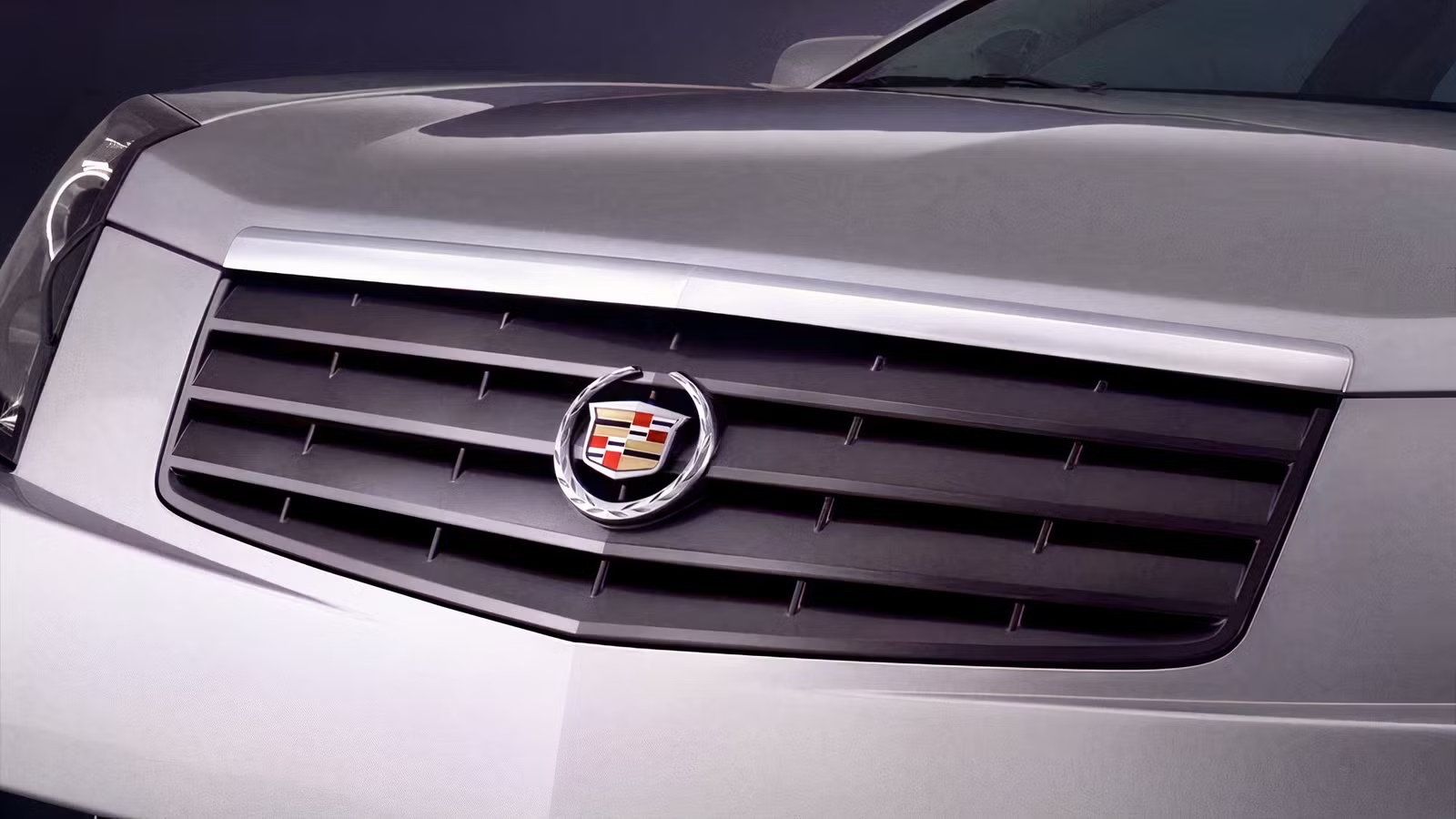
What better place to debut a sophisticated new engine than under the hood of a sophisticated new luxury sedan? The first vehicle to use GM’s latest 3.6-liter compact V6 was the 2004 Cadillac CTS. At launch, the engine carried the designation ‘LY7,’ and its headline features were lightweight construction and a quad-cam layout with variable valve timing and 24 valves — good for 255 horsepower and 252 lb-ft of torque, with improved fuel efficiency over the V6 engines it replaced. It was a meaningful step forward.
Before long, the new V6 spread across a wide range of incoming sedan and SUV products entering a fiercely competitive marketplace. The overhead-cam design and compact dimensions helped it achieve respectable power and mileage figures right out of the gate, and they laid the groundwork for future development. However, the lengthy timing chain and associated hardware required to drive the complex new valvetrain would become a costly reliability liability for several years. Owners documented issues with timing chains that prematurely wore and stretched — a problem attributed to the timing system’s design and made worse by substandard timing system components and extended oil change intervals.
2005 Cadillac CTS 3.6L V6Cadillac
By 2008, the original engine had been updated with Gasoline Direct Injection, a technology that was proliferating across the industry as automakers scrambled to meet tightening fuel economy and emissions targets. Now designated the LLT, this direct-injection variant represented the next major step forward. Fuel was now blasted directly into the combustion chambers at extreme pressure, cooling them from the inside with every injection event. Cooler combustion chambers support higher power output, and this version of the engine duly delivered up to 302 horsepower alongside improved fuel consumption.
2010 Cadillac SRX Overhead view Cadillac
Timing chain problems persisted nonetheless, and some owners began reporting excessive oil consumption and carbon buildup on intake valves — a known side effect of GDI technology in certain engine designs. The high-feature V6 found itself in an awkward position: praised by industry experts and impressive on paper, yet generating a steady stream of owner complaints on internet forums about ongoing timing chain and wear issues.
The Fix Finally Arrives For 2012 With the LFX
2010-2013 Chevrolet CamaroChevrolet
The V6 received its second significant update for the 2012 model year, and it was a substantial one. With the transition to direct injection now complete, engineering attention shifted to programming and materials refinements aimed at trimming fuel consumption further and extracting more power. Critically, a redesigned cam timing chain and tensioner system was introduced to address the well-documented — and expensive — timing system failures that had plagued earlier versions. Additional revisions for this ‘LFX’ iteration targeted reduced internal friction and stress, along with greater overall structural rigidity.
The highest-output version of this engine again went into the Camaro of the era, with the third-generation engine delivering 323 horsepower — a gain of 12 over the second-generation unit. Every other variant of the LFX now produced at least 300 horsepower, roughly matching the peak output of the best second-generation versions. An increased compression ratio, made possible by optimizing the direct injection system, was a key contributor to those gains.
A Clean New Design Arrives With the LGX for 2016
2017 Buick Lacrosse. Front, three-quartersBuick
By the time the 2016 model year arrived, GM had been refining this V6 family for 12 years, and the early timing chain headaches were firmly in the rearview mirror. The next evolution came in the form of the LGX, an engine that shares surprisingly little hardware with its predecessors. The primary targets were further gains in efficiency and refinement.
The aluminum engine block carried over but received structural improvements for added rigidity, while nearly everything inside was redesigned from scratch — pistons, connecting rods, crankshaft, and the valve timing system all got the full treatment. The oiling system was new. The cooling system was new. Exhaust manifolds were now integrated directly into the cylinder heads, saving weight. In its top-performing Camaro application, the LGX produced 335 horsepower.
The LF4 Version Powers The Fastest V6 Cadillacs With A Major Boost And Patented Charge Cooling
2016 Cadillac ATS-V Coupe White Front Angled View DrivingCadillac
A second new variant also debuted for 2016. Engineered to be the most powerful six-cylinder in its segment, the Cadillac ATS-V housed the most extreme interpretation of the 3.6-liter engine yet.
Sharing little with the LGX in terms of materials or hardware, this twin-turbocharged version — designated LF4 — employed a patented liquid charge cooler to manage boost temperatures, and made use of titanium components in both the engine internals and the turbochargers themselves for a combination of light weight and durability. To go toe-to-toe with the world’s quickest performance sedans, the ATS-V produced 464 horsepower and arrived with an extensive suite of track-focused supporting upgrades.
Is It Finally On The Way Out?
Across GM’s lineup, the trend has moved decisively toward turbocharged four-cylinder engines and electrified powertrains. With the Cadillac XT6 discontinued, only the Cadillac XT5 continues to rely on the LGX V6. It seems unlikely the engine will find its way under any additional hoods, and equally unlikely that either of those two models will carry it forward through future updates. The writing appears to be on the wall for GM’s 3.6-liter V6. It may have endured a rocky beginning, but once those timing chain troubles were resolved, this engine proved itself one of GM’s most versatile and valuable powerplants — one that millions of drivers still depend on every day.
Sources: GM, Cadillac, wbodytech.com.
