

Honda is the largest two-wheeler manufacturer in the world, and that distinction has been built on decades of small, dependable runabouts sold across developing markets. Those machines strip away everything non-essential while holding onto the legendary reliability that defines Team Red. Yet Honda has never been content to stay in one lane. At the opposite extreme, it produces the world’s most powerful naturally aspirated inline-four engine, and it once chased displacement records with such conviction that it culminated in the VTX1800 — before pulling back to focus on refinement over raw cubic centimeters.
One model, however, has always made a virtue of going big in every sense. It carries one of the great engines in motorcycling, packs technology that would impress many car buyers, and stands as Japan’s sole representative in its segment. That machine is the Gold Wing tourer — a bike so deeply embedded in American riding culture that it recently celebrated its 50th anniversary, and one that continues to define what a grand touring motorcycle can be.
Why A Big Engine Matters On A Touring Bike
Honda Gold Wing Chassis and SuspensionHonda
Before we get to the Gold Wing, let’s look at why a big engine is a benefit on a touring bike. Generally, manufacturers balance power output with engine displacement to optimize both while keeping weight as low as possible. This is particularly true for sports bikes, where manufacturers have moved away from the “no replacement for displacement” philosophy. However, on touring bikes, that same philosophy still applies.
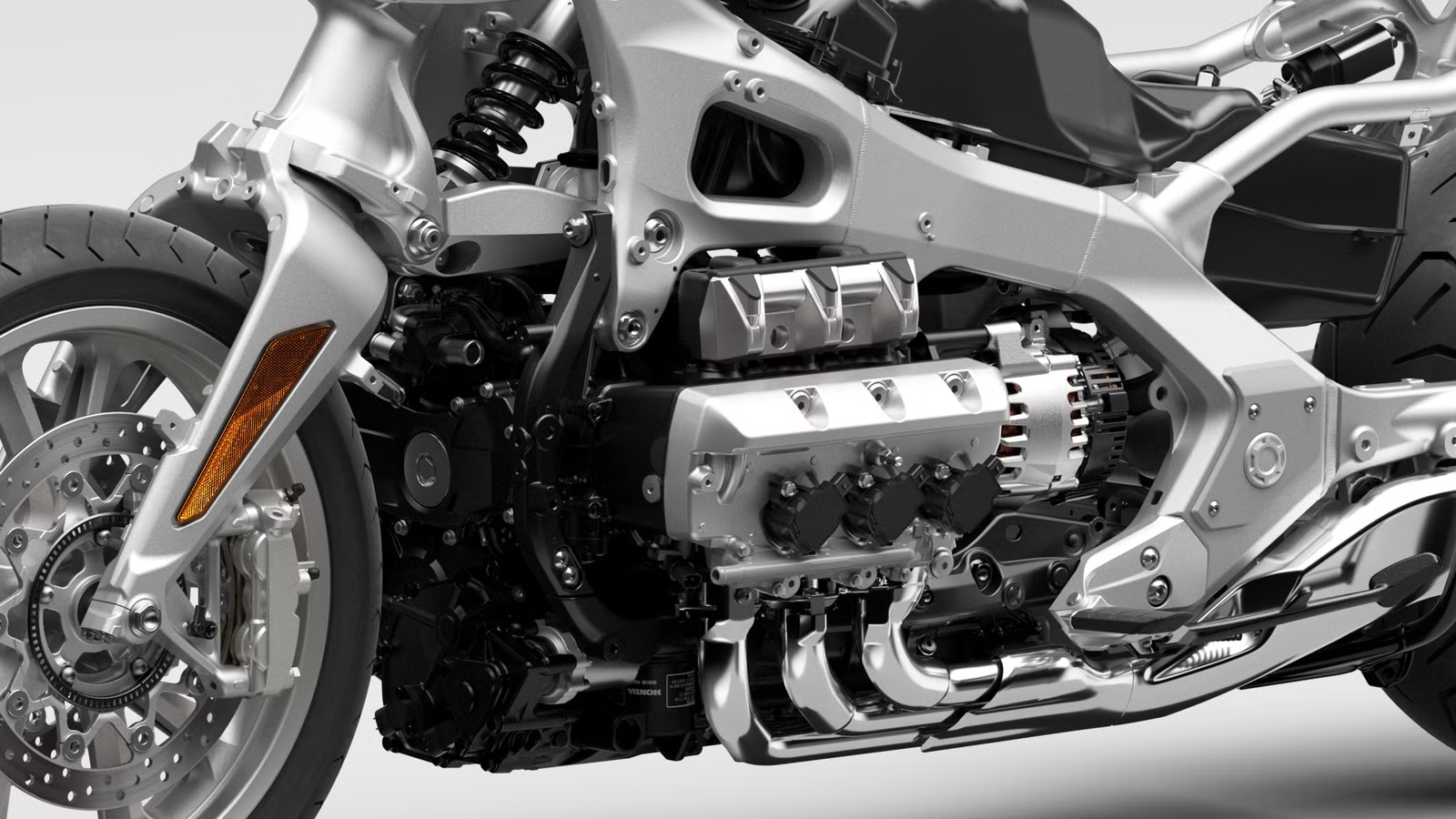
An image of the Honda Gold Wing’s EngineHonda Powersports
Touring bikes really show that, sometimes, there isn’t a replacement for displacement. That’s because a large engine offers several benefits at the cost of a slight weight penalty. For starters, larger engines use larger pistons, which translate into more torque across the rev range. As a result, the engine can cruise effortlessly on the highway with enough passing power still in reserve, even if the bike is fully loaded.
2020 Honda Gold Wing touring with rider and pillion rear cinematic shotHonda Powersports
That also allows the manufacturer to use a more relaxed state of tune, which improves the bike’s reliability and smoothness, while giving the impression that the engine is not stressed at highway speeds. In some cases, a big engine also improves handling by lowering the bike’s center of gravity. That’s especially beneficial for large touring bikes that can easily weigh over 800 pounds; a low center of gravity can make them feel more nimble at low speeds and more stable on the highway. That’s why Honda chose to go big with the Gold Wing’s mill.
The Gold Wing Is Powered By A 1,833cc Engine
2025 Honda Gold Wing Tour line-upHonda
Honda decided to take on the Americans at their own game, and the result was the Gold Wing. It started life powered by a flat four-cylinder mill, but in its fourth generation, the increased displacement warranted an extra two cylinders, for a grand total of six. That’s right — the Gold Wing and premium Porsches both run similar engine layouts (not to mention gearboxes!). Another fun way to look at the Gold Wing engine is that Honda has never made an engine with more than six cylinders for either cars or bikes. Shoutout to Honda Marine for making a V8, though! Back on two wheels, in its current form the Gold Wing’s displacement stands at 1,833 cc, while the horizontally opposed six-cylinder layout remains. That makes it the biggest Honda motorcycle you can buy today — capacity and size-wise both.
Standout Features Of Honda’s Flat-Six Engine On The Gold Wing
Bringing Six-y Back
Honda Gold Wing Tour leaning into a wide cornering, front third quarter cinematic shotHonda Powersports
Let’s start with the basics: this is a liquid-cooled engine, and it features a four-valve-per-cylinder-head configuration — a meaningful step forward from the previous-generation engine that displaced just 1 cc less. The extra valves improve airflow, boosting efficiency and helping meet modern emissions standards. It also runs Honda’s Unicam SOHC setup for its 24 valves, which keeps the head compact and reduces the Gold Wing’s overall width at the bottom. This means a greater lean angle can be achieved, and a narrow-bottomed motorcycle becomes accessible to a wider audience as well, since you don’t need giraffe legs to get around that width. There isn’t any other high-tech wizardry going on here. No fancy VTEC system or forced induction is required for Euro 5 compliance from this engine.
Moving on, notice that Honda calls it a horizontally opposed six and not a boxer engine. That means each cylinder is on a different crank pin, meaning the power pulses can be tuned to the manufacturer’s convenience. Honda has chosen to keep an even firing order for butter-smooth power and torque delivery. The goal here isn’t to maximize traction and shoot out of a corner like a cannonball, so there is no need for a big-bang firing order. Just a smooth but strong shove in your back.
2025 Honda Gold Wing 50th Anniversary BadgeHonda
A 180-degree configuration is usually longitudinal — BMW uses this format as well — and the cylinder heads stick out to make cooling an easier task than traditional transverse inline or V-shaped configurations. Porsche will also be quick to tell you that a horizontally opposed six-cylinder engine is shorter than an equivalent inline six, which means the Gold Wing engine is light and compact for what it is. Of course, BMW has its own six-cylinder solution with the K 1600 GTL, but that’s a story for another day.
Honda Gold Wing Engine Specifications
Gold Wing, Gold Wing Tour
Engine Type
Horizontally opposed six-cylinder, liquid-cooled, 4 valves per cylinder, Unicam SOHC
Displacement
1,833 cc
Bore
73 mm
Stroke
73 mm
Compression Ratio
10.5:1
Power
124.7 HP @ 5,500 RPM
Torque
125.3 LB-FT @ 4,500 RPM
Transmission
6 speed manual/7 speed DCT
Final Drive
Shaft drive
Top Speed
NA
Claimed Fuel Economy
NA
As befits a modern engine, the throttle is by-wire, and Honda has given it four modes: Tour, Sport, Economy, and Rain. Not only does throttle response change in each mode, but the combined braking system also adapts accordingly. Lastly, Honda doesn’t use a conventional starter motor with the Gold Wing engine — instead, it opts for an integrated starter generator that doubles as both a starter motor and an alternator.
The Gold Wing Engine Is Part Of A Great Driveline
ISG Or DCT, It Has All The Best Acronyms
Honda Gold Wing corneringHonda
Honda has positioned the transmission under the engine, which helps reduce overall length and lowers the center of gravity at the same time. The dual-clutch transmission is the only one of its kind in the world, with seven forward speeds. It shifts differently based on the selected engine mode and offers a manual mode as well. There’s also a ‘crawl’ feature that makes parking lot maneuvers genuinely easy, both forward and backward.
Honda Gold Wing Tour front shot riding on winding roadHonda Powersports
The Gold Wing with the six-speed manual uses the integrated starter motor for this ‘crawl’ feature. We wonder whether, in the future, Honda might put the ISG to work as a small electric motor to assist the engine — extracting better economy or sharper performance in the process. It isn’t out of the realm of reality, especially when you consider some of the things it might gain down the road. The Gold Wing is packed with innovations not just in its engine, but throughout its chassis and suspension — all of which combine to make it one of the finest tourers available, and unquestionably the best automatic tourer on the market today.
The Honda Gold Wing Has No Shortage Of Competition
It Takes On Both Europe As Well As America
2024 Indian Roadmaster Elite front quarter shotIndian Motorcycle
The Gold Wing’s engine faces competition that is remarkably varied when it comes to powerplants. We start with the most low-tech of the bunch: the Indian Roadmaster Elite’s Thunderstroke 116, which is fully air-cooled and is good for 92 horsepower and 116 pound-feet. A step up the ladder is the BMW R 18 Transcontinental’s air/oil-cooled boxer twin, which generates 91 horsepower and 116 pound-feet of torque from 1,802 cc. Another step up is the Harley-Davidson CVO Road Glide, whose Milwaukee-Eight 121 VVT V-twin has water-cooled heads but air-cooled cylinders, and generates 115 horsepower and 139 pound-feet of torque.
Harley-Davidson
Indian’s PowerPlus V-twin with 1,768 cc and fully liquid cooling offers 122 horsepower and 126 pound-feet in the Challenger Elite. Another contender is the Kawasaki Vulcan Voyager’s 1,700 cc liquid-cooled V-twin, though its 82 horsepower and 107 pound-feet leave it trailing in this company. Finally, the only other series-production motorcycle with a six-cylinder engine on sale today is the BMW K 1600 series. The K 1600 GTL generates a monstrous 160 horsepower and 132.7 pound-feet from its 1,649 cc inline six-cylinder engine.
Sources: Honda, Indian, BMW, Harley-Davidson
