

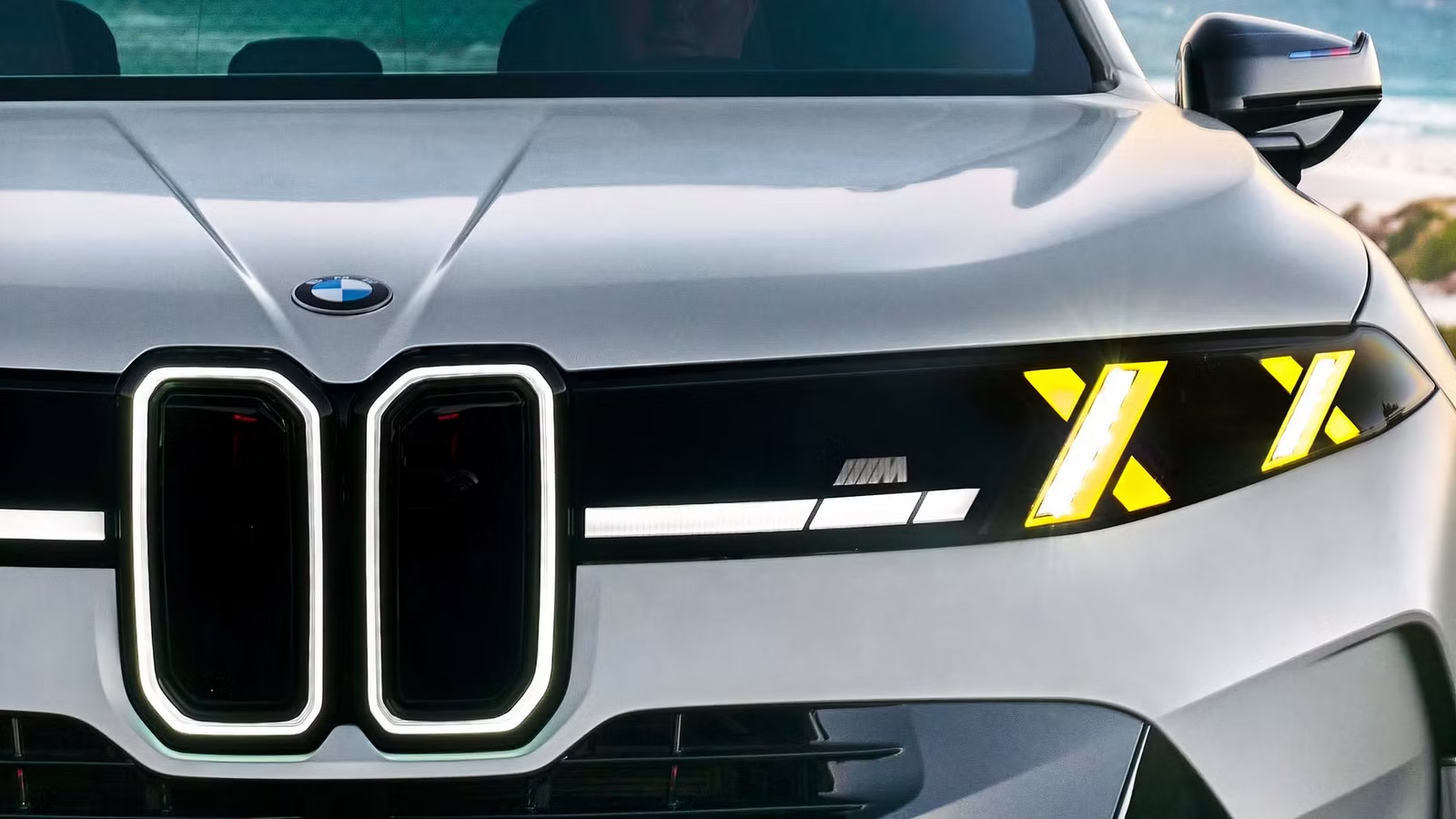
Ever since the BMW X5 first debuted way back in 1999, it has acted as one of the German manufacturer’s most popular offerings. It was envisioned to take on the emerging sports-SUV market, which was becoming a big business in the run-up to the new millennium. The X5 combined the sporty, engaging handling normally reserved for lower-riding conventional cars with the high-riding practicality of an SUV.
The machine has only gotten more successful over the years, with its best year of sales in the US coming as recently as 2022. With the fourth-gen car starting to feel a bit long in the tooth, BMW has now unveiled its latest generation of the X5. While most of the new car’s highlights read like a typical 2026 revolution, the big news is that the standard X5 is no longer available with a V8 engine – a first in the nameplate’s history. While a big change, BMW has sound reasoning for its decision to focus on other engine options.
The X5 Has An All-New Engine Option
2026 BMW X5 plug in hybrid phevBMW
2027 BMW X5
Engine
3.0L turbocharged I6, 3.0L turbocharged I6 with hybrid
Transmission
8-Speed Auto
Power
394-483 hp
Torque
428-516 lb-ft
0-60 mph
4.6-5.1 seconds
BMW started from pretty much a blank sheet of paper with the 2027 X5 (known by the internal code G65), the brand wanting the vehicle to highlight the brand’s new design language and technology front and center. This started from the ground up, with the chassis and the powertrains found lurking beneath the skin. Like its predecessor, the G65 X5 primarily uses straight-six engines from the lower end of the range, though the layout is now consistent across the entire family.
The base model, the 40 xDrive, is equipped with the latest evolution of BMW’s B58 engine family, which debuted in 2015. The turbocharged 3.0-liter inline-six engine thus makes its US debut, and it is quite different from other B58 units. First and foremost, it uses the Miller cycle combustion process rather than the traditional Otto system. The layout means some air-fuel mixture can be pushed out of the cylinder before it’s ignited, so the engine needs to expend less energy to complete the combustion process.
The result is that the engine runs cooler and uses less fuel because it doesn’t have to work as hard. The downside is that low-end torque and responsiveness are compromised, but BMW gets around this by providing a mild-hybrid system to fill in the gaps. A new cast-in-head exhaust manifold also joins the party, which not only decreases the weight of the entire system, but also further enhances thermal efficiency. The more expensive 50e xDrive gets a plug-in hybrid powertrain that incorporates a detuned version of the new B58 engine alongside a single electric motor.
The Outgoing V8 Still Holds The Performance Advantage
2024 BMW X5 M 4.4L Twin-turbo V8 EngineBMW
Of the two, the PHEV is the more powerful. Despite the B58 being detuned to produce 308 horsepower, the single motor increases total output to 483 hp, with 516 lb-ft of torque at the driver’s mercy. The standard mild hybrid version of the X5 kicks out 394 hp and 428 lb-ft, which is still a solid gain when compared to the 3.0-liter unit found in its predecessor. While there’s only an extra 19 hp to play with, the extra 45 lb-ft of torque should make a real difference.
Still, the departing S68 V8 engine found in the old M60i grade remains the power king. With 523 hp and 553 lb-ft on its books, it comfortably gets the better of anything found in the new machine.
The Inefficient V8 Was Surplus To Requirements
2027 BMW X5 40 xDriveBMW
The trouble with the V8 is that it runs counter to BMW’s aim to provide engine options that enhance the efficiency and cleanliness of its models. While it easily gets the better of its newer counterparts from a pure grunt aspect, an average fuel economy figure of just 19 mpg means you’d be forced to make a trip to the gas station more often than you’d like. The beauty of the plug-in hybrid inline-six found in the 2027 X5 is that, even though it’s a fair way down in terms of grunt, it’s expected to manage closer to 45 mpg. This ensures its owner will spend a hell of a lot less keeping the thing running.
Plus, with the aid of the electric motor, the 50e doesn’t lack grunt. The instantaneous torque delivery allows it to hit 60 mph in just 4.6 seconds, which is only a few tenths of a second slower than the M60 could manage. When paired with the vastly superior fuel efficiency, BMW felt this trade-off was more than worth it.
Another factor that led BMW to prioritize making a PHEV the upper-end version is how well the vehicle segment is selling at the moment. Like the wider automotive arena, BMW saw a drastic uptake in the number of PHEVs that it shifted in 2025, with the brand shipping over 30% more of the things than it had in 2024. Seeing the writing on the wall, BMW elected to make a high-power PHEV the focal point of the higher-end X5 range.
A Higher-End Version Of The X5 Will Likely Get A V8 Anyway
2027 BMW X5 40 xDriveBMW
Then there’s the fact that the new X5 will probably be getting a V8 after all. BMW will offer a new X5 M version of the SUV at some stage, which is pretty much guaranteed to come loaded with a V8 powerplant. Whereas the marque couldn’t justify including one with the standard X5 range due to fuel efficiency and emissions reasons, it felt that a performance-focused version of the vehicle would be the perfect route to keeping an eight-cylinder available for those who want it.
The most likely powertrain is the one already found in the XM and BMW M5. The PHEV unit built around the famous 4.4-liter twin-turbo V8 produces in excess of 700 horses these days, and that’s a mighty jump up from the previous-generation X5 M. And let’s not forget about the possibility of an all-electric X5 M. the standard EV model produces 570 hp, but we know the i7 M70 can produce up to 650 hp.
BMW’s Direction Isn’t An Alien One
2027 Audi Q7 dynamic driving imagery.Audi
Overall, BMW’s change of direction regarding the V8 being ejected from the normal X5 range is far from unprecedented. If you examine its mid-size crossover rivals available in the US market, the vast majority are no longer offered with V8 engines, unless it’s the dedicated performance version. Most, such as the Audi Q7, Genesis GV80, and the Volvo XC90, can’t be had with V8s anymore, with these models only available with four- or six-cylinder powerplants.
The Mercedes-AMG GLE 63 uses a 4.0-liter V8, but this is essentially placed at the same level as the upcoming X5 M will be with its V8. The same can be said for the Porsche Cayenne, with the more focused S, GTS, and Turbo variants all sporting eight-cylinder beasts under the hood, as well as the Dodge Durango RT and SRT, plus the Range Rover Sport.
The days of having a V8 included in a non-sporting mid-size SUV as a way of creating more of a luxurious model are over, with engine technology having progressed to the point where smaller and more efficient V6s can do the same job that the trusty V8 used to. BMW was simply behind the curve with the fourth-gen X5, and the upcoming variant gives it a chance to match the competition.
Related
The Go-Faster BMW X5s That Never Got The M Badges They Deserved
These BMW SUVs packed plenty of power and provided more than enough pace, but yet they missed out on becoming fully-fledged M models.
BMW Wants To Make A Mark With Its New X5
2027 BMW X5 40 xDriveBMW
2027 BMW iX5
Powertrain
Dual electric motors
Power
570 hp
Torque
593 lb-ft
Range
435 miles
There’s more to the story too, as the new X5 shows BMW is determined to embrace the future in other ways. Firstly, the first-ever all-electric variant of the X5 will be unleashed. Named the iX5, it uses BMW’s new Gen 6 cylindrical-cell batteries, which deliver an excellent range of 435 miles per charge.
This comes despite a commanding 570 hp and 593 lb-ft of torque being available, which is comparable to its Audi SQ6 e-Tron and Mercedes-AMG EQE rivals. The thing is, these cars can only manage 285 and 230 miles on a full charge, respectively, leaving them well behind the future BMW in terms of outright range.
As the cherry on the cake, the vehicle can take advantage of 460-kilowatt charging, meaning it can be topped up much faster than either of its German competitors. There will also be a hydrogen fuel cell-powered variant arriving in the future, though details are scarce at the moment.
Related
The 15 Best BMWs Of The Last 50 Years, According To CarBuzz
BMW has produced many Ultimate Driving Machines over the last half-century, and these are our favorites.
A New Futuristic Cockpit Will Also Debut
2027 BMW iX5 60 xDriveBMW
Aside from the technical stuff, the G65 X5 also sports an all-new cabin. Wanting to elevate refinement and the class of the cockpit, BMW worked hard to include a range of nicer-feeling and looking materials throughout the interior, to ensure it feels a step above its predecessor in this regard. There’s also been a step from a design standpoint, as illustrated by the pillar-to-pillar dashboard display placed at the bottom of the windshield. Featuring a range of important driving information, it not only looks clean, but also ensures the driver won’t have to take their eyes off the road to access crucial info.
There’s also a new 17.9-inch touchscreen display located in the middle of the dash, which provides a cleaner look than the setup in the previous X5. With all this wrapped up in a new exterior design inspired by BMW’s Neue Klasse design language, the X5 represents a true revolution rather than simply an evolution. Ridding the standard X5 of a V8 option may seem to be yet another nail in the coffin for the engine configuration, but hold on for a little longer, and you’ll get your eight-cylinder back. It’ll just look and drive more aggressively than usual, that’s all.
Sources: BMW.
