

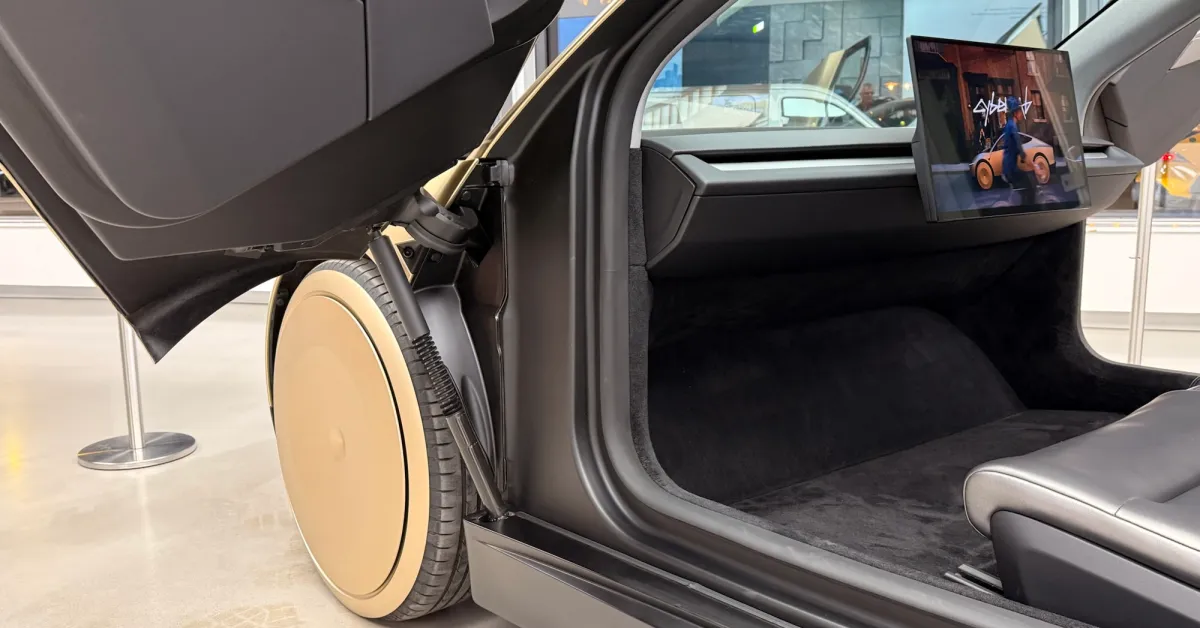
Tesla said today it will sell Cybercab to consumers by the end of this year, raising questions of what end users would do with a vehicle with no steering wheel and no self-driving software.
During Tesla’s Q3 conference call today, a question was asked about when Tesla will deliver unsupervised FSD to customer cars.
That question was answered slightly differently than usual. Instead of the standard “end of next year” that we’ve heard every year for a decade, Tesla changed the answer to: “middle of next year.” In order words, Q2 2027.
So, alright, that’s when Tesla says its cars will be able to drive themselves with nobody paying any attention. Great. It would be quite a big step from their current level 2 system to a level 4 or 5 system, which are the only categories that could be deemed as “unsupervised” as level 3 still includes a driver in the driver’s seat who needs to be ready to take control at any time.
But then, in the same question, Tesla made another prediction. VP of Engineering Lars Moravy said that Cybercab will be in customer hands by the end of this year – which means within the next two months. Here’s the answer:
In short we’re trying to get Cybercabs to customers by the end of this year in 2026, obviously we’re producing a lot in Texas but all of those are going to our own internal Robotaxi fleet, and as Tesla grows we’ll mainly deliver fully designed autonomous vehicles to our customers and Cybercab will be the first. And so as we start small this year and we learn about all the things Ashok mentioned about delivery and ownership and fleet management and autonomous vehicles in customer hands, we’ll continue to scale that.
Musk then added on to the answer, highlighting that Cybercabs would mostly be Tesla-owned transport-as-a-service vehicles, which somewhat contradicts Tesla’s call for Cybercab fleet buyers which it put out the same day as its Cybercab launch event.
But did you notice anything? Moravy said that Cybercabs would be in customer hands – that is, not Tesla’s hands – by the end of 2026. And Ashok, in his answer which we reported on here, said unsupervised FSD would be in customer hands in Q2 2027 (if that’s to be believed).
This would leave a half-year where these Cybercabs, which are intended to come with no steering wheel or pedals, are completely inoperable. You couldn’t even push them into your driveway, because you’d have no steering wheel to help you do so.
Unless, of course, these Cybercabs get delivered with steering wheels – which most of the ones in the wild have these days anyway. And if they did, then why not just call it a Model 2 and sell it to people for $25k, like you should have done in the first place?
Either that, or the vehicles will be limited to the same areas that Cybercabs are already limited to. Despite Musk predicting that Robotaxis would cover half the US population by the end of last year, it is currently available only in small portions of 6 cities in 2 states.
If Tesla gives customers access to the same software it uses (which it has promised for a long time), then presumably they could operate Cybercabs in the same areas. But Tesla said, in the same call, that it won’t give people access to that software, even in the areas where it’s already operating, until Q2 2027.
So, per Tesla’s statements today, it plans six months of selling a car that is usable by precisely nobody, to do precisely nothing.
Either that, or all the timelines are made up. But Tesla would never do that, would they?
Charge your electric vehicle at home using rooftop solar panels. Find a reliable and competitively priced solar installer near you on EnergySage, for free. They have pre-vetted installers competing for your business, ensuring high-quality solutions and 20-30% savings. It’s free, with no sales calls until you choose an installer. Compare personalized solar quotes online and receive guidance from unbiased Energy Advisers. Get started here. – ad*
FTC: We use income earning auto affiliate links. More.
