

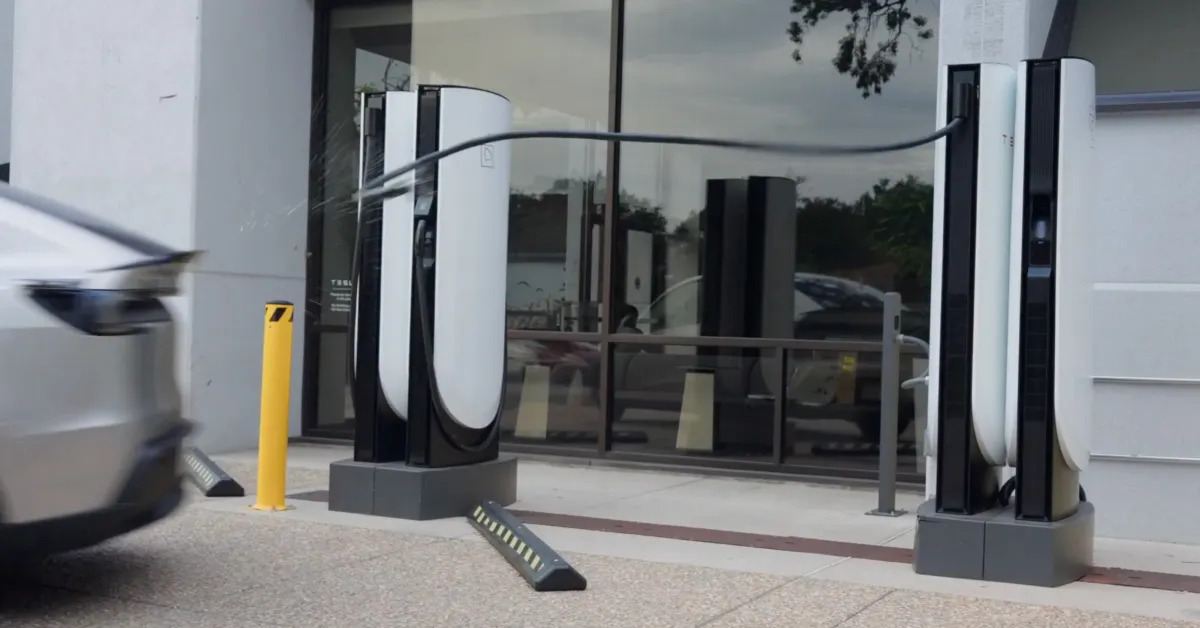
Tesla launched a new feature called “Emergency Drive Away” that lets drivers shift into Drive and leave while still plugged into a Supercharger.
The update comes two months after a gunman shot three people in Teslas at a Supercharger station in Twin Falls, Idaho. And Tesla is limiting it to the US.
Tesla’s charging team announced the feature on X today with a 36-second video and a few short follow-up posts:
Until now, a Tesla wouldn’t shift out of Park with a charge cable connected. You had to unlock the charge port from the touchscreen, the app, or the button on the handle, then wait for the latch to let go.
Emergency Drive Away removes that lockout, and Tesla isn’t pretending it’s gentle. “Use of this feature will damage your vehicle and the Supercharger,” the company wrote. It says the feature is for emergencies only and that deliberate misuse will bring “additional penalties.” It didn’t say what those are.
The feature requires software update 2026.38.3, and Model S and Model X vehicles built before 2021 aren’t supported. When an owner asked whether stalls need new hardware, Tesla answered that it works at all Superchargers in the US.
But only in the US. Tesla says the feature applies to US Superchargers “for now.”
Two months after Twin Falls
Tesla didn’t mention the shooting in its announcement. But the timing is hard to miss.
On August 1, a gunman killed three people and injured seven at an In-N-Out in Twin Falls, Idaho. According to police, he fired on three people in two Teslas at the Supercharger station next to the restaurant, and one of them, a 66-year-old man from Salt Lake City, died.
In the days that followed, Tesla owners asked for a native way to escape a Supercharger stall without waiting on the charge port latch. Hundreds of them also started pushing EVject, a $299 breakaway adapter that Tesla sued in 2024 over claims it could reach 100°C during high-current charging.
Twin Falls wasn’t the first deadly shooting at a Supercharger either. A Tesla driver was shot and killed at a station in Colorado in 2023.
Electrek’s Take
After Twin Falls, we wrote that the fix had to come from Tesla, since it controls both the car and the charger, and that it should be gated to prevent abuse and cover equipment damage. That’s roughly what Tesla shipped, and it took two months. Credit where it’s due.
But it’s a crude version of the idea. We were hoping the car and the stall would cut power and release the latch so you could leave clean. Tesla instead removed a software lockout and is warning you that you coul break your car and its charger on the way out. That beats being stuck.
Then there’s the US-only part. Tesla says this works at every Supercharger in the US, and stations in Canada use the same connector, so we don’t see a hardware reason to stop at the border. Tesla built a feature to help drivers get away from gunfire and decided that, for now, only the US needs it. Sadly, we can’t argue with the logic. Shootings like this are very much a US problem, and as we said in August, the real answer is gun control and serious investment in mental health, not a software update.
Charge your electric vehicle at home using rooftop solar panels. Find a reliable and competitively priced solar installer near you on EnergySage, for free. They have pre-vetted installers competing for your business, ensuring high-quality solutions and 20-30% savings. It’s free, with no sales calls until you choose an installer. Compare personalized solar quotes online and receive guidance from unbiased Energy Advisers. Get started here.
FTC: We use income earning auto affiliate links. More.
