

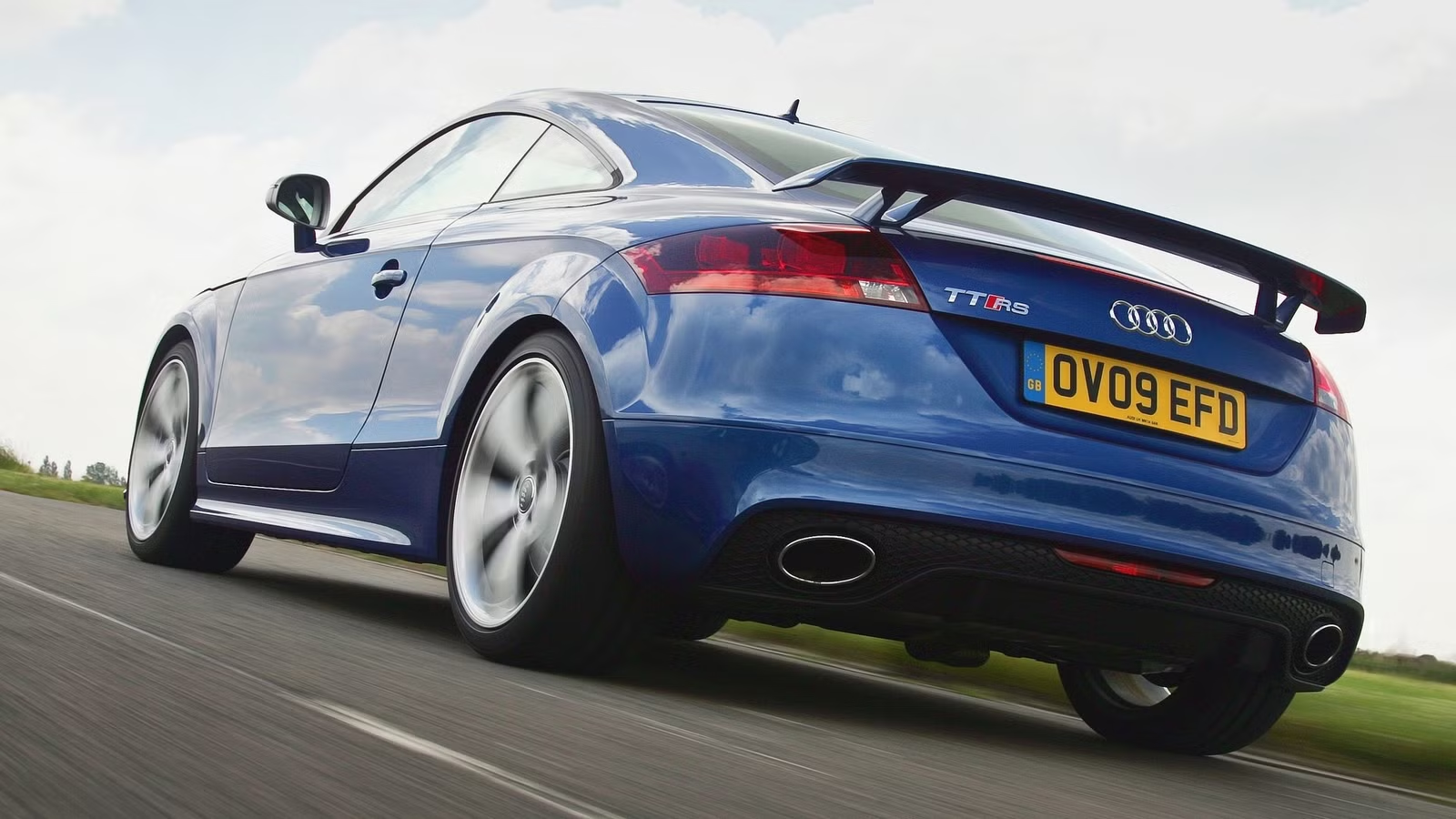
In the US, the chance to buy a Mk2 Audi TT RS was fleeting at best. It was only offered from 2012 to 2013, after which it was yanked from our shores with no chance of returning. Those who managed to get their hands on one were treated to a great set of attributes: five-cylinder power, a six-speed manual, four seconds to 60 mph, and a lightning-quick 12.7-second quarter-mile time. The USDM Mk2 Audi TT RS’ overall motto might as well be, “Now you see me, now you don’t.”
The darn things hold their value well, too, which is to be expected of a rare Audi in the States. At present, Classic places its average value above that of a brand-new 2026 Mazda MX-5 Miata, but not by much. That means you can either spring for the new Mazda, which has an adequate amount of power, a stick, and a removable top. Or, you could spring for something that packs a huge amount of power under its skin, and combines it all with a legendary mechanical package the market no longer really offers.
Audi Gave The Mk2 TT RS A 360-HP Five-Banger
Action shot of the 2010 – 2012 Audi TT RSAudi
Nestled underneath the Mk2 TT RS’ short hood is a 2.5-liter turbocharged inline-five belonging to the fabled VW/Audi five-cylinder engine family. Despite its small displacement, it manages to put out 360 horsepower with ease, along with 343 pound-feet of torque. Transforming that power into usable momentum is a six-speed, close-ratio manual transmission hooked up to Audi’s quattro all-wheel drive system. Try to find all of that in a modern performance coupe.
The TT RS’ five-cylinder engine is special for a multitude of reasons outside its incredible power density, like its exhaust note. Because it has an uneven firing order, the motor gives off a primal, raspy mechanical growl. It’s that unique sound that ties the engine directly into Audi’s long-standing five-cylinder engine heritage, as nearly all of them feature the same throaty, uneven warble.
The engine delivers most of its torque right at the bottom of the rev range — at 1,650 rpm, to be exact — meaning it gets off the line in a hurry. It also means you don’t have to continuously search for the proper gear at higher revs. On a racing circuit, being able to have a lot of power right off the rip is an important plus because every single corner can be used as a slingshot, especially considering the Mk2 TT RS boasts Audi-bred all-wheel drive.
Its 2.5-liter wasn’t just plopped in without a second thought; Audi spent a considerable amount of effort fine-tuning it before it received TT RS duty. Its turbocharger was enlarged, and a set of strengthened internals were added, such as a forged crankshaft and forged connecting rods. Its block is also made out of vermicular graphite cast iron. Oh, and for once, the US got the hotter version. Ours made 360 horsepower, while the European iteration made do with just 340 ponies.
The Little Audi Is Properly Fast
A studio shot of the 2010 – 2012 Audi TT RSAudi
It’s one thing to have a hot engine; it’s another to have the mechanical cojones to put it to good use. Being the RS model, its chassis was stiffened in order to provide oodles of grip and control through fast corners. Its ride height is lowered by 10 millimeters over standard, and Audi’s Magnetic Ride suspension comes standard, which constantly adjusts to driving conditions. Stopping is charged to a pair of 370-mm front brakes tended by four-piston calipers.
On a dedicated skid pad, a Mk2 TT RS managed to achieve 0.96 lateral g before breaking loose, and a braking test revealed a 159-foot total stopping distance from 70 mph. Compare that to the global average of 314 feet at 70 mph, and you can see just how well those four-piston front calipers earn their keep. Audi itself reported a 0-60 mph time of 4.1 seconds.
A studio shot of the 2010 – 2012 Audi TT RSAudi
To get performance akin to the TT RS in 2013, you’d likely have to spring for something much higher-end. Take the Porsche Cayman R, for instance. It produces a similar amount of power, 330 hp to be exact, and comes with a 0-60 mph time of roughly 4.3 seconds on the low end. Around a skid pad, the Cayman R achieved 1.01 lateral g before it broke loose, and its braking distance from 70 mph is roughly 155 feet.
The specs are comparable, but the starting prices were not. The 2013 Porsche Cayman R stickered for approximately $66,300, but just a couple of options could easily send that price well over 75k. The Audi, however, cost about $57,200. US-spec iterations came with virtually every option already built-in, too. The icing on the cake? The Audi comes with Haldex-actuated quattro AWD, whereas the Porsche makes do with rear-drive only. No, the Audi isn’t a one-to-one Porsche fighter. In terms of bang for your buck, though, its plus points can’t be ignored.
2013 Marked The End Of An Important Audi Era
An interior shot of the 2010 – 2012 Audi TT RSAudi
The 2013 Audi TT RS marked the end of not one but two Audi eras at the same time. Not only was that the final year for a manual TT RS in the US, following its introduction just a year earlier, it was the final year for a USDM manual TT full-stop. After that year, the hot TT was yanked from the proverbial American shelves and wouldn’t come back until near the very end of the TT’s life. While it did return with a five-cylinder engine, the transmission hooked up to it was a seven-speed dual-clutch automatic.
Compounding the sadness, the loss of the 2013 Audi TT RS from the American market meant buyers no longer had access to one of the most unique and exciting sports car formulas from the modern era. No other model offered a transverse, turbocharged five-cylinder engine paired with a six-speed manual, all-wheel drive, and a two-door body. The Audi RS 3 comes close, but it’s a four-door and doesn’t offer a stick shift.
An interior shot of the 2010 – 2012 Audi TT RSAudi
The ’13 TT RS wasn’t all shouting and flexing; it has a soft side, too. Inside its cabin, owners are treated to heated, sport-bolstered seats trimmed in genuine Silk Nappa leather. You could spring for Alcántara material, or two-tone leather, too. Navigation is built into its 6.5-inch infotainment screen, and a premium sound system handles audio duties. The instrument cluster even comes with a digital lap timer.
A $33,000 Market Benchmark Puts The Miata Comparison On Rails
Action shot of the 2010 – 2012 Audi TT RSAudi
According to Classic, a 2013 Audi TT RS fetches roughly $33,433 in the open market. Individual examples will inevitably vary in price, as everything from condition, color, odometer mileage, and even physical location can alter the price. Some examples have sold for a bit less, some for a bit more, but none have strayed too far from that $33,433 average benchmark.
2025 Mazda MX-5 Miata RFIan Wright/CarBuzz/Valnet
At the same time, a brand-new 2026 Mazda MX-5 Miata sells for roughly $30,430 before any destination fees, taxes or other charges are factored into the mix. With the MX-5, you’re granted a naturally-aspirated four-pot making 181 horsepower and 151 pound-feet of torque. A six-speed manual sits between the front passengers, and rear-wheel drive takes care of the car’s movement. Compared to the 2013 Audi TT RS, the Miata might as well go back to sleep.
Action shot of the 2010 – 2012 Audi TT RSAudi
Of course, this is not to say the little Mazda sports car is no good. It’s one of the most beloved, affordable sports cars to ever grace the earth’s asphalt, and will likely continue to live in the hearts of millions for decades to come. Not to mention, it would come with a new car warranty and a boatload of proven reliability under its belt. It just doesn’t have that much power, nor does it come with nearly as much luxury as a used Audi TT RS does at roughly the same price.
In that sense, it’s best to not simply think of the 2013 Audi TT RS as a Miata alternative. Rather, you’d be better served thinking of it as an affordable avenue into the type of performance car that the world no longer builds. It just happens to cost broadly the same as the Mazda, too.
Sources: Mazda, Audi, Classic, Car and Driver, Motor Trend, CarKeys.
