

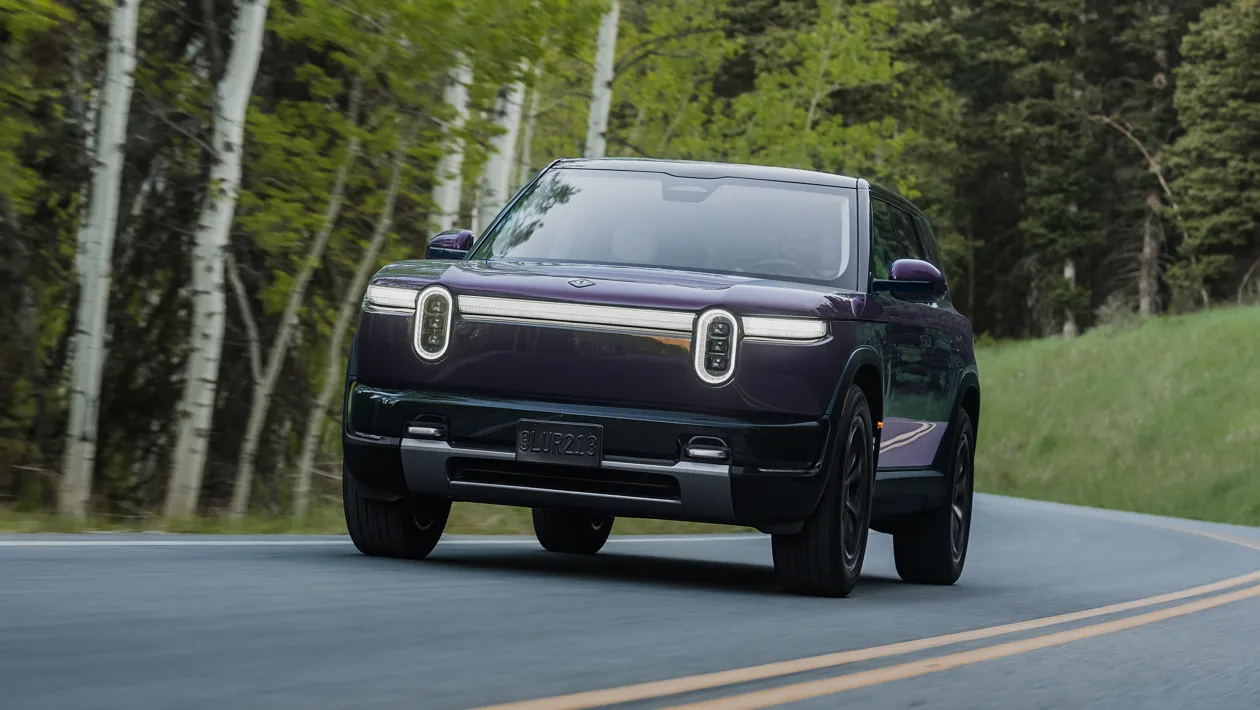
“As a car enthusiast, I sort of lament that because I really loved the period of time where different brands had wildly different takes on a segment. And you could see the personality, you could see the teams that had different perspectives. The colloquial way to say it is like cars look like jelly beans, they’re just all sort of the same. And so we try not to be like that.”
Rivian is also going to be facing off against Chinese car makers for the first time when it finally arrives in Europe, which doesn’t seem to faze Scaringe, either. He praises the quality of the Xiaomi SU7’s execution and admires the wide-reaching appeal of BYD’s portfolio, even if they do “blend in with one another often”.
Scaringe believes that many Chinese cars simply try to do too much and, as a result, don’t have the kind of simple or seamless user experience that their much more established rivals do. Rivian tries to do this by offering a user experience that’s supposed to feel consistent throughout, hence why it chooses not to offer Apple CarPlay.
The future of Rivian rests on this one car
Rivian has built itself up to be a big company, not a small-time player, burning through cash to build its infrastructure and vertically integrate everything that it felt was important, from the electric motors and gearboxes to software. In effect, “anything that has to do with the high-voltage or the low-voltage system, we brought in-house,” says Scaringe. “We even developed our own silicon chips for self-driving.”
The company also recently broke ground on a new factory in the southern state of Georgia that’s due to open in 2028; it will have an initial production capacity of 300,000 units per year, and will be a key part of supporting European sales. But in time, Scaringe wants Rivian to be producing millions of cars a year, hoping to catch up with Tesla, which churned out more than 1.6 million EVs in 2025.
“The ‘bet the company’ element of this is that we’re building this large engineering capability to support becoming a much larger business,” Scaringe says. “And the only way we become a much larger business is if we have a product like R2. And therefore, the R2 must be successful to support the way Rivian’s been designed.”
Fortunately for Rivian, demand has been strong out of the gate and the brand is now projecting it will deliver up to 70,000 cars this year – almost 70 per cent more than it shifted in 2025.
That’s going to consume all of the company’s production capacity for quite a while, according to Scaringe, which is part of the reason why the CEO wouldn’t commit to a solid timeline of when it will come to Europe. However, 2028 or 2029 would be our guess.
Did you know you can sell your car through Auto Express? We’ll help you get a great price and find a great deal on a new car, too.
