

For more than six decades, some of the world’s most extraordinary performance cars and racing machines have relied on Cosworth-developed engines. The company’s powertrain engineers have extracted astonishing amounts of power from relatively small displacements. With work that includes screaming naturally aspirated V12s capable of more than 11,000 rpm and turbocharged racing mills producing enormous outputs in qualifying trim, these mills demonstrate how far internal-combustion technology can go.
Some were created for Formula 1, others for IndyCar, while the latest examples have found homes in some of the most exclusive hypercars ever produced. Here are 13 of the most potent engines developed by Cosworth for road and racing applications – all by a single engineering company.
14
GMA S1 V12
681 hp
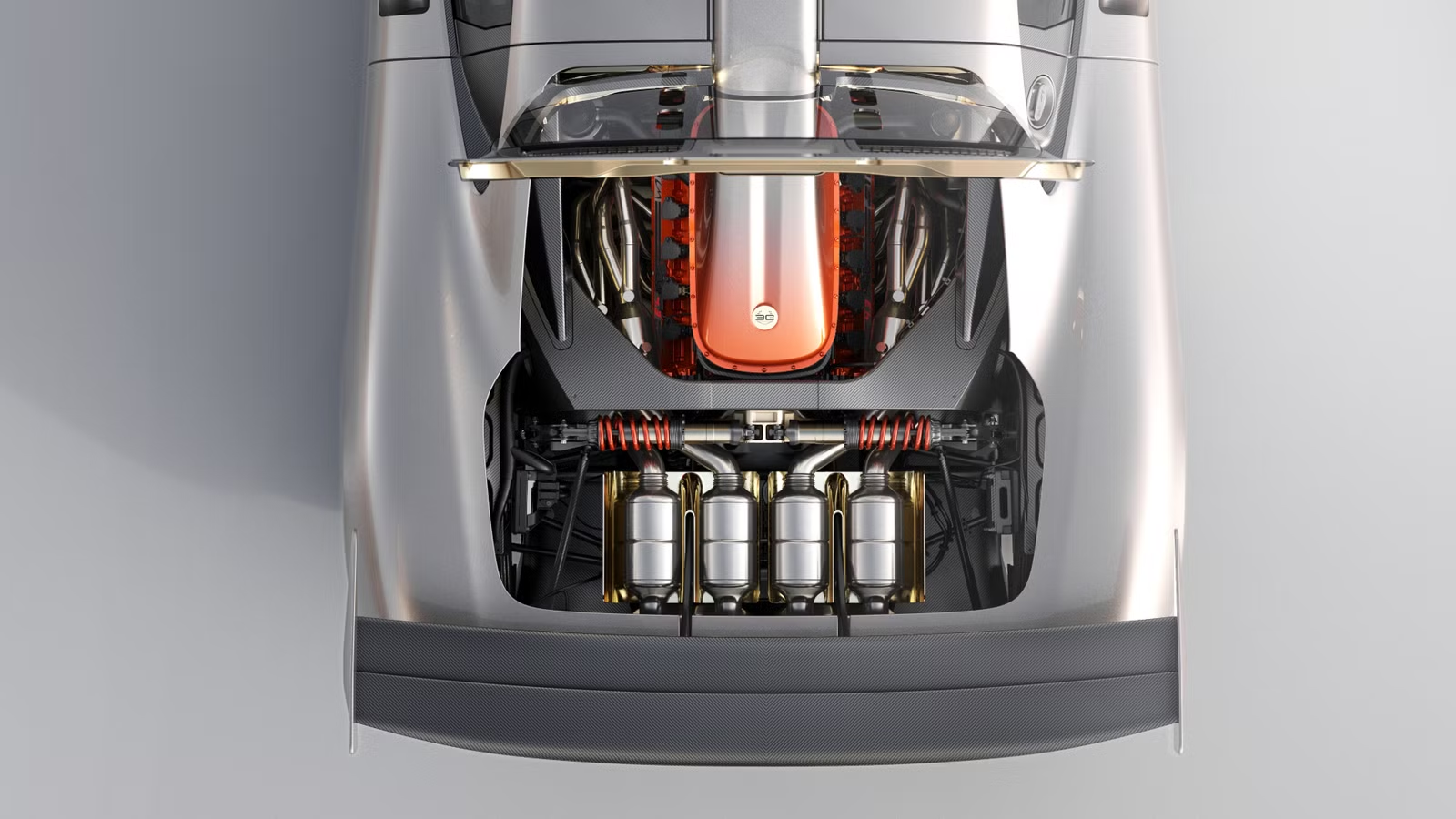
The latest addition to the family is the 4.2-liter naturally-aspirated Cosworth V12 developed for the GMA S1. It produces 681 hp at 12,100 rpm. Although it shares its lineage with the S1 LM engine, Cosworth developed this version with greater accessibility and touring usability in mind.
It uses competition-derived components, including silicon-carbide-coated lightweight pistons, titanium valves, and titanium connecting rods, along with dry-sump lubrication. GMA says the engine delivers 80% of its maximum torque from just 2,500 rpm, while still reaching 12,100 rpm. Production is limited to 64 cars, each with a six-speed manual gearbox.
13
GMA S1 LM V12
710 hp
The S1 LM uses a bespoke 4.3-liter naturally-aspirated V12 producing 710 hp. It is a newer development in the same broad lineage of high-revving V12 engines created for Gordon Murray’s road and track cars, but this one has a distinct engine program specifically for the S1 LM.
The engine pairs with an extremely lightweight carbon-fiber chassis and a track-focused aerodynamic package. GMA only produced five S1 LMs, making the engine exceptionally rare and powerful. GMA describes the S1 LM as the first Special Vehicles model from its new division and developed the car around the bespoke Cosworth V12 from the outset.
12
Cosworth VJM V10
730 hp (qualifying trim)
Sauber C15 V10 at Imola in 1996Sauber
The 3.0-liter VJM V10 was part of the JD/VJ/VJM family of engines developed for Formula 1 during the second half of the 1990s. The powerplant retained the family’s 72-degree V10 architecture and eventually produced about 720 hp in race trim and 730 hp in qualifying specification, with a maximum engine speed of 16,500 rpm.
Teams using the powerplant included Sauber, Stewart, and others. The Ford Zetec-R name appeared on several applications. The VJM’s high-revving nature was central to its output, while its lightweight construction and pneumatic valve technology let it run at speeds unimaginable for earlier Cosworth V8s.
11
Cosworth EC V8
740 hp
Micheal Schumacher driving Benneton B194Benetton
The 3.5-liter EC V8 debuted in the 1994 Formula 1 season and represented a major development of the earlier HB engine. In its most powerful form, it produced approximately 740 hp at 14,500 rpm. The engine was particularly significant because it powered Michael Schumacher’s Benetton B194 to his first Formula 1 World Championship in 1994.
The EC was a naturally aspirated engine, so extracting this level of output required very high engine speeds and highly developed cylinder-head, combustion, and valvetrain technology. The 740-hp output resulted in more than 211 hp per liter.
10
GMA T.50s V12
761 hp
Cosworth has now become synonymous with Gordon Murray Automotive thanks to their close partnership. The T.50s Niki Lauda uses a specially developed version of the naturally aspirated V12 created for the Gordon Murray T.50. Its 4.0-liter-class engine produces 761 hp at 11,500 rpm and can rev to 12,100 rpm.
Compared with the road-going engine, the track version received revised cylinder heads and camshafts, a higher 14:1 compression ratio, a redesigned intake system, and a lightweight exhaust system. It also weighs around 26 lbs less than the road-car engine. Only 25 examples are being produced, making it one of the rarest modern naturally aspirated V12 applications.
9
Cosworth CR-1 V10
770 hp
Stewart-Ford Formula 1 car driven by Rubens BarrichelloWikipedia
The 3.0-liter CR-1 V10 debuted with the Stewart Grand Prix and represented a major development of the preceding VJ and VJM engines. By the end of its development cycle, the engine produced about 770 hp at 16,500 rpm. The lightweight V10 powered Stewart’s Formula 1 cars before the team became Jaguar Racing.
Its high output came from a combination of naturally aspirated breathing, pneumatic valve technology, lightweight components, and extremely high engine speeds. At 16,500 rpm, each piston was completing 275 revolutions every second.
8
Cosworth XFE V8
880 hp
Sebastien Bourdais drivign at Long Beach Wikipedia
The XFE was the final major evolution of Cosworth’s turbocharged American open-wheel V8 family and powered Champ Car from 2003 through 2007. The 2.65-liter V8 was rated at approximately 750 hp, while additional boost available through the series’ push-to-pass system could raise output to around 800 hp.
Unlike earlier DFX engines, the XFE was designed around tighter regulations intended to improve engine life and control speeds. The engine was electronically managed, used a 12,000-rpm rev limit, and could deliver its substantial output while surviving much longer between rebuilds.
7
Cosworth CA V8
Up to 915 bhp
Cosworth CA2006 V8Collecting Cars
The 2.4-liter CA V8 was developed for Formula 1’s move from 3.0-liter V10 engines to 2.4-liter V8s in 2006. Its extraordinary power density let it produce up to 915 hp in its most developed form, with contemporary reports of the engine exceeding 20,000 rpm.
The CA used pneumatic valve-return technology and an extremely compact design, allowing Cosworth to extract huge power from just eight cylinders. The Williams FW28 and other Formula 1 applications used the CA during 2006, when the engine was generally reported at around 750 hp in race specification. The CA was one of the most extreme naturally-aspirated engines ever developed for Formula 1.
6
Cosworth DFX V8
Up to 1,000 hp
The 2.65-liter turbocharged DFX V8 was derived from the legendary DFV and became one of the most successful engines in American open-wheel racing. At its peak, the DFX produced 840 hp, while Motor Sport magazine reported that it could momentarily reach 900 to 1,000 hp under unrestricted boost conditions.
The engine normally operated around 9,500 rpm, although some examples were reportedly pushed beyond 10,000 rpm. The DFX powered CART and USAC cars through one of the greatest periods of IndyCar racing and won the Indianapolis 500 ten consecutive times from 1978 to 1987.
5
Cosworth GBA V6
Up to 1,000 hp
Cosworth twin-turbocharged GBA V6 at National Motor Museum Wikipedia
The 1.5-liter twin-turbocharged GBA V6 was developed for Ford’s return to turbocharged Formula 1 racing and made its debut with the Haas Lola team in 1986. Its compact 120-degree V6 configuration used twin-turbochargers to produce 750 hp in racing trim, an extraordinary output from just 1.5 liters.
Benetton later used the engine exclusively in 1987, with Teo Fabi and Thierry Boutsen scoring podium finishes. Period sources also record substantially higher figures for special qualifying configurations, with Motor Sport magazine reporting that around 1,000 hp was available with special fuel.
