

Knowing that your car has motorsport roots is special. That same engine that powers your commute can also compete at Le Mans, which is a feeling that only a few manufacturers can truly provide. Porsche is the most successful automaker ever at the French race, so it’s no surprise that their cars feature the same bulletproof reliability that’s necessary to win there. And there’s an engine available in the 911 that combines race-winning capability with reliability for daily driving.
Sports cars are great, but not so great when you’re stuck on the side of the road. That’s why Porsche enthusiasts still treasure the Mezger engines. These units have all the appeal of race-derived components without the fear of letting you down on the Interstate. But are they worth the extra cost? And what makes them so special? Let’s dive in.
The Mezger Is For Porsche Purists: A History
997 Porsche 911 GT2 showing its Mezger enginePorsche
Few engines are so iconic that they’re named after their engineers. Think of the Colombo V12 engines in old Ferraris or the Busso V6 in Alfa Romeo models. The Mezger engine is just like those named after Hans Mezger, who also designed the very first flat-six used in the original 901-generation 911. From there, he would bring success to the Porsche racing team as the lead engineer for the famous 917, which was awash with sports car racing wins in the early seventies.
Maybe it was the champagne, but we had a lively discussion about whether the Porsche engine or the McLaren chassis had won the first Grand Prix. We joked and found that the word ‘Engineer’ was after all derived from ‘Engine.’
– Hans Mezger, after winning with McLaren F1 in 1984
He also helped develop a three-time championship-winning engine for McLaren’s F1 team and helped Porsche dominate Can-Am racing with a turbocharged engine that would later power the 930 911 in 1974. That means he was one of the architects of bringing racing technology to the standard on road cars, as turbocharging has become synonymous with the 911 now.
Porsche 911 GT1 racing car, on track.Porsche
The lines are sometimes a bit vague, as technically every 911 engine before the water-cooled powerplant in the 1990s 996-generation 911 is a Mezger design. However, when Porsche wanted to make a special engine for the first-generation 911 GT3, the company chose to use an adaptation of their actual Mezger-designed racing engine to make it even more special. The unit has a slightly different design from the contemporary 911 Carrera’s powerplant and powered both the 996- and 997-generation GT3, GT2, and Turbo models.
Related
2025 Porsche 911 GT3 RS Track Drive: A Few Laps In Heaven
Here’s what it feels like to take the Porsche 911 GT3 RS around Monza.
What Makes It Special?
Unlike some sports car engines inspired by racing engines, the Mezger powerplant line actually started as a motorsport unit and later made its way to road-going models. It’s especially good at handling high revs for extended periods, has smooth power characteristics, and is built to last. Oh, and they sound mega.
Related
These Are The Rarest Porsches Ever Made
These Porsches are so rare that they make the 918 Spyder feel commonplace.
When Porsche wanted to race the 996-generation 911, homologating the regular M96 engine from the base model would have been tricky. It had reliability issues due to catastrophic IMS bearings, cylinders prone to cracking, and a leaking rear main seal. So, when Porsche was first developing the 911 GT3, it decided to use the engine from the GT1 race car that won Le Mans in 1998. This was a proven engine and would be a great selling point for the new line of 911 GT3 models.
It felt like in the 997-gen Turbo, you could access all of the twin-turbocharged power instantly at any given speed or road setting – emphasizing the all-round package the Turbo offered as an ‘everyday supercar’ that never felt held back, even in regular traffic.
– Adrian Ma, Road Tester, CarBuzz
It’s not only that it’s more reliable, but also that having an engine directly linked to the race-winning Porsche GT1 is a point of pride. The engine is available in both naturally aspirated and twin-turbocharged forms and has a dry-sump lubrication system with an external oil reservoir. It also has a ‘split’ crankcase that’s cooled on both sides by water jets.
A Reliability Endurance King
It’s no surprise that forums are littered with owners talking about how their 500 hp engines cost just as much to run (or less) than a base Carrera. With no major flaws like those found in other Porsche units, many examples have over 150k miles and less wear than a comparable Ferrari. The main issues don’t actually come from the engine itself, but the turbochargers and gearbox. Some higher-mileage models may require a turbo rebuild, which can get pricey.
Longtime Porsche fans are always saying 911 models get softer as they get newer, so it’s no surprise that so many owners use them as their daily drivers. The Turbo models in the pre-fresh 997.1 generation (the last Turbo to have a Mezger) even gained Bluetooth and a much-improved navigation system for ease of use, making them great for long trips. But when you need to be on the ball, the 997 gained variable-turbo technology, which helped it sustain boost over a wider rev range.
A shot of the 2007-2008 Porsche 911 GT3 997.1 enginePorsche
As with any engine, though, there are some things to look out for. Leaking coolant pipes are a common issue, but they’re not a major fix if they go wrong. With many examples crossing over 100,000 miles with sustained track use, it’s useful to do any pre-emptive maintenance and keep on top of servicing. Bore scoring is an extremely rare issue compared to the base 911s of this era, but it can still happen. If the same engine can run at 10,000 rpm in a race car for hours, it can probably keep up with a country road.
What Cars Feature A Mezger Engine?
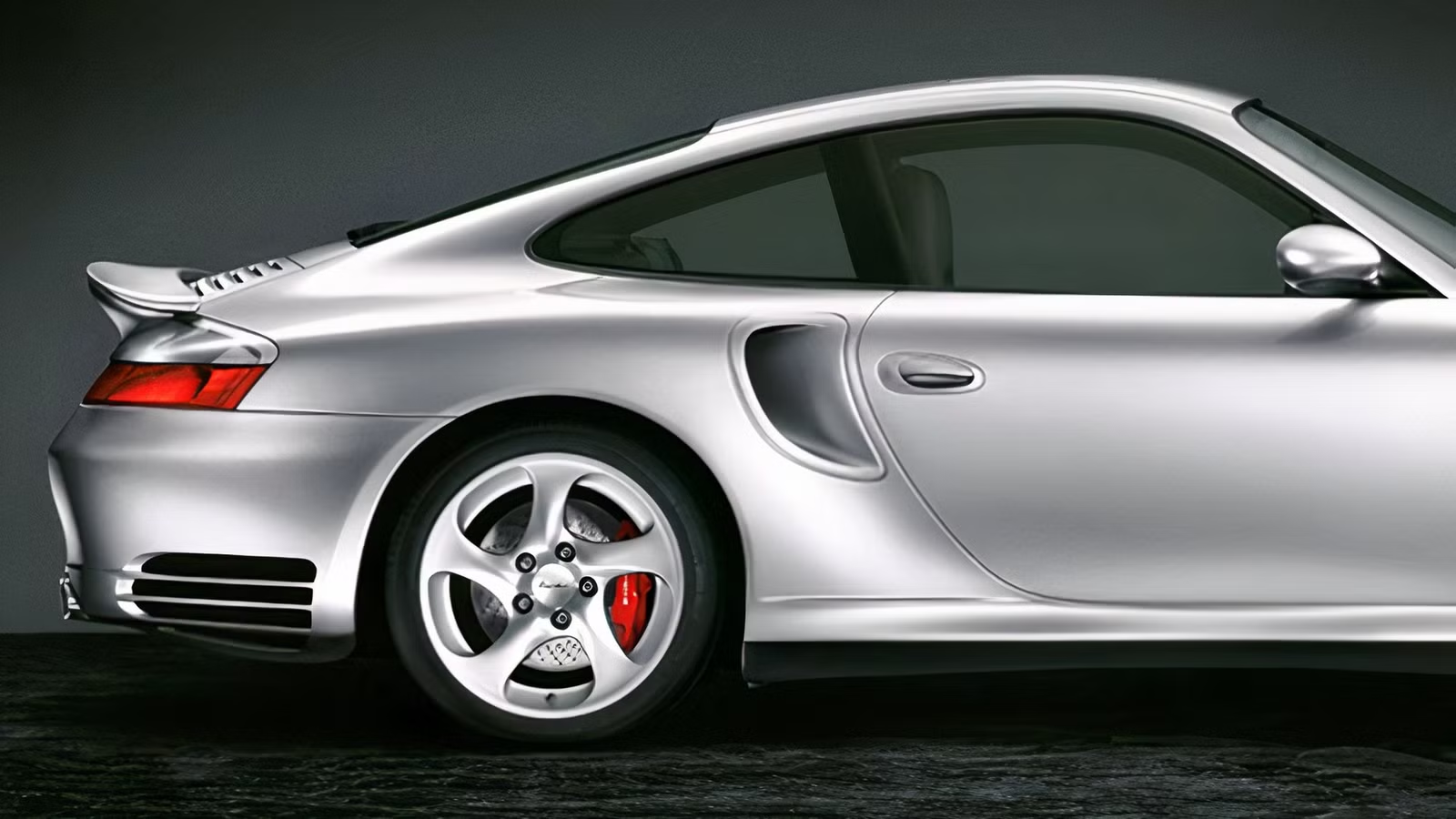
2001 Porsche 911 (996) Turbo
Porsche 911 996 Turbo Specs
Engine
3.6L twin-turbo flat-6
Transmission
6-speed manual
5-speed automatic
Power
415 hp (444 hp with X50 pack)
Torque
415 lb-ft (457 lb-ft with X50 pack)
The first of the water-cooled Turbo models wasn’t as appreciated in its day as it is now. Featuring a 415-horsepower twin-turbo flat-six, it got to 60 miles per hour in just over 4.0 seconds with all-wheel drive. The Turbo S had carbon-ceramic brakes and the X50 pack as standard, which pushed power to 444 hp. Values have been growing and now float at around $80,000 to $100,000.
2004 Porsche 911 (996) GT3
1996-2005 Porsche 911 996 GT3 from the rear in red drivingPorsche
Porsche 911 996 GT3 Specs
Engine
3.6L flat-6
Transmission
6-speed manual
Power
381 hp
Torque
283 lb-ft
The whole reason Porsche chose the Mezger engine for road use was to use it in this car. While we now love the GT3 as a staple of the 911 range, it was the 996 generation that introduced it to us, powered by a 3.6-liter flat-six producing 381 hp. The output is down to what the model makes now, but this one is all about how it makes you feel. The engineering team saves precious weight by removing creature comforts, and the suspension is more track-focused.
Related
Why Now Is The Perfect Time To Invest In The Most Hated Porsche 911
Whatever comes down must go up.
Porsche 911 (997) GT3 RS 4.0L
2012 Porsche 911 GT3 RS 4.0 Exterior Finished In White Driving On TrackPorsche
Porsche 911 997 GT3 RS 4.0 Specs
Engine
4.0L flat-6
Transmission
6-speed manual
Power
493 hp
Torque
339 lb-ft
You might be wondering why this one is so special, since the GT3 nowadays has a 4.0-liter engine. Well, the 911 GT3 RS 4.0 is considered by many to be the greatest 911 of them all. Built as a send-off for the Mezger engine, this engine’s larger displacement (up from 3.8 liters on the regular 997 GT3 RS) comes courtesy of a longer-throw crankshaft from the actual GT3 race car. The intake system from the GT3 R Hybrid also helps push power up to around 500 hp. Porsche only built 600 examples, and good luck finding one.
Sources: Porsche, Stuttcars, Rennlist
