

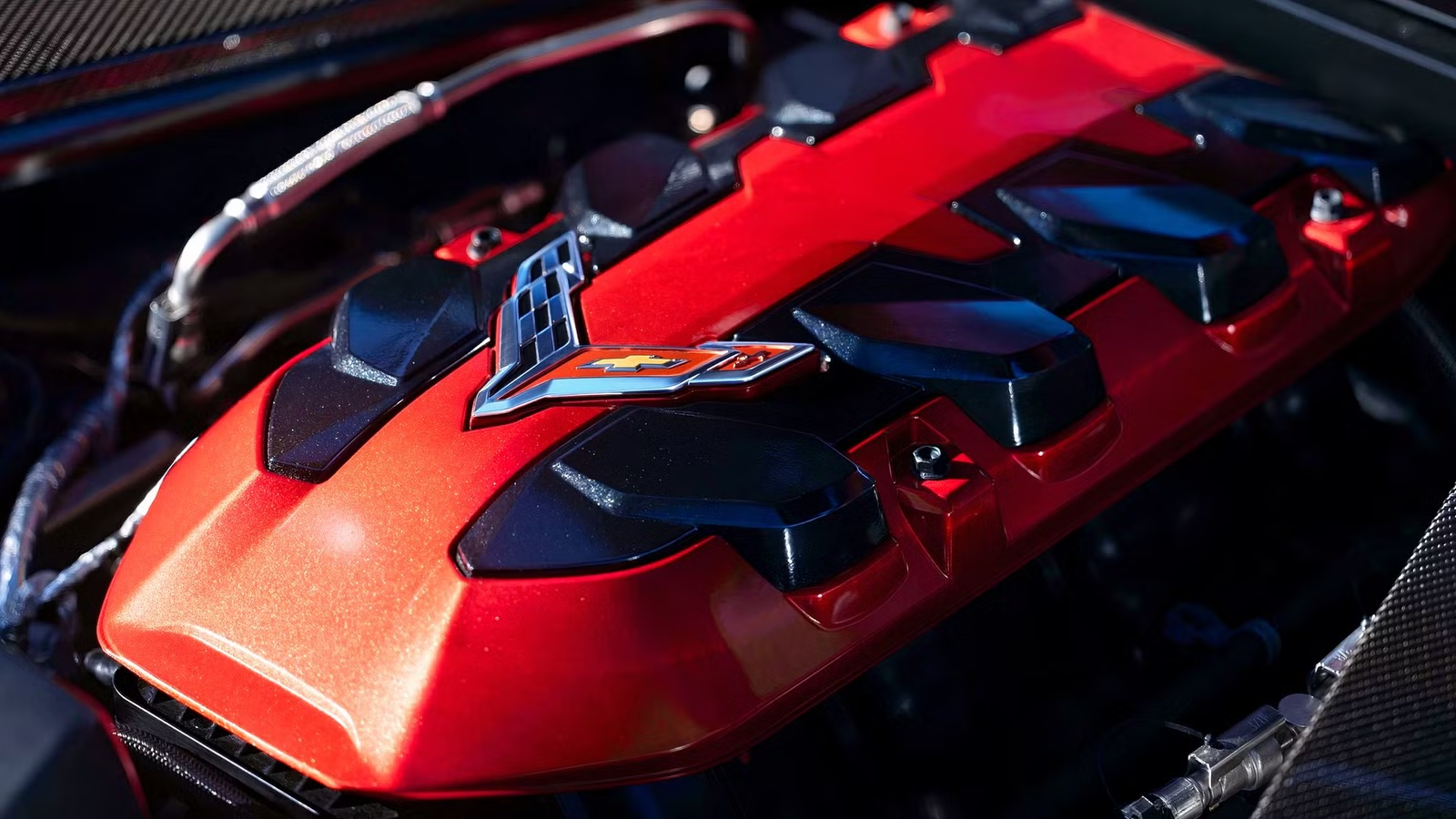
Grab a bib, we’re diving into a bit of alphabet soup. If you’re trying to trace the timeline of Chevrolet Corvette engines back to the start, you’ll likely find the slew of designations, order codes, displacements, and engine family names to comprise a particularly confusing word salad. Don’t worry, this makes you a completely normal human being.
Since its historic launch in the fifties (with a straight-six engine at first), the Corvette took V8 power to the mainstream masses, and spent decades as the technological showpiece that embodied the best V8 technologies of the day. Along the way, we’ve seen LT4s and LS2s and Z06s with LS7’s, the exotic C6 ZR-1, and plenty more. The latest? The LS6 small block V8 is coming soon to a Corvette Grand Sport near you.
2027 Chevrolet Corvette Grand Sport C8 from the front three-quarter angleChevrolet
The Corvette engine lineup has evolved once again with the latest incoming model and refresh, which will sport the first (and flagship) application of an all-new sixth-generation V8 that adds advanced high-compression performance for more power and torque, and resurrects a famous displacement from the archives: the 409 cubic-inch (6.7-liter) V8. Wdifferences between small-block and big-block engines exactly does the latest Corvette powerplant fit into the historical (and modern) lineup where displacement is concerned? Read on for a look at why so few factory-built Corvettes had engines that were bigger.
Understanding Big Block and Small Block Engines
1969 Chevrolet COPO Camaro 7.0L NA L72 Big-block V8 Air CleanerBring A Trailer
In the pre-emissions era, Chevrolet had a V8 engine for just about any application you could think of, from sports car to commercial equipment. These V8 engines were grouped into two families: the small block V8 and the big block V8. To a casual observer, that nomenclature suggests the two types of V8 engines are separated from one another merely by displacement, but that’s not exactly the case: there is such a thing as a 427-cubic-inch small-block, as well as a 396-cubic-inch big-block.
2027 Chevrolet Corvette Grand SportChevrolet
2027 Chevrolet Corvette Grand Sport
Type
Next-Generation LS6 6.7L V8
Displacement
6.7L / 409 cu in
Bore & Stroke
4.065 inches x 3.937 inches
Block Material
Aluminum block with cast-in iron cylinder liners (Gen 6 Small Block architecture)
Cylinder Head Material
Aluminum
Fuel Delivery
Direct and Port Injection with Active Fuel Management
Oiling System
High-capacity, performance-focused lubrication system engineered for extended high-load, high-temperature operation
Induction
Naturally aspirated; tunnel-ram intake with high-velocity ports; 95 mm throttle body
Compression Ratio
13.0:1
Power
535 hp
Torque
520 lb-ft
Exhaust
Corner exit standard; available center-exit (standard on track performance package)
Assembly Location
GM Flint Engine Operations – Flint, Michigan
Recommended Fuel
Premium fuel required
Max engine speed
6,600 rpm
Related
The Most Mass-Produced Automobile Engine Of All Time
There are dozens of widely-produced engines out there, but one from America takes the cake.
Throughout history, small-block V8 engines have climbed all the way up to 427 cubic inches displacement, or 7 liters, under the hood of a Corvette. Historically, you could have your Corvette with a 427-cubic-inch (7-liter) big-block as well, or an even larger 7.4-liter (454 cu-in) big-block if you liked. The small-block has ranged as small as 265 cubic inches (4.3 liters), specifically considering the original small-block V8 of the fifties.
2027 Chevrolet Corvette Grand Sport Close CropChevrolet
On the big-block side, there’s a modern-day tie-in to the incoming C8 Corvette Grand Sport: its 409-cubic-inch (6.7-liter) displacement was originally a big-block V8 of the sixties, though it never saw Corvette duty back then. Today, on the latest small-block architecture, the 6.7-liter (409-cubic-inch) V8 returns, showing us how sometimes the lines between big-block and small-block can seem a little blurry.
We’re simplifying here, but the small-block V8 engine refers to the compact bore spacing and pushrod architecture with dimensional continuity between its introduction in the original ‘265’ to the present day. The big-block engines were designed to be tougher and more industrial. They had thicker cylinder walls and internals built for strength and durability, though this made them ideal candidates for some of the biggest displacement performance V8 engines ever built by Chevrolet.
2027 Chevrolet Corvette Grand SportChevrolet
On the big-block side, factory-equipment configurations went all the way up to 8.1 liters displacement, a whopping 496 cubic inches. These monstrous and heavy V8s were popular with many muscle cars, but their size and weight made them a rarity under the hood of the Corvette, which was meant to be small and light. You can learn plenty more about the differences between small-block and big-block engines here.
Base Trim Engine
6.7L V8
Base Trim Transmission
8-speed dual-clutch automatic
Base Trim Drivetrain
Rear-Wheel Drive
Base Trim Horsepower
535 hp
Base Trim Torque
520 lb-ft
Segment
Sports Car
The Corvette Is The Small Block V8’s Flagship Car
Almost every Corvette throughout history has been small-block powered, with each generation layering on the latest lessons learned from motorsports and the latest engineering updates and enhancements. The original concept for the small-block V8 was to create a compact, lightweight, and affordable engine with plenty of power. As iteration after iteration of this approach arrived in the decades to follow, technological innovation, not all-out displacement, was typically in the spotlight.
Specifically, the Corvette ran with a 350-cubic-inch (5.7-liter) small-block V8 engine for three generations, from the late sixties until the mid-2000s. Its replacement, a 364-cubic-inch small-block V8, didn’t have the same historical ring as the “three-fifty,” so it was just called the six-liter instead. A 6.2-liter (376 cu-in) small-block V8 came next, but by this point, we were mostly referring to engines by their liters, not their cubic inches.
Chevrolet C5 LS1 engine close-upChevrolet
To summarize, a long period of Corvette history was well served by V8 engines of 5.7 to 6.2 liters displacement. Translation? Power per liter, not outright size, was the driving force behind the Corvette’s performance successes for ages.
The 2007 Chevrolet Corvette C6 Z06 has a naturally-aspirated, seven-liter V8 that revs to 7,000 rpm. Perfect for track days.Chevrolet
The latest Corvette is usually first to market with the latest V8 tech cooked up by the engineers, and when the Corvette Z06 arrived in 2006, they were looking to party. A new 7-liter V8 (427 cu-in) called the LS7 arrived with the biggest displacement the small-block family would ever see, bringing exotic lightweight internals and a furious 7,000 RPM redline to the mix. Built to spin fast and breathe with maximum efficiency, this biggest-ever small-block is one of the Corvette’s most iconic engines.
Engineering Details: 2006 Chevrolet Corvette Z06
Engine:
7.0-liter (427.7 cu .-in.) OHV V8 LS7
Horsepower:
505 @ 6300 rpm (SAE certified)
Torque:
470 lb.-ft @ 4800 rpm (SAE certified)
Bore x stroke:
4.125 in. x 4.00 in. (104.8 mm x 101.6 mm)
Compression ratio:
11.0 :1
Fuel shutoff:
7100 rpm
PistonType:
Flat top, short skirt, valve reliefs, lightening pockets, anodized top land, second land with pressure balance groove
Piston Material:
High-strength aluminum alloy, T-7 heat treat, polymer-coated skirts
Piston Weight:
482 grams
A big-block engine was relatively rare in Corvette history. In the late sixties to mid-seventies, you could march right into your local Chevrolet dealer and drive off in a Corvette stuffed with either a 454-cubic-inch (7.4-liter) big-block V8 or 427-cubic-inch (7-liter) big-block V8 from the factory, and no emissions controls to be seen. That party came to an abrupt end, but as Corvette engines re-emerged from the emissions era, new technologies made the use of heavier big-block engines a thing of the past. In this era, Corvettes were also getting serious about staying light and delivering benchmark handling, so the lighter and more compact small-block V8 wound up being the ideal solution moving forward.
The 2007 Chevrolet Corvette C6 Z06 has a naturally-aspirated, seven-liter V8 that revs to 7,000 rpm. Perfect for track days.Chevrolet
Of course, that didn’t stop enthusiasts and tinkerers from adapting big-block V8 engines to Corvettes of all stripes. Specialized racing engines can take the Corvette’s displacement and power output to terrifying heights for those who partake. As reported by The Drive earlier this month, at least one displacement fanatic has adapted the 8.1-liter big-block V8 into the current C8 Corvette.
Related
The Most Powerful Corvettes Of The Last 70 Years
There have been eight generations of Chevrolet Corvette so far – and some of the most powerful of these may surprise you.
So, Where Does The Grand Sport Sit Today?
Today, in 2026, the incoming Corvette Grand Sport with its 6.7-liter (409-cu-in) V8 engine sits firmly near the top of the Corvette’s historical displacement ladder. The only two models to ever run larger-displacement engines were big-block Corvettes of the seventies and the Corvette C6 Z06 of the mid-2000s, with its 7-liter (427-cu-in) small-block V8.
How does that stack up to the biggest-displacement American engines ever built? It’s 1.3 liters smaller than the original 8.0‑liter Dodge Viper, and 1.7 liters smaller than the final 8.4‑liter Dodge Viper, both the sports‑car displacement kings of their eras. It’s also 1.4 liters smaller than the 8.1‑liter big-block V8 GM used in other applications. Ford’s biggest modern V8 is the 7.3‑liter “Godzilla,” though their now‑retired Triton 6.8‑liter (415-cu‑in) V10 is a close match for the Grand Sport on displacement, but not cylinder count (and you won’t find it in a sports car). The closest match seems to be Chevrolet’s heavy‑duty 6.6‑liter (401-cubic-inch) gas V8, which is technically a small-block.
2027 Chevrolet Corvette Grand Sport C8 from the rearChevrolet
We don’t know what’s next for the Chevrolet Corvette, or its new small block V8 engine. We do know that this engine family is just starting to roll out and that GM has taken steps to eliminate catastrophic problems plaguing the outgoing 6.2-liter V8 in some applications. Though it’s not certain how much higher engineers can take the displacement of the latest V8 engine, we do know that an increasing tendency towards electrification likely means that future performance-enhanced Corvette models will continue to use electric motors, not additional displacement, as a means to drive performance to new heights.
Sources: CorvetteForum.com, TheDrive.com, Chevrolet
