

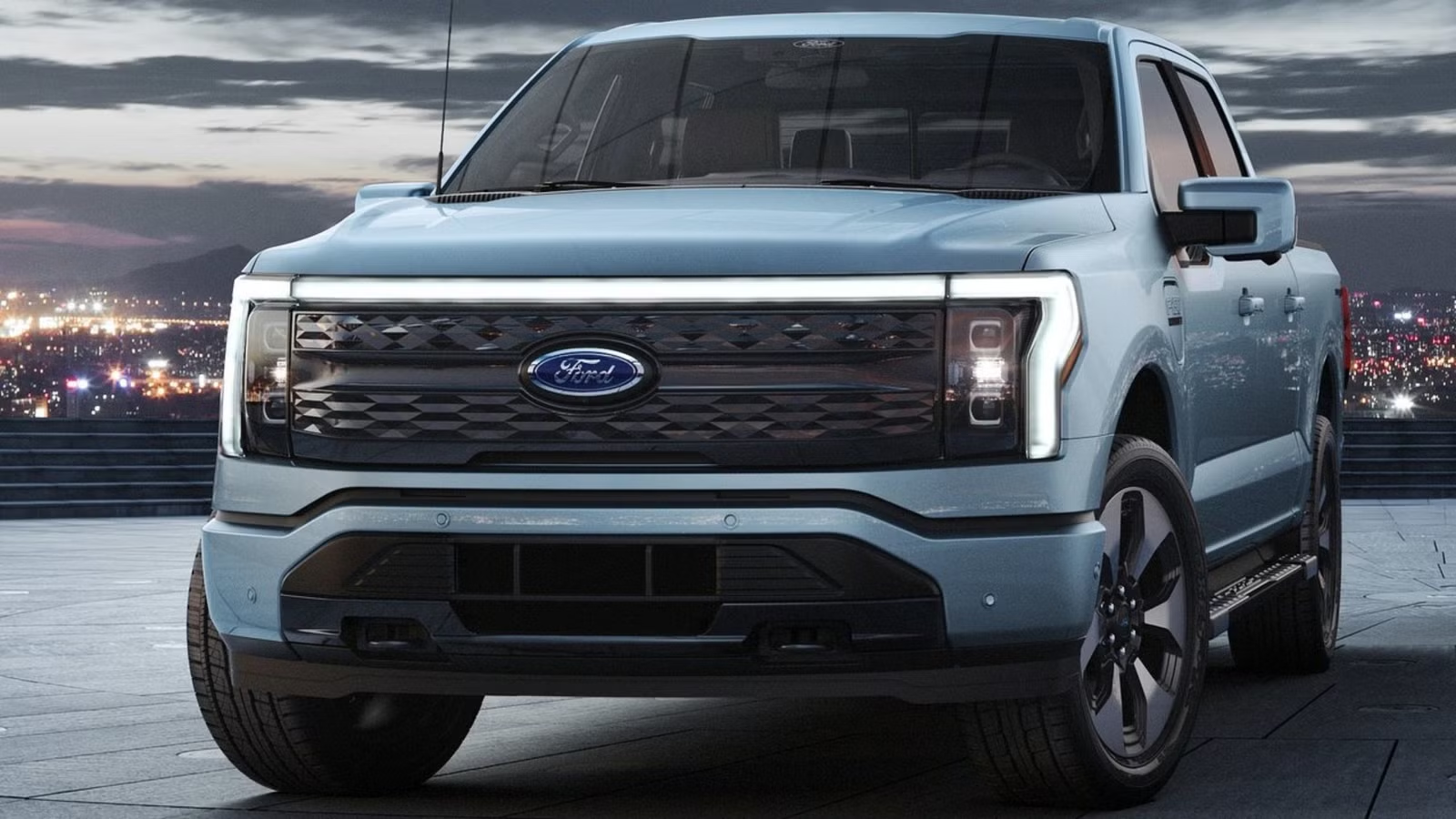
In many ways, the end of the tax credits brought the EV segment’s momentum to a screeching halt last year. They pulled the $7,500 bonus for qualifying electric vehicles and, seemingly overnight, countless battery-powered cars were discontinued or canceled, and sales plummeted.
We won’t argue that there are fewer electric cars on the road today than there would be if those credits were still in place. But, we could argue that electric trucks like the Tesla Cybertruck and the Ford F-150 Lightning would be in essentially the same place they’re in right now, with or without the credits. Here’s why…
Electric Pickup Sales Are In A Tailspin
The numbers look catastrophic at first – but one outlier in this table quietly blows up the standard narrative about why EV sales collapsed. We’re probably not telling you anything you don’t know when we say that electric pickup sales have seen brighter days, but let’s compare H1 sales for some leading models to see what we’re talking about.
2025 H1 Sales
2026 H1 Sales
GMC Hummer EV (includes SUV)
17,279
3,601
Tesla Cybertruck
10,712
7,263
Ford F-150 Lightning
13,029
2,060
Chevrolet Silverado EV
5,439
3,672
Rivian R1T
3,300
3,700
With the sole exception of the Rivian R1T, every electric pickup has seen a dramatic fall-off into 2026. Yes, the disappearance of EV credits plays a big part in this decline in sales numbers, but we don’t think that’s the only reason this has been such a bad year for the segment.
Ford Offered $8,000 Cash Back And Still Couldn’t Move The Needle
Exhibit A: Declining sales have been a common, but not uniform, trend in the electric segment. Tesla sold around 1,000 more Model Ys in May and June than it did in the same months in 2025. EV credits helped to make a lot of new converts, but they haven’t been the only factor in electric car adoption.
Exhibit B: incentives that match, or beat, the EV credits have failed to move the needle. Ford offered $8,000 cash back incentives on the F-150 Lightning in January this year, and only managed to sell 647 units that month. $8,000 more than makes up for the loss of the $7,500 incentive, and the brand still sold fewer than half as many electric pickups as it had a year prior. Not even free money worked.
These were regional offers, but they were being offered in major metropolitan areas. Additionally, Ford repeated the deal in various regions throughout the rest of H1, and still wound up selling around 16% as many units in H1 as it had in that same stretch of time in 2025.
The Early Adopters Are Gone – And There Aren’t Many Buyers Left
We’re not arguing that the evaporation of the EV tax credits has not had an impact on electric pickup sales, only that this is not nearly the only factor at play. But what does a market that’s truly bottomed out look like? One data point stands out – and it’s the one brand that didn’t collapse.
The Rivian R1T Sales Numbers Look Better Because They’re So Small
Our argument is that, once your early adopters have been taken care of, there aren’t that many buyers left. EV credits helped to expand the potential customer base a bit, but the growth was always going to be limited. The Rivian R1T’s 2026 sales are actually better than its 2025 sales, which we think helps to support our theory that it’s not just the EV credits, and that we’re looking at a very small potential market, with or without the credits.
Rivian R1T Sales
H1 2025
H1 2026
January
533
684
February
512
632
March
555
684
April
574
552
May
596
601
June
530
547
With the sole exception of April, Rivian has been kicking its own butt every single month this year on sales. But, its sales numbers are very small. The R1T hasn’t hit four figures in a month since September 2024, when it sold 3,541 units.
We can’t tell you exactly what Rivian’s sales goals are, or whether these numbers make the brand’s investors happy; we can only tell you that 530 sales last June is an easy number to beat. Ford sold 2,200 Lightnings in that same stretch of time last year, an improvement over the year prior, and a number that the brand failed to match in June 2026, at just 491 units sold.
Our hypothesis? A handful of supply-chain hiccups over the years mean that not everyone who wants a Rivian R1T has one just yet. The brand will likely continue selling anywhere from 500 to 600 units a month until those buyers are covered.
While EVs Stall, Hybrid Pickups Are Setting Sales Records Every Month
2022 Ford Maverick Hybrid XLT Rear Hybrid ScriptFord
EVs will likely continue to be a small, niche segment into the coming years, with expensive electric pickups being a niche within that niche. Hybrids, on the other hand, seem to set a new best month, every single month. Earlier this year, Ford sold 33,861 Maverick pickups in Q1, with 17,050 of those being hybrids, accounting for just over half of the total.
The i-Force Max Hybrid Toyota Tacoma only accounted for about 10% of Q1 Tacoma sales, but that comes out to 6,887 units in the first three months of 2026. That’s more business than any electric pickup did in that same stretch.
We could go on for pages about why hybrids are more popular than EVs (and we have, more than once), but one key consideration is the fact that you don’t need to plan your trips around charging stations.
There’s Never Been A Better Time To Buy A Used Electric Pickup
If this all sounds very doom and gloom, the upside is that the auto industry’s $1.2 trillion loss is your $42,100 gain. That’s what you’ll be saving on a 2022 Ford F-150 Lightning Platinum, according to our price tracker tool, which currently sees the top trim trending at just $48,774 from an MSRP of $90,874, representing a 46.3% drop in value after four years on the market.
EVs have been notoriously fast depreciators, thanks in large part to their steep initial costs and the fact that so many of these cars were leased rather than bought, meaning that dealer lots are now flooded with those first-year models. To round up some attractive used listings we were able to find…
- A 42,380-mile 2022 Ford F-150 Lightning XLT is selling for $37,990 in Oklahoma.
- A 43,692-mile 2023 Ford F-150 Lightning XLT is selling for $40,590 in Nevada.
- An 18,072-mile 2023 Ford F-150 Lightning XLT is selling for $49,990 in Texas.
- A 12,957-mile 2023 Ford F-150 Lightning XLT is selling for $48,990 in Massachusetts.
- A 40,115-mile 2024 Ford F-150 Lightning Flash is selling for $49,990 in Virginia.
These numbers are just to give you an idea of what’s out there, but the higher up the trim ladder you go, the more money you’ll save, as the depreciation is steepest at the top.
Those who drive electric pickups tend to swear by them. But, Ford spent around $19.5 billion restructuring it’s EV plans and getting these cars into production. A small-but-passionate fanbase simply isn’t going to cut it at that price.
Sources: Ford, Ford Authority, Chevrolet, Toyota, Rivian, Tesla, GMC.
