

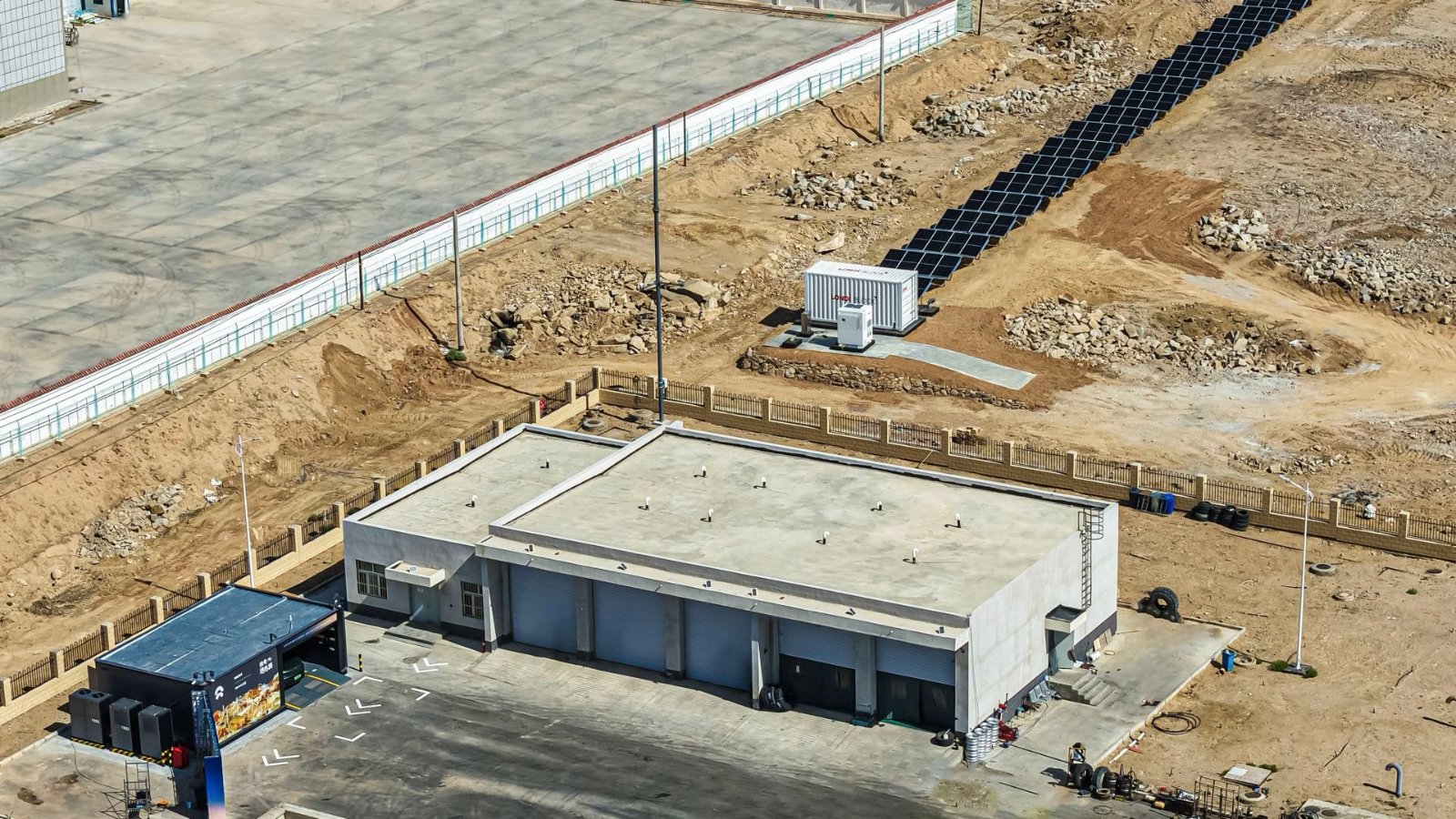
Nio’s first fully solar-powered battery swap station began operations at the Xingxingxia service area in Xinjiang on September 23, 2026, using solar generation and energy storage to operate off-grid. Credit: Nio.
- The battery swap station in Xinjiang uses solar power and energy storage to operate off-grid.
- The station is a key node on Nio’s 3,605-kilometer Silk Road battery swap route, which is scheduled to be fully connected on September 26.
Nio (NYSE: NIO) has built its first battery swap station powered entirely by solar energy in Xinjiang, opening a new path for expanding its energy network into remote areas with limited grid coverage.
The Chinese electric vehicle (EV) maker announced on Wednesday that the station at the Xingxingxia service area in Xinjiang had officially begun operations, calling it the world’s first zero-carbon, off-grid battery swap station powered by solar energy and storage.
Located along the G30 Lianyungang-Horgos Expressway on the route into Xinjiang, the station meets all its electricity needs through solar generation and energy storage, without relying on the power grid, Nio said.
The project marks Nio’s first deployment validating off-grid battery swapping and will provide experience for expansion into similar areas, co-founder and president Qin Lihong said at the opening.
Xingxingxia lies in the Gobi Desert in eastern Xinjiang, where grid coverage is limited. Conventional grid expansion would require power lines across vast stretches of desert, involving lengthy construction and high costs, Nio said.
The area experiences winds of force 8 or higher on more than 100 days a year. Summer ground temperatures can exceed 70 degrees Celsius, while extreme winter temperatures drop to minus 30 degrees, posing challenges for equipment operation.
The station uses Chinese solar giant Longi’s Longi Block mobile energy station and Longi H2D energy storage system, automatically switching operating modes based on sunlight conditions to support 24-hour operation.
During the day, solar generation powers the swap station directly, with surplus electricity stored in the energy storage system. At night, the storage system discharges to keep the station running.
During prolonged cloudy weather, the system automatically enters an emergency mode, reserving electricity for critical loads. Mode switching requires no on-site staff, while liquid-cooling temperature control and other features help the system withstand extreme conditions, Nio said.
The Xingxingxia station is also a key node on Nio’s Silk Road battery swap route. Spanning 3,605 kilometers and featuring 33 swap stations, the route is scheduled to be fully connected on September 26.
Once it opens, users starting from any Nio swap station in China will be able to reach every provincial-level administrative region in the Chinese mainland by swapping batteries along the way, the company said.
The opening builds on Nio’s efforts to integrate solar generation into its energy network. As early as 2021, the company signed an agreement with Unisun Energy to install rooftop solar systems at its second-generation swap stations.
In January 2024, Nio and Longi formed a strategic partnership to promote the use of solar power at charging and battery swap stations.
Their first jointly developed HPBC (Hybrid Passivated Back Contact) solar-powered swap station opened in Xi’an at the time. The Xingxingxia project takes that effort further by operating entirely off-grid.
As of September 23, Nio had 4,109 battery swap stations in China, including 1,060 along highways, as well as 5,301 charging stations.
The milestone comes just 6 months after the 100 million mark was reached on February 6, showing accelerating usage.
