

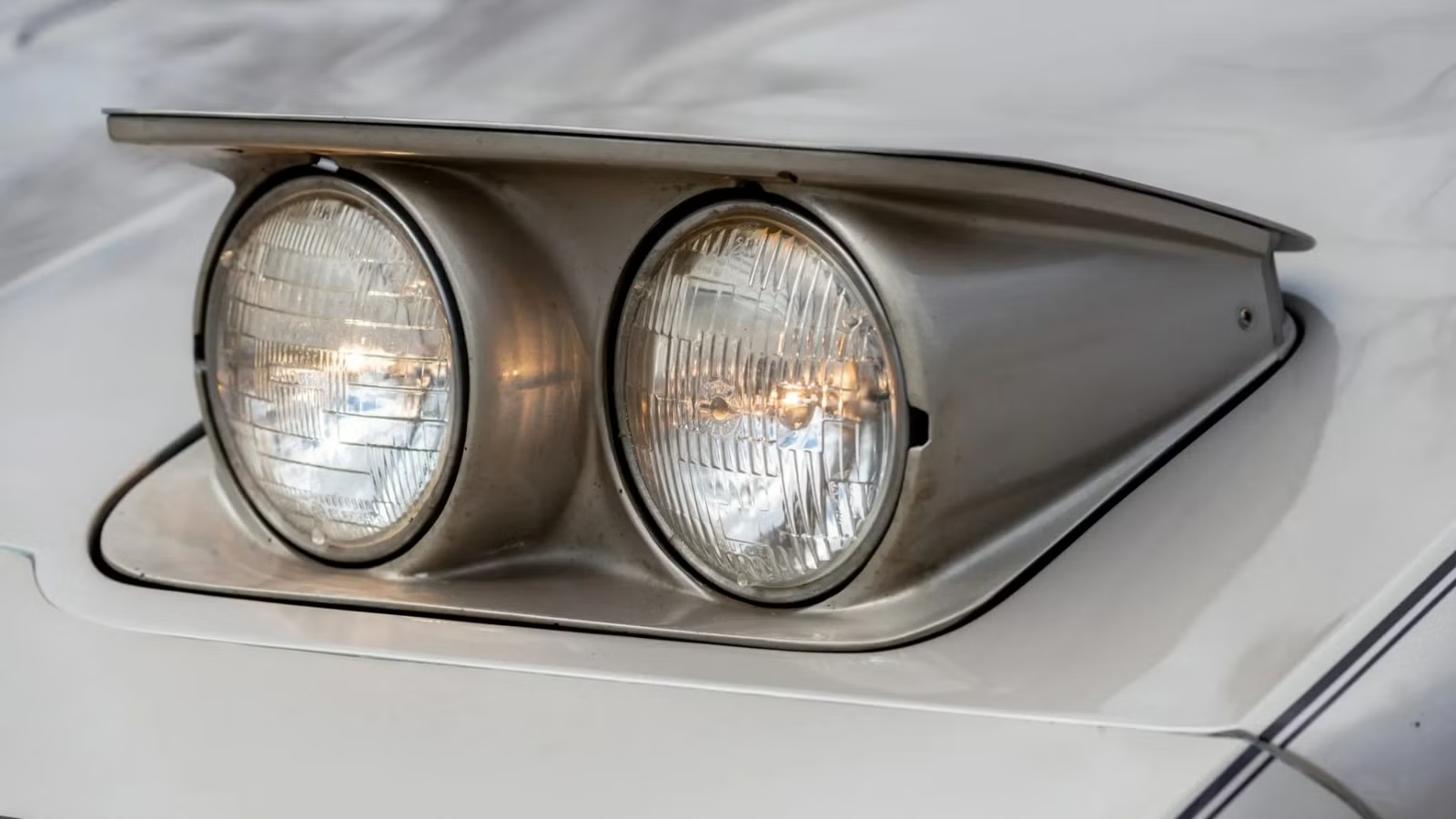
Pop-up headlights have been extinct for more than two decades now, and yet we still mourn their passing from time to time. And although they’re very unlikely to make any sort of comeback for the foreseeable future, Mercedes-Benz might soon give us something in the same vein. It may not be as charming as those traditional pop-up arrangements, but that’s not to say it isn’t cool as heck.
Recently, CarBuzz came across a patent submitted by Mercedes to the US Patent & Trademark Office, and we think it warrants a closer look. It is essentially a fresh take on the old concept of hideaway headlights, implemented extensively on classic American cars from the 1960s and ‘70s. With that, let’s take a closer look at how this modern interpretation works.
Illustrations of Mercedes-Benz’s hideaway headlight patentUS Patent & Trademark Office
The patent drawings illustrate a couple of different versions for the headlight assemblies, but the underlying structure is pretty much the same. Each headlight module comprises an upper and a lower section, with the upper remaining visible at all times. The magic happens down below, where a shutter can be raised to conceal that section of the lens while sitting flush against the bodywork.
Otherwise, the flap is discreetly tucked behind the vehicle’s bodywork. The mechanism makes use of a gear wheel running along toothed guide tracks, curved at the bottom to bring the shutter inward seamlessly when it’s not needed. Two tracks are part of the whole arrangement, one mounted on the headlight’s left side and the other on the right.
As for the illumination hardware itself, the design offers a wealth of possibilities. One example shows dual lighting modules placed side-by-side up top and down below, while the other has a sloped upper section along with a trio of circular illumination units at the bottom. The lower portion can hypothetically store the low and high beams, cornering lights, or adaptive driving lamps. Up top, there’s room for things like daytime running lights, turn signals, and position lights, as well as ADS markers.
How Likely Are We To See This Tech Implemented In The Future?
Illustrations of Mercedes-Benz’s hideaway headlight patentUS Patent & Trademark Office
Technically speaking, pop-up headlights were never banned outright. Changes in regulations for pedestrian safety eliminated anything sharp or protruding on the front of vehicles, and it’s hard to have pop-up lights that don’t protrude. Additionally, in the quest to reduce weight, modern slim headlamps still offer the sleek face buyers like without the added weight and complexity of pop-up units. But hideaway lights aren’t necessarily pop-up, so there is some room to make this work.
Of course, there is a long way between a manufacturer filing a patent and the technology actually making it onto production cars. So, we can’t be sure if some Mercedes models will come with hideaway headlights in the future, and the setup would likely be reserved for certain high-end vehicles if it even becomes a reality at all. With the current cost-cutting trends seen throughout the auto industry, this feature appearing on production models in the near term seems unlikely.
CarBuzz Insight – Why This Matters:
All things considered, it’s nice to see manufacturers experimenting with new ideas, even if some people might say this entire concealed headlight affair is nothing more than a gimmick. And they wouldn’t be entirely wrong, but there’s still something rather appealing about the concept.
Perhaps it stems from our nostalgia for pop-up headlights or those old-school hideaway modules, as it would be pretty interesting to see a similar setup used on modern cars. Let’s not get too far ahead of ourselves, though, because only time will tell if Mercedes-Benz has serious plans to make this a reality.
Patent filings do not guarantee the use of such technology in future vehicles and are often used exclusively as a means of protecting intellectual property. Such a filing cannot be construed as confirmation of production intent.
Source: US Patent & Trademark Office
