

Lotus is one of the most prolific performance brands in the world, mainly due to its efforts to prioritize making a light and extremely balanced handling vehicle above anything else. This shouldn’t come as a surprise when you learn its founder, Colin Chapman, lived by the adage of “simplify, then add lightness.” The result was a range of cars that would usually not be anything special from a pure power standpoint, but could outperform pretty much anything in the bends. Eventually, Lotus couldn’t ignore the straight bits anymore.
Lotus Needed To Revise Its Engine Lineup
Front shot of a yellow 2005 Lotus Elise.Bring A Trailer
The Elise was arguably the most important car in the brand’s history, as failure would likely mean the end of the marque. Lotus thus put all of its cash towards nailing the chassis and keeping the car as light as possible, and borrowing the Rover K-Series as a relatively cheap and easy powerplant to work on. This gamble paid off, and the Elise proved extremely popular around the world thanks to its refreshing and thrilling handling, with the car eventually becoming by far the most successful model ever produced by Lotus in terms of sales.
The thing was, Lotus had accrued a reputation for building unreliable cars before it opted to use the K-Series, and using the Rover powerplant only further emphasized this expectation. The engine was notorious for suffering from head gasket failure, and with good reliability becoming an expectation rather than an advantage through the 2000s, Lotus needed something better. To sort out its issues, it turned to Toyota, with which it had worked during the 1980s on developing the Japanese giant’s MR2 sports car.
It cut a deal to use its 2ZZ-GE inline-four in the more hardcore 111S version of the Elise, before eventually rolling out the powerplant to the rest of the Elise range and its track-focused Exige sibling.
Lotus Felt Toyota’s V6 Would Be Ideal For Its New Sports Car
2016 Toyota Avalon Limited detail shot of the engine bay (2GR-FE engine)Toyota
By the late 2000s, Lotus wanted to unleash a more GT-like model to exist alongside the more specialist Elise and Exige offerings. Called the Evora, the plan was to team a comfortable cabin with the nimble handling the brand was known for. Needing extra power and refinement for this new vehicle, but without the budget to design its own unit, Lotus once again looked to Toyota for help. These discussions proved fruitful, and it eventually secured the use of the brand’s 2GR-FE V6 engine.
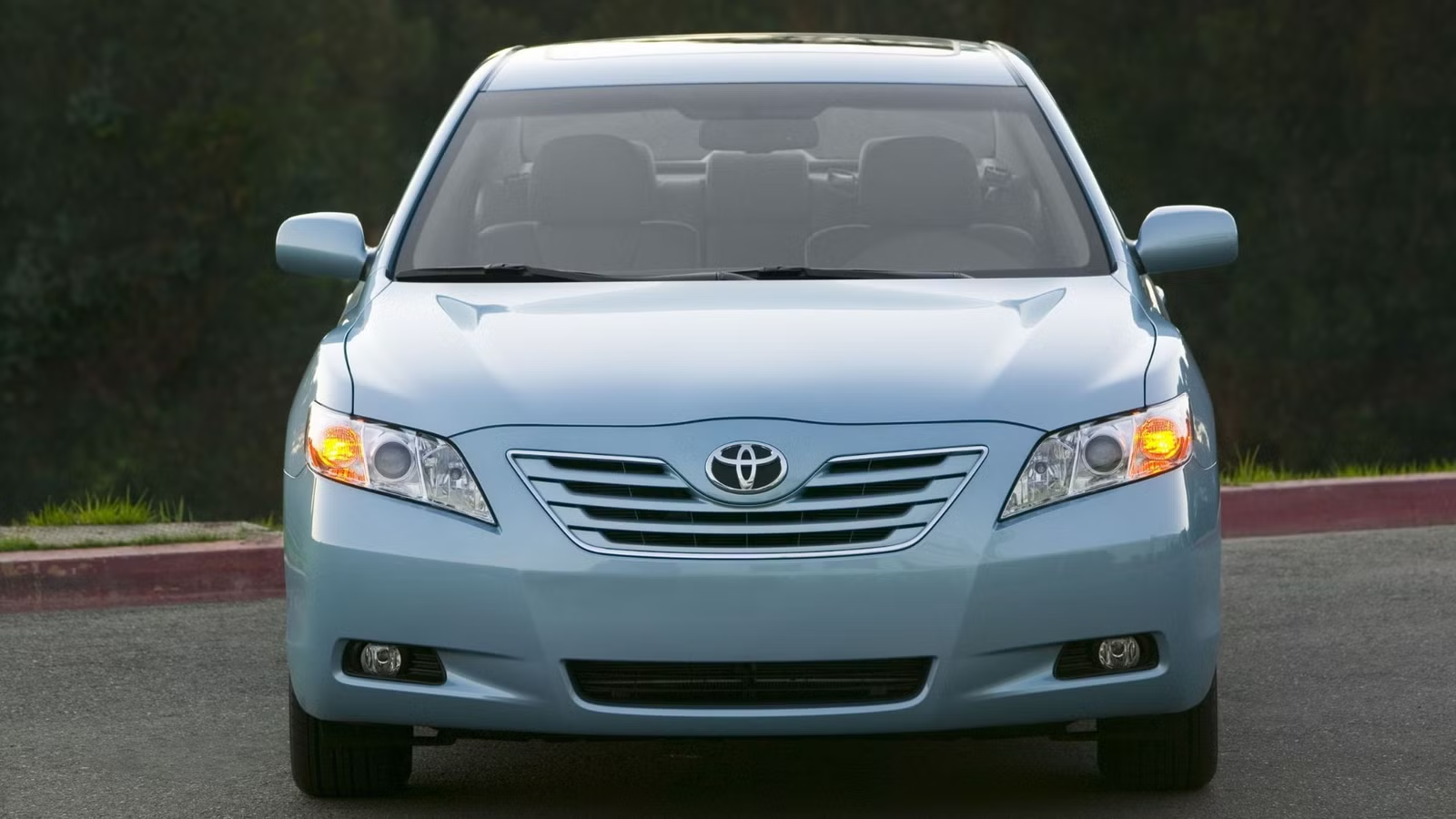
Lotus felt it would be the ideal fit for the Evora for a couple of key reasons, with the main one being how dependable it was. Having made its debut in 2005 powering the likes of the Avalon and RAV4, before soon being applied in the widely-popular Camry sedan, the powerplant was designed to last the distance. Thanks to engineering approaches like using aluminum internals throughout to reduce friction, and thus reduce the amount of heat being produced during operation. The block was also crafted from aluminum, which ensured the engine was light, a crucial ingredient that Lotus prioritized throughout the Evora’s design.
Another plus point of the 2GR-FE was its forged internals, which consisted of an extra-tough crankshaft and connecting rods. Lotus had big plans for the powerplant, so these elements provided the headroom needed for some, well, tweaking. Timing chains were also used to increase longevity, which helped examples reach over 200,000 miles with regular maintenance. It was also equipped with Toyota’s VVT-i adaptive timing system, which helped improve mid-range torque, enhance fuel efficiency, as well as keep emissions as low as possible.
The Engine Provided The Versatility Needed By Lotus
A rear three-quarter shot of a 2010-2014 Lotus Evora S drivingLotus
Aside from the dependability and plug-and-play advantages offered by the 2GR-FE, it also acted as the ideal base for Lotus to inject some of its own character into it. For the standard 2GR-FE found in the base Evora, Lotus changed little of the powerplant overall, leaving the core internals identical to the way it arrived at its Ethel factory. It did introduce a new aluminum exhaust system that was lighter and improved airflow out of the engine, while also affording the vehicle a more unique engine note.
Lotus also brought along its own ECU, so that it could develop a specific power map to better match the Evora’s performance philosophy. A couple of years after the Evora was released, in 2011, Lotus undertook a larger revision of the 2GR-FE for an upgraded version of its flagship, which would be named the Evora S. The S in its name was the biggest clue towards Lotus’ intentions, as it stood for Supercharger. Yep, Lotus strapped a Harrop-built supercharger to the V6, which provided an extra 3.5 psi of boost.
To ensure the engine could take the extra punishment, Lotus treated it to a range of upgrades. A new cooling system was employed to ensure its temperature remained firmly under control, while the fuel system was also tweaked with new high-flow injectors to allow the engine to deal with extra air flow. A new ECU was also developed to make sure the engine still provided a smooth torque curve, which was crucial in keeping the Evora as accessible as possible.
Toyota’s Trusty V6 Ensured Lotus’ Creations Had Enough Grunt To Compete
2015-2018 Lotus 3-Eleven 3.5L Supercharged 2GR-FE Toyota V6 EngineLotus
Lotus’ changes proved effective when the engine was deployed in its vehicles, with the normal NA version of the unit kicking out 276 horsepower in the back of the Evora. This allowed the car to reach 60 mph in an impressive 4.9 seconds, a sprint partially helped by its lightweight 3,049-pound frame. Unsurprisingly, the supercharged Evora S was vastly quicker, with Lotus’ alteration seeing the V6’s peak power figure boosted from 276 hp to 345 hp. Torque was significantly improved, too, with the standard 258 lb-ft of pulling power flying up to 295 lb-ft.
Thanks to the extra framework only adding around 100 pounds to the overall weight of the vehicle, the enhanced Evora was able to reach 60 mph in less than 4.5 seconds. It achieved even more in the middle of the Series 3 Exige, which was unleashed in 2012. Having used the same inline-four engines as its Elise sibling in its earlier incarnations, Lotus moved it up the pecking order for the third evolution. Like the Evora, the standard car used the NA version of the 2GR-FE, while the S got the supercharged unit.
While it pumped out the same power figures in the Exige, the car’s lower weight figure ensured it was even quicker than its more compliant sibling. The S, which was around 600 pounds lighter than the Evora S, could hit 60 mph in a blazing 3.8 seconds. And all the while being practically bulletproof.
Lotus And Toyota Have Enjoyed A Long-Standing Partnership
Lotus Emira 420 SportLotus
Nearly 20 years on from Lotus’ decision to start sourcing engines from Toyota, it’s hard to argue with the effectiveness of the collaboration. Lotus has been able to save a ton of money by using Toyota’s excellent range of four and six-cylinder powerplants, which have provided the grunt and dependability needed to ensure Lotus could shake off a good chunk of its reputation for building unreliable cars, which could well have threatened to bring the company to its knees in the modern automotive world.
Plus, it’s not as if Toyota hasn’t got anything out of the arrangement. Aside from receiving a handy paycheck from Lotus for the engine supply, it has also been able to leverage the decades of experience Lotus has in designing and building lightweight cars that can outhandle a wasp. Lotus has worked with Toyota’s Gazoo Racing department on various projects over the years, with a good example being the Yaris GRMN. The knowledge gained from Lotus has likely played a hand in nailing the handling of its performance models, which have been praised for their road-going prowess in recent years.
While successful though, it seems the relationship between the two great manufacturers is set to be concluded. Having featured the supercharged 2GR-FE since its release in 2022, Lotus’ current Emira sports car is set to replace the aging unit with a new hybrid V6 powertrain developed by owners Geely from 2027. With the Elise and Exige now long gone, that means Lotus’ days of using Toyota-sourced engines for its creations are done.
Still, the partnership will always remain a crucial one, and the impact of which cannot be overstated. Thanks to Toyota’s advanced engine technology, Lotus was able to still cut the mustard in the 21st century, as opposed to being left in the past like many of its fellow British sports car manufacturers.
Sources: Lotus, Toyota.
