

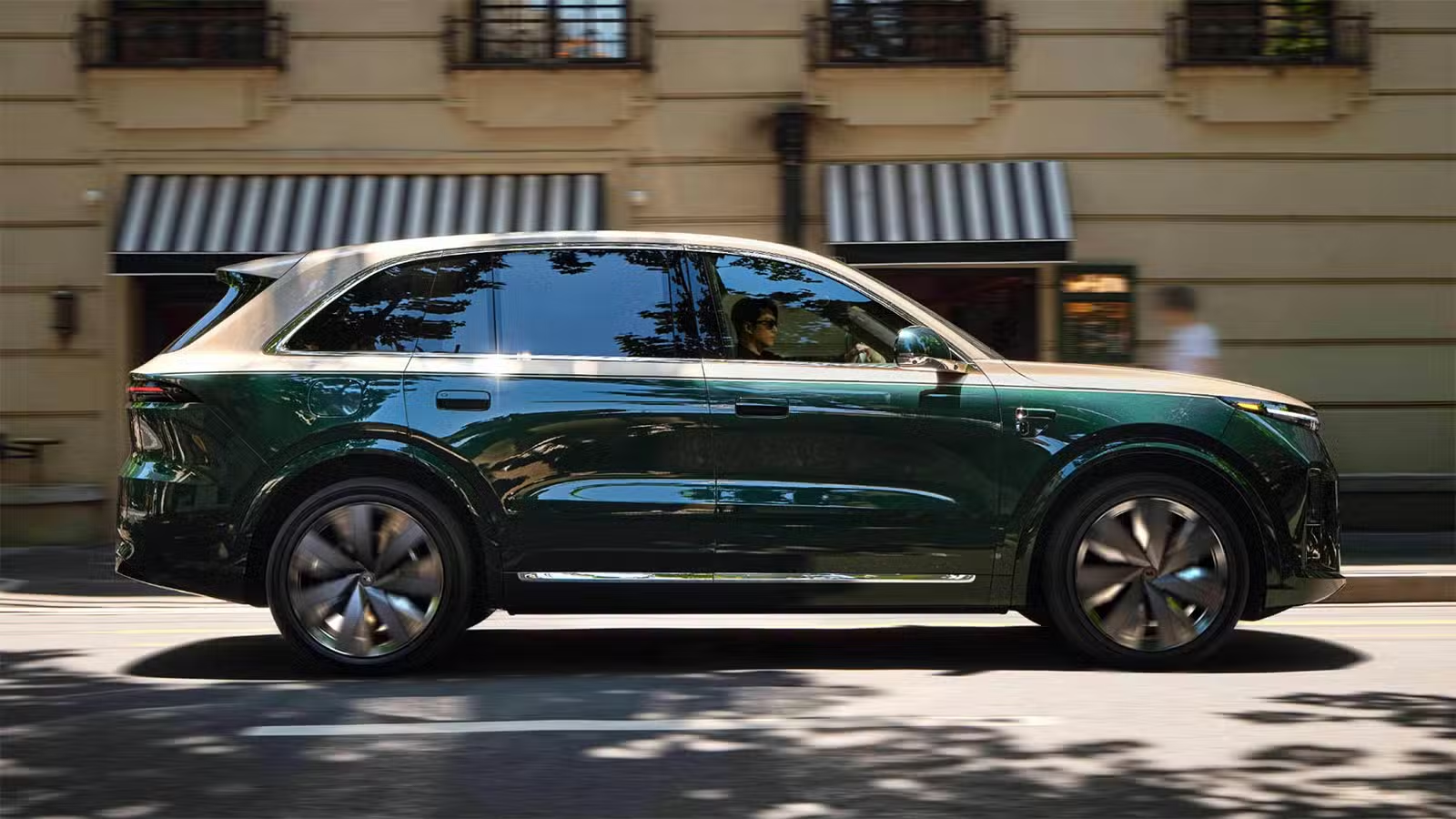
Updated Li L8. Credit: Li Auto
- The new Li L8 drops the six-seat design in favor of a five-seat layout, offering a CLTC battery-only range of 430 km.
- The Livis variant carries two Mach M100 chips with a combined computing power of 2,560 TOPS.
Li Auto (NASDAQ: LI) will officially launch the new Li L8 extended-range SUV (sport utility vehicle) on June 23, positioning it as a “no-compromise five-seat flagship SUV” with specifications benchmarked against 9-series flagships in China.
Display vehicles of the updated Li L8 will arrive in stores on June 13 for consumers to experience ahead of the launch, according to product information the company released on Friday.
The new Li L8 marks a major repositioning of the model. It abandons the current version’s six-seat design in favor of a five-seat layout, avoiding internal cannibalization with the larger Li L9 flagship, which also features a six-seat configuration.
The new model gets upgraded dimensions, measuring 5,135 mm in length, 2,000 mm in width, and 1,800 mm in height, paired with 285-mm wide tires.
For comparison, the current Li L8 measures 5,080 mm long, 1,995 mm wide, and 1,800 mm tall, with its three variants starting at 321,800 yuan ($47,500), 349,800 yuan, and 379,800 yuan, respectively.
The new Li L8 will be available in two variants — Ultra and Livis — both equipped with the third-generation 5C extended-range system, including Li Auto’s in-house developed third-generation range extender.
The model carries a 72.7-kWh fast-charging battery, offering a CLTC battery-only range of 430 km and a combined range of 1,670 km.
The Ultra variant features dual-chamber air springs, steer-by-wire, and rear-wheel steering, with a turning radius of 5.1 meters.
The Livis variant upgrades to an 800-volt active suspension and electro-mechanical braking (EMB) with a response time of less than 100 milliseconds.
For assisted driving, the Ultra variant is powered by one of Li Auto’s in-house developed Mach M100 chips with a computing power of 1,280 TOPS.
The Livis variant carries two M100 chips with a combined computing power of 2,560 TOPS. It adds three solid-state variable-focus LiDARs on top of the Hesai ATL-P LiDAR, and comes with an embodied intelligence package.
The assisted driving software is free for life on both variants, in line with the strategy for Li Auto’s other models.
The new model’s launch comes as demand for the current version has been significantly suppressed. With consumers largely holding off on purchases while waiting for the new model, deliveries of the Li L8 shrank sharply to 421 units in May, plunging 92.07% year-on-year.
Li L8 Monthly Deliveries 2024-2026
Month
2024
2025
2026
January
9,061
4,325
1,173
February
5,457
3,340
1,046
March
6,392
5,275
1,622
April
5,035
5,178
1,457
May
5,322
5,312
421
June
5,754
4,338
July
6,592
3,088
August
5,476
2,639
September
7,109
2,436
October
6,471
2,183
November
6,383
2,130
December
8,571
3,010
Li L8 monthly deliveries
2024
2025
2026
Li Auto as a whole is also facing pressure on both sales and finances. The company delivered 33,350 vehicles in May, down 18.37% year-on-year.
In the first quarter of this year, it unexpectedly recorded a net loss of RMB 2.3 billion yuan, with its gross margin plummeting to 7.9% from 20.5% in the same period last year.
However, the initial market response to the revamped models appears positive. The new Li L9, launched on May 15, saw its high-end Livis variant secure more than 10,000 firm orders within just two weeks of going on sale, according to Li Auto.
Ahead of the new Li L8’s launch, Li Auto will also hold a software and AI event called Livis Day on June 15, showcasing its latest capabilities in areas including in-vehicle interaction, foundation models, assisted driving, and in-house developed chips.
With the new Li L8 and Li L9 hitting the market, Li Auto is betting that these higher-margin extended-range models can revive its overall sales performance and improve its strained profitability.
Li Auto will detail what embodied intelligence is and its roadmap in the software and AI fields.
($1 = 6.7753 yuan)
