

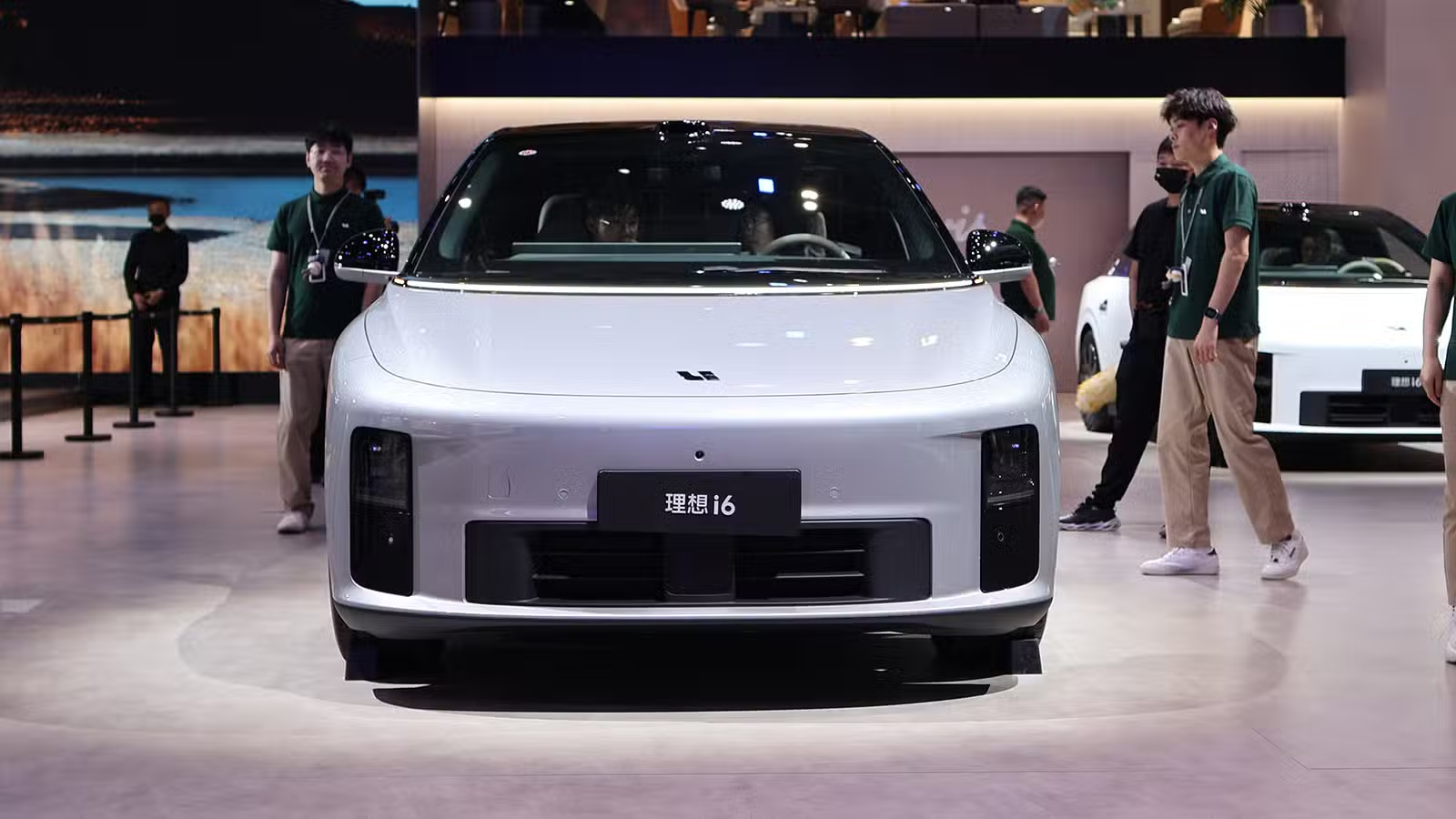
A Li i6 on display at the Beijing Auto Show in April 2026. Credit: CnEVPost
- Li Xiang said at a small-scale shareholder meeting that gross margin is all the money and ammunition the company can spend.
- Li Auto’s Hong Kong-traded shares have fallen to a nearly five-year low, while its US-traded ADRs have hit their lowest level since November 2022.
Li Auto (NASDAQ: LI) founder, chairman and CEO Li Xiang said the company’s core goal remains maintaining a healthy gross margin to face fierce market competition.
“Gross margin is all the money and ammunition we can spend,” Li said at a small-scale shareholder meeting of fewer than 20 people held on May 29, according to a report by 21jingji on Friday, June 12.
The remarks came as the Chinese electric vehicle maker’s profitability deteriorated sharply. In the first quarter of 2026, Li Auto unexpectedly posted a net loss of 2.3 billion yuan ($340 million), with its gross margin plunging to 7.9% from 20.5% in the same period last year.
Li said the company has little room to adjust per-vehicle profit on a temporary basis, as a vehicle’s bill of materials (BOM) cost is largely determined at the start of a project. If a model is an extension of an existing line, it is also difficult to make major price changes.
He said the two most important tasks this year are completing the full transition of the L series extended-range electric vehicle (EREV) lineup, including the upcoming updated Li L8, Li L7 and Li L6, and stabilizing the i series at 30,000 monthly sales after the launch of the Li i9.
“This way, when facing fierce competition, we can ensure a relatively healthy scale and gross margin,” Li said.
On the industry’s competitive landscape, Li said the competition will not end anytime soon. “I don’t think L3 (autonomous driving) will end the competition. It will take L4. Only after L4 will the auto industry consolidate into five or six companies globally, like today’s smartphone industry.”
He expects that during the competition, mid- to high-end brands will no longer engage in malicious price wars, “because everyone may come to realize one thing — no one can kill anyone.”
When pressed pointedly by a shareholder about his weaknesses, Li paused for a long while before admitting: “Fine-grained operations is what I’m not good at. Once a company grows in scale, the operational challenges become enormous.”
In response to shareholder suggestions that Li Auto should cater to users and offer products with a stronger sense of luxury and design, Li said he rejects a patchwork product strategy.
“I can’t pair a BMW exterior with a Mercedes-Benz interior. We still hope to become a company like Apple,” he said.
Li also revealed that the company’s in-house developed Mach M100 smart driving chip is currently for in-house use only, and external supply is not under consideration for now due to limited capacity at TSMC.
However, the next-generation chip will incorporate the computing power needed for home computing centers, vehicles and robots from the design stage.
Behind the shareholders’ barrage of questions is Li Auto’s sharply fluctuating stock price.
On June 11, the company’s Hong Kong-traded shares closed at HK$53.15, a nearly five-year low. Its US-traded ADRs have also fallen to their lowest level since November 2022.
To shore up its stock price, Li Auto has conducted 12 buybacks so far this year, repurchasing a total of 16.3 million shares for HK$936 million.
The company delivered 33,350 vehicles in May, down 18.37% year-on-year. It expects second-quarter deliveries of between 95,000 and 100,000 vehicles, trailing the guidance of Nio Inc (NYSE: NIO) and Xpeng (NYSE: XPEV).
Deliveries of the all-electric SUV Li i6 reached 20,878 units in May, contributing 62.60% of the total.
($1 = 6.7753 yuan)
