

Automotive
Hyundai is preparing to turn its N performance brand into a much larger part of its global business, and for driving enthusiasts, that may be one of the most interesting pieces of the company’s newly announced 2030 strategy. During its 2026 CEO Investor Day in Seoul, Hyundai confirmed plans to grow N to 100,000 annual sales by 2030 while introducing a new volume-oriented high-performance tier. That new category is expected to sit between today’s N Line models and the full-fledged N cars, effectively giving buyers another step on the performance ladder without forcing them all the way into the price, suspension tuning, and track-focused character of something like an Elantra N or IONIQ 5 N.
That fills a fairly obvious hole in Hyundai’s current lineup. N Line models have proven popular because they give mainstream vehicles a sportier appearance and, in some cases, mild performance upgrades, but they stop well short of the transformation delivered by a true N model. Hyundai sold roughly 161,000 N Line vehicles globally in 2025 compared with about 20,000 full N models, so the company already has evidence that there is a much larger audience interested in performance-flavored Hyundais than the hardcore N sales numbers alone suggest. A new middle tier could tap into buyers who want more power, sharper chassis tuning, better brakes, and a more aggressive personality while retaining the comfort and everyday usability that keeps a car easy to live with.
The strategy is similar to what has worked extremely well elsewhere in the industry. BMW has spent years creating a clear progression from conventional models to M Performance cars and finally to full M products, while Honda offers buyers increasingly serious versions of the Civic through its Sport, Si, and Type R hierarchy. Hyundai now has enough credibility in the performance world to pull off something similar. The important difference is that Hyundai can do it across several powertrain types, from turbocharged internal-combustion engines to high-output EVs, giving N a broader canvas than it had when the division was still proving itself.
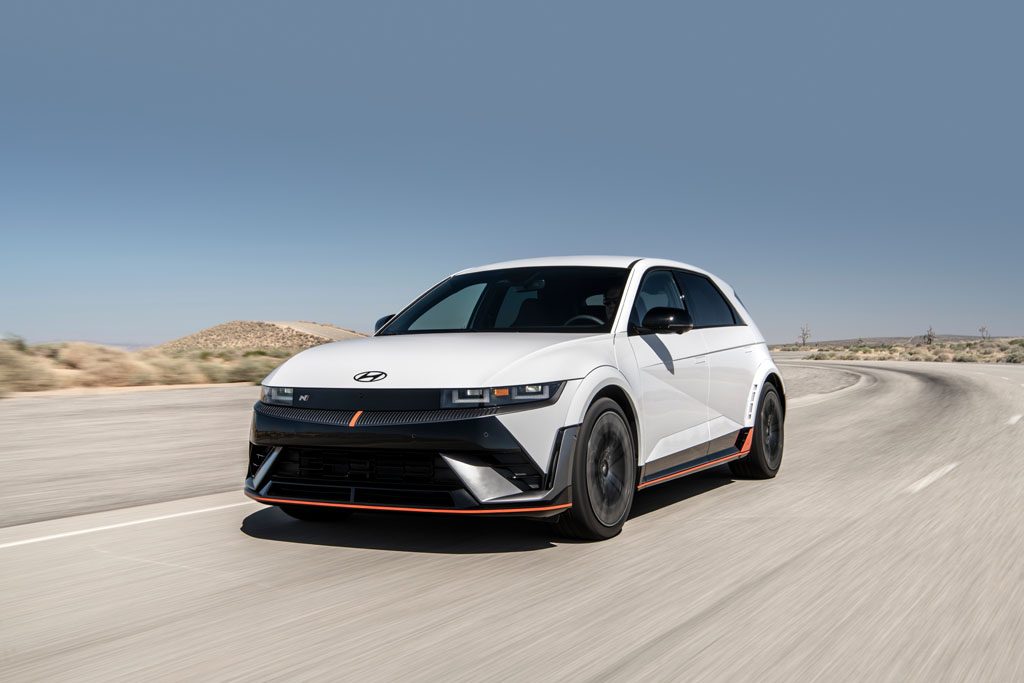
The existing N cars have certainly done the difficult part already. The Elantra N remains one of the most entertaining affordable front-wheel-drive performance cars on the market, while the IONIQ 5 N showed that an electric vehicle does not have to feel sterile or disconnected. Its clever simulated shifting, aggressive power delivery, drift capability, and track-focused thermal management gave Hyundai a distinctly different answer to the high-performance EV question. The upcoming IONIQ 6 N takes that philosophy even further, joining a global N family that also includes models such as the i20 N and i30 N in markets outside the United States.
What makes the expansion especially interesting is the possibility that creating a middle performance tier could allow the full N cars to become even more extreme. If Hyundai no longer needs every N model to serve buyers who simply want a faster daily driver, the flagship cars could move further toward specialized chassis tuning, stronger brakes, lighter components, more aggressive aerodynamics, and track-oriented software. In other words, broadening the bottom and middle of the performance lineup could give engineers more freedom at the top. That would be welcome news for enthusiasts who already view N as one of the few performance divisions still willing to prioritize driver involvement.
There should also be far more opportunities for N products as Hyundai rolls out one of the largest product offensives in its history. The company plans to launch or refresh more than 100 vehicles globally by 2030, including dozens of products in North America and more than 18 entries into segments where Hyundai is currently underrepresented. All-new versions of the Elantra and Tucson are among the products on the near-term schedule, and both would be natural candidates for expanded N Line, intermediate performance, or full N treatment. Hyundai has not yet said which vehicles will receive the new performance tier, but the sheer number of products coming gives the company plenty of room to experiment with sedans, crossovers, hatchbacks, and electrified models.
The bigger picture is that Hyundai appears ready to treat N as more than a small halo operation. A target of 100,000 annual sales represents a dramatic jump from where the division stands today, and reaching that number will require more models, more price points, and more accessible performance. If Hyundai manages to preserve the playful character that made cars such as the Elantra N and IONIQ 5 N so memorable while expanding that formula into more affordable and usable packages, the result could be one of the most diverse performance lineups in the industry by the end of the decade.
Mike Floyd is a finance executive by trade and a car enthusiast at heart. As a CFO with a keen eye for detail and strategy, Mike brings his analytical mindset to the automotive world, uncovering fresh insights and unique perspectives that go beyond the surface. His passion for cars—especially his favorite, the Porsche 911, fuels his contributions to Automotive Addicts, where he blends a love for performance and design with his professional precision. Whether he’s breaking down industry trends or spotlighting emerging innovations, Mike helps keep the site both sharp and forward-thinking.
