

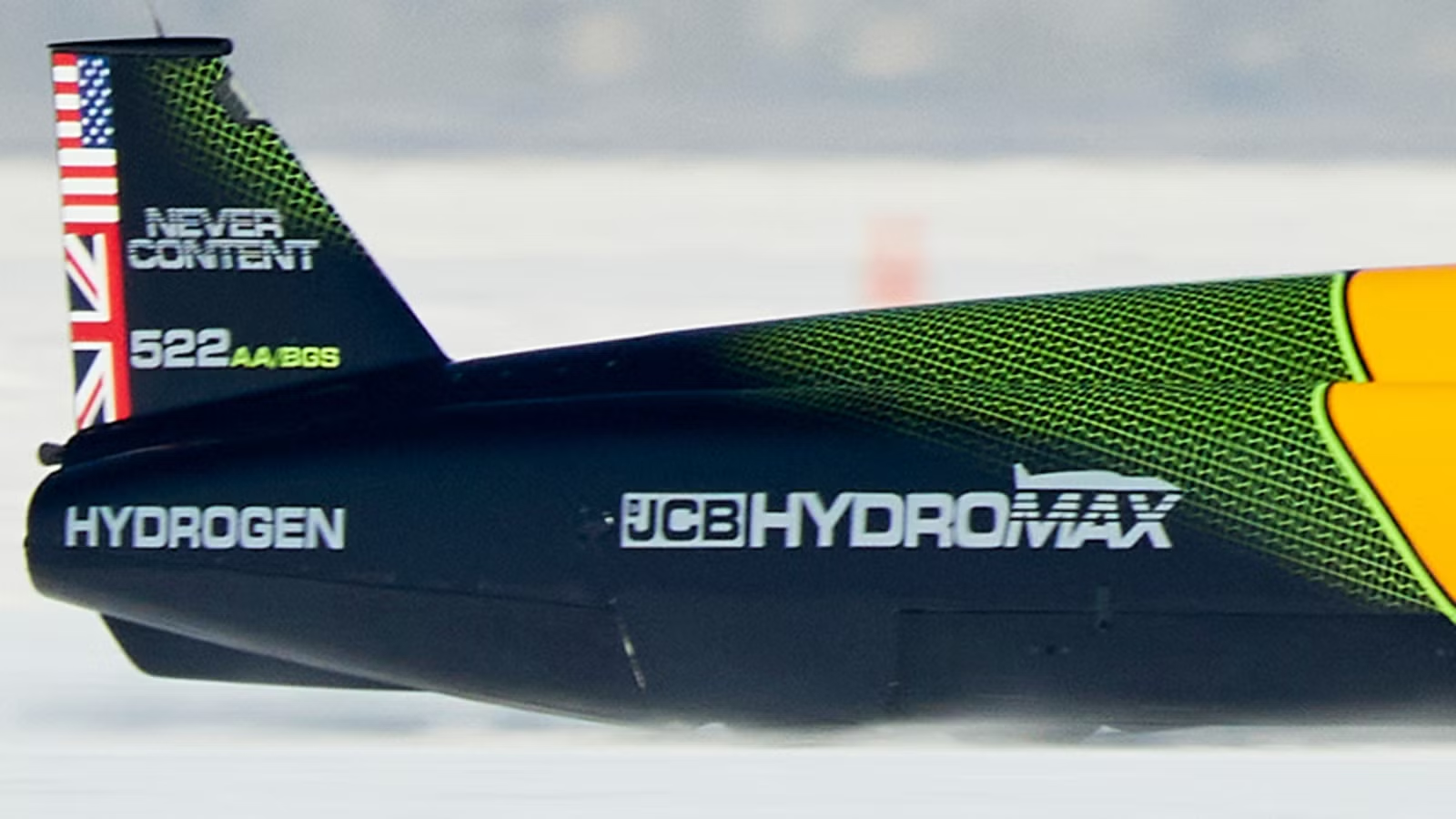
Since the invention of the automobile, there has been an effort to make them go faster. Currently, the absolute land speed record belongs to the jet-powered ThrustSSC that achieved 763.035 miles per hour in 1997 with driver Andy Green at the wheel. While that overall title looks safe at the moment, JCB, the British heavy-equipment company, has created a purpose-built hydrogen-combustion machine for chasing records in its class.
And it’s not just chasing records. The company is setting them.
JCB Hydromax Sets A Record, Then Sets Another One
JCB Hydromax Bonneville recordJCB
On August 7, the JCB Hydromax set a new speed record of 368.347 miles per hour at the Bonneville Salt Flats. The Southern California Timing Association certified the achievement and put the car in the Blown Gas Streamliner (AA/BGS, 500+ cubic inches) class. Andy Green was once again behind the wheel. The rules required the car to take two runs on consecutive days, with the maximum velocity determined by the average of the speeds.
The Hydromax hit 367.141 mph for its first run and 369.554 mph on the second attempt. The effort was enough to beat the existing record of 348.342 mph set by the Spectre Streamliner in 2010. But that wasn’t the end of the record-setting speed.
How Much Faster Can The JCB Hyrdomax Go?
JCB Hydromax Bonneville recordJCB
On August 11, the hydrogen-powered Hydromax went back out on the salt flats for another run. This time, the first run across Bonneville resulted in an average speed of 400.623 mph – well above the previous run. The second run was even faster at 412.135 mph, giving the Hydromax an average speed of 406.320. It’s officially the fastest hydrogen-powered internal combustion car in the world.
Andy Green was once again behind the wheel for the new run. After the previous record, Green said there was “huge confidence in the car, the team and the quality of the engineering.” He explained that the team was “turning up the power on the engines” for a faster run, and that’s exactly how it all went down.
“Bonneville is the spiritual home of the world land speed record, and JCB Hydromax has just written itself into that history. The car was terrific — stable, strong and fast. Setting a world land speed record with hydrogen power, twenty years after Dieselmax, is a huge privilege. This record is a huge achievement by a world class team and superb technology.”
Here’s How The Record Was Set
JCB Hydromax Bonneville recordJCB
The new land-speed record holder uses two of JCB’s hydrogen-fueled, turbocharged internal combustion engines. They have a combined total output of 1,600 horsepower and are packed into a streamlined body with a tall stabilizer fin on the back. The powerplant hooks up to a twin-transmission and clutch system that routes the output to all four wheels. The legendary rally car builder Prodrive assisted with assembling the Hydromax.
Creating a high-performance hydrogen-fueled combustion engine comes with special requirements. For example, the pistons require a liter of cooling oil every second to keep them from overheating. The turbochargers use titanium compressors and spin at more than 150,000 rpm.
JCB Hydromax Bonneville record with driver Andy Green.JCB
Preparing for a land speed record requires lots of testing. The Hydromax has completed 44 runs to date, making sure it’s the fastest hydrogen-fueled machine ever on Earth. One of them included taking the machine to 177 mph at the Royal Air Force Wittering base in Cambridgeshire, England.
JCB specializes in building construction equipment, such as excavators and forklifts. However, the company also enjoys making world speed record attempts with specially engineered vehicles. In 2006, its Dieselmax became the world’s fastest diesel-fueled vehicle that reached 350.092 mph on the Bonneville Salt Flats. The company also built the Fastrac, the world’s fastest tractor at 135.191 mph. Plus, the JCB GT became the world’s fastest backhoe loader at 72.58 mph in 2014.
JCB Hydromax Bonneville recordJCB
CarBuzz Insights — Why This Matters:
For all the controversy surrounding hydrogen as an alternative to traditional combustion fuels, efforts like this show it can be a viable alternative to pumping oil out of the ground. Judging by the experiments from Toyota and JCB, a hydrogen-combustion engine could be a simpler alternative instead of making the full switch to more-complex hydrogen fuel cells in models like the Toyota Mirai.
