

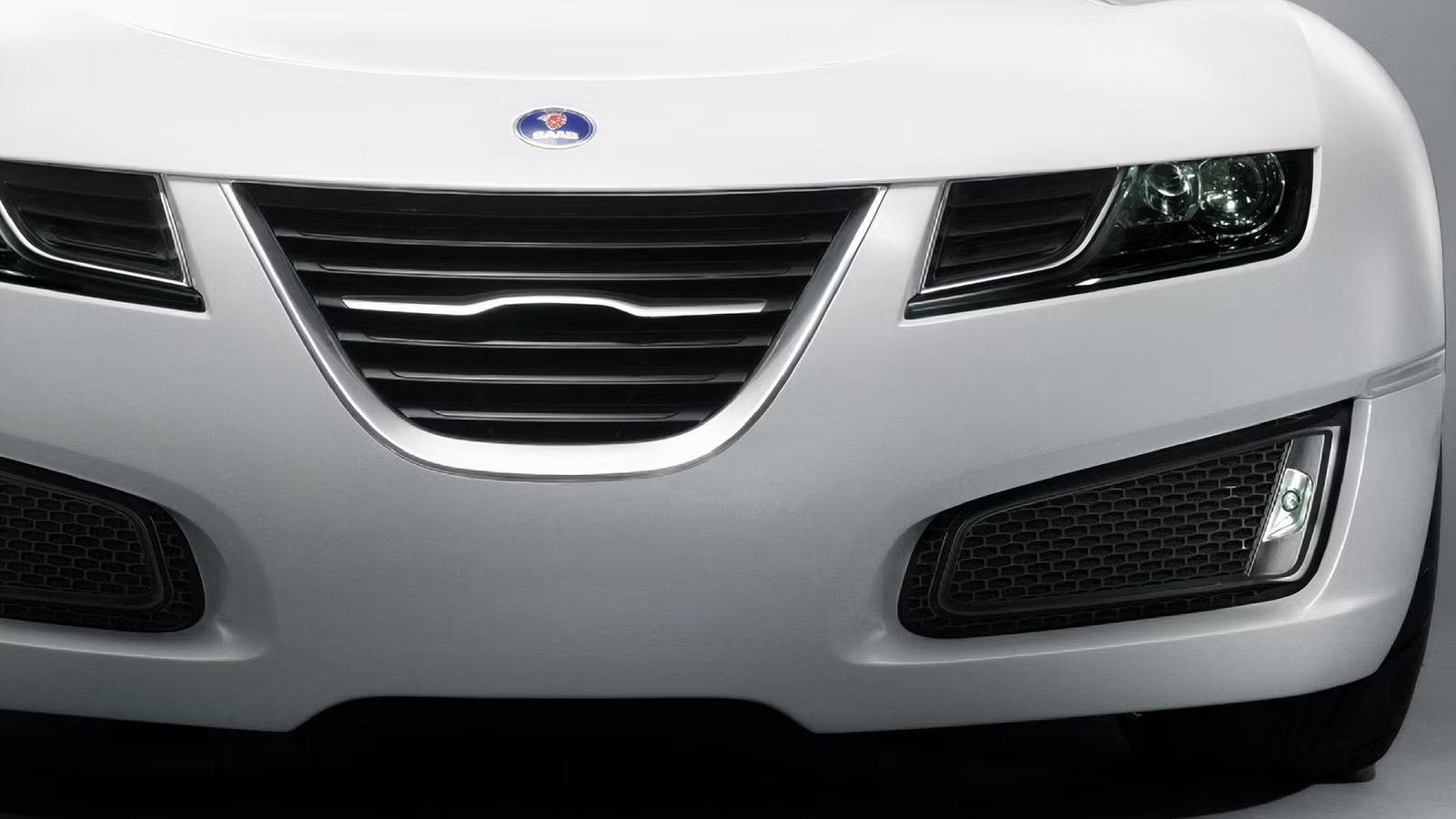
While many brands would love to build the most overengineered and exquisitely specced cars in the world to sell off, doing so can be very hard on their bank accounts. Development costs to even design a cheap runaround are huge, let alone a model with advanced and robust engineering that is made to last for decades.
Base Trim Engine
2.0L Turbo Inline-4 Gas
Base Trim Transmission
6-Speed Manual
Base Trim Drivetrain
Front-Wheel Drive
Base Trim Horsepower
220 hp
Base Trim Torque
258 lb-ft @ 2500 rpm
Fuel Economy
20/33 MPG
Segment
Compact Luxury Sedan
Find 2012 Saab 9-5 Sedan and more cars for sale on our Marketplace
Shop Now
The same goes for having a plush cabin, as the necessary materials cost a fortune to source, which means brands have to charge more when it comes time to sell. Unless a manufacturer is called Ferrari or Rolls-Royce, many buyers won’t even give it a second glance.
The same kind of issue afflicted Swedish marque Saab, which struggled to contain its ambition to build amazing vehicles that would last the test of time and keep its occupants safe. Ultimately, this approach ended up killing the company.
Saab Moved Into The Automobile Business After World War II
1950 Saab 92 Exterior next to plane Saab Planet
The story of Saab Automotive begins in 1945, shortly after the conclusion of the Second World War. Its parent company, Saab AB, focused on aerospace and defense solutions for its home nation of Sweden. It primarily built fighter aircraft for use during WW II, though it needed to diversify its portfolio as wartime eventually came to an end. Feeling automotive was the way to go, it designed its first car, the 92, during the late 1940s and put it into production in 1949. Saab vehicles became well-known for their aeronautical designs, which usually showed themselves as curvy and sleek silhouettes.
Saab Always Strived For Perfection
Red Saab 99 Turbo rear on roadBring a Trailer
Having prioritized finding its feet in the car sector early on, it started to make a push to stand out across the world during the 1960s. Its 99 model was designed to lift the brand to a higher end of the market, and Saab put a heightened focus on safety. The vehicle featured revolutionary crumple zones to help dissipate energy in the event of a crash to help keep its occupants safe, as well as side impact door beams. Beyond this, it featured industry firsts such as headlight washers and self-repairing bumpers.
Later, it became the first brand to properly harness turbocharging technology with the 99 Turbo, the model ending up being successful from a sales standpoint. The same could be said for its successor, the 900, of which the marque managed to sell over a million. By this stage, Saab had entered into a shared ownership arrangement with truck manufacturer Scania, though things had got tough by the 1980s. While Saab’s sales were decent, it was spending so much money during the development phase that it was struggling to turn a profit.
Discussion
Which car manufacturers have the best build quality?
Judging quality for new cars is tough, but according to J.D. Power, these are the best brands for initial quality in 2024: Ram, Chevrolet, Hyundai, Kia, Buick, Nissan, Porsche, and Lexus.
General Motors Swept In To Save The Day
SaabSaab
By the time the early 1990s rolled around, Saab had failed to turn a profit for over half a decade, primarily as it was determined to build cars that were brilliant, rather than ones that would make money. Seeing potential in the popular marque, American automotive giant General Motors entered into a 50% ownership deal in 1989, which led to the debut of a new 900 in 1994. The company managed to turn a profit in 1995, a feat mainly due to the fact that Saab was able to use GM’s Opel Vectra platform as a base for the new 900, saving a considerable amount of development cash.
Related
This Underrated Swedish Sports Sedan Will Get Your Pulse Racing
In the market for a classic sports sedan? This Swedish weapon will turn heads as well as it does corners, and at a bargain price to boot.
The Likes Of The 9-5 Helped Boost Saab’s US Presence
1999-2000 Saab 9-5 Sedan Rear Angle ViewSaab
The larger 9-5 model followed in 1997, which again utilized the foundations from the Vectra. Thanks to GM’s influence, Saab’s US sales increased handily as a result of the introduction of these more modern vehicles, which helped improve the manufacturer’s bottom line. There was still work to do to get Saab towards the same level as the likes of BMW and Mercedes-Benz, but the signs for success looked to be there.
Saab’s Overengineering Ways Proved Difficult To Eradicate
2003-2007 Saab 9-3 Sedan Silver Front Angled ViewSaab
While Saab’s losses had been limited by utilizing GM’s vehicle platforms, as well as streamlining its production facilities, the issue of overengineering was still prevalent. One example of this was its Active Head Restraint technology, which helped prevent whiplash in the event of a crash. Having observed an early form of the tech at GM’s Detroit facility, Saab engineers took the idea back to Sweden and developed it for themselves, with it being included in the likes of the 9-5. GM didn’t bother to continue with the solution, but Saab didn’t care about the financial implications in pursuit of building safer vehicles. The trouble is, it couldn’t ask for more money than the competition, meaning its bottom line was negatively affected.
Why Saab Failed
- Focused too much on developing advanced technology, but without the sales and profits to back up development costs
- This resulted in overengineered vehicles that people liked, but not enough to become a sales phenomenon and swallow the extensive development costs
- Examples include changing 65% of the 9-3’s components from its Vectra base car, which was hard on the company’s bottom line
Another great example of this approach was the 9-3, which launched in 1998. Having been told to base it heavily on the Vectra, Saab instead felt it could improve upon much of the model. The 9-3 ended up only sharing 35% of its parts with the Vectra, with the manufacturer choosing to develop a bespoke air conditioning system and rear suspension setup, among other things, at great expense. It went down this road as it felt Opel’s components were insufficient. While this approach ended up with better cars being developed, GM was left thoroughly dissatisfied with the lack of cash being thrown its way. It had taken over the brand completely in 2000, and was determined to get some proper reward from its investment.
Related
Never Forget Saab’s Fighter Jet-Inspired Hot Hatch
One of the most powerful cars Saab ever made deserves your attention.
GM Tried To Limit Saab’s Playbox
Front view of the 2005 Saab 9-2XSaab
Desperately trying to prevent Saab’s consistent overspending, GM went down the direction of pure badge engineering as it looked to further increase the brand’s footprint in the US. Models like the 9-2X and 9-7X were introduced especially for the American market, with the former being a rebadged Subaru Impreza wagon and the latter a Chevrolet Trailblazer. Unfortunately, consumers could see straight through them, and they flopped. With Saab’s other models failing to cut the mustard when it came to pure profits, GM was running out of options as Saab failed to make a big enough impact to justify its running costs.
The 2008 Financial Crash Proved The Final Nail In Saab’s Coffin
2011 Saab 9-4xSaab
With Saab already not being the flavor of the month within GM due to its lack of profitability, its chances of future growth were further thrown into the air when the 2008 financial crash hit. Automakers were hit particularly hard by the crash, GM included. Needing to free up funds quickly, and wanting a hefty loan from the US government, GM decided to cull some of its brands, and only keep its most profitable ones.
Long-standing marque Pontiac was one of those cast off, as was Hummer. Saab fans were left crushed when it was also put on the chopping block, though there looked to be some hope as Swedish supercar manufacturer Koenigsegg was interested in acquiring it. This deal never happened, though Chinese automaker SAIC did take it on. The brand was ultimately shuttered anyway though, closing the book on the characterful and bold marque.
Related
The Swedish SUV Built On The Bones Of A Chevy Trailblazer
When a svelte Swede marry a beefy American, the result can be quite intriguing, as can be seen with the curious case of the Saab 9-7X.
Saab’s approach to building the types of cars it wanted to make was admirable, if not irresponsible, given it simply lacked the finances to bolster such an approach. At least used buyers can still enjoy Saab’s handiwork, and at a great price due to the models not holding their value particularly well. Its methods may not have been appreciated by its owners, but they certainly were by the loyal drivers who swore by their cars.
Sources: Saab.
