

There’s nothing wrong with having a reliable, daily commuter car for the mundane events of the week. Something like a Toyota or a Honda comes to mind, two brands where it’s hard to go wrong with any choice you make. On an ordinary Wednesday morning, there’s absolutely no shame in zipping off to the office in an Accord after the Corn Flakes have been downed and the coffee poured.
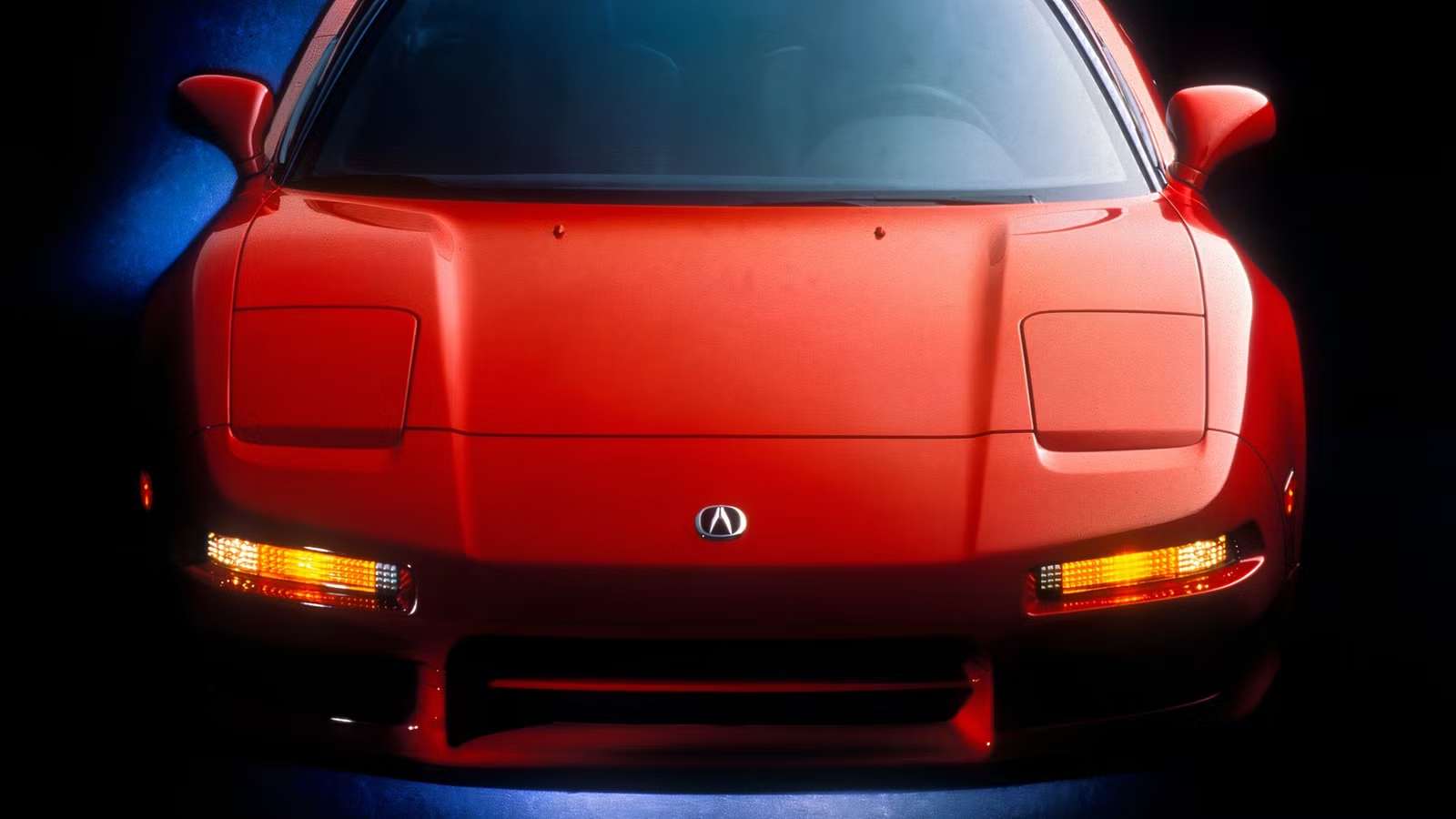
The scene could look something like this: you scoop the keys out of the bowl and head out to the garage where your chariot awaits. The door whirs open, and you roll down the driveway, past the neighbor’s kid who can’t take their eyes off your New Formula Red Honda sports car. Oh, I’m sorry, did I forget to mention this is an NSX?
No Shame In Daily Driving This Honda
Close
It almost sounded like Honda encouraged the practice of daily driving their new sports car when it debuted for the 1991 model year. Forget for a moment the reliability standards all Honda and Acura products are subject to. The original NSX came with a 3-year, 36,000-mile warranty covering the C30A naturally aspirated 3.0-liter V6 put to use behind the cockpit, just in case you were wary of a Honda/Acura product that wasn’t up to muster. The 90-degree transversely mounted heart of the NSX used a litany of mechanical trickery to produce 270 horsepower. Lightweight connecting rods, a large bore (90mm) and short stroke (78mm), dual overhead camshafts, and Honda’s infamous variable valve timing and lift electronic control (colloquially known as VTEC) all made appearances in the NSX.
To ensure the V6 would slot properly into place, Honda engineers had to tilt the engine backwards 5 degrees so it would fit between the rear axle and cabin. The standard 5-speed manual or optional 4-speed automatic gearbox sat just below and shifted power right to the axle to make the 0-60 sprint in under 6 seconds. Top speed was rated at 165 MPH, too, and even though these figures seem modest compared to what’s available today, these were strong numbers put up by a brand known for mundane sedans and hatchbacks. The NSX became the second car in Honda’s lineup to employ VTEC, which kicked in at 5,800 RPM to push the needle into the 8,000-RPM redline faster by switching to a longer-duration cam profile to increase airflow.
1992 Acura NSX V6 engine topAcura
Not only was the powertrain designed for durability and every day usability, the rest of the car featured nods to usability by way of its design and ride comfort. It wasn’t dialed in for extreme use all the time; rather, it was prepared from the factory to be enjoyed best on the road. A compliant suspension delivered a comfortable ride that didn’t fall apart when you wanted to push it hard over winding roads, as well as excellent visibility granted by the “fighter-jet inspired canopy” greenhouse. These were just a few of the things that made the NSX a comfortable, entertaining driving experience that owners were happy to get into on a daily basis.
Compared to the Ferraris this car was chasing, the NSX was a different breed of speed: useable, reliable, and surprisingly capable. It has been said many times before, but this car truly influenced everyone else in the business to rethink their approach to building sports cars. The interior featured supple leather seats, a silky-smooth gear engagement, and a familiar dash layout with easy-to-reach climate and radio controls. Every NSX came standard with traction control, anti-lock brakes, a Bose 4-speaker sound system, and a theft-deterrent system—today, those are manual transmissions.
A Handful Of Cars Have 250k+ Miles Today
Exterior view of the Acura NSXAcura/Honda
The key to buying an NA1 NSX is finding the happy medium between one you’re not afraid of driving, and one that hasn’t been completely toasted. Just because it’s a Honda doesn’t mean it’s protected from everything that can happen to a 30-to-35-year-old vehicle. It will, however, stand the test of time and harsh ownership far better than any other car in its class from the early 90s, which is how we get cars with over a quarter-million miles today that are still going. A post by Mileage Impossible (@Mileage_impo) on X from August 12 shows the dashboard of an NSX with an odometer reading of 319,401 miles.
The New Formula Red Targa model in question appears to be in excellent condition based on the images posted, especially since the post claims the car retains its original engine and transmission. In 2024, the same account posted to Facebook a picture of a 1991 model with 452,890 miles on the clock, which was supposedly the highest documented mileage on any NSX at that time. In 2025, Jalopnik wrote about a 5-speed 1991 NSX up for sale that had covered 259k miles, listed for $54,999. That one was also painted New Formula Red, but hosted a few alterations that dampened its originality. For instance, they spotted an RM Racing nitrous-oxide system, an aftermarket air intake, an aftermarket coolant bottle, and a set of gold alloy wheels. Inside, the seats seem to have been replaced and an aftermarket radio sits wedged into the dashboard.
Over on Bring a Trailer, the least expensive NSX sold in 2026 so far was a gloss-purple 1991 5-speed with 241k miles on the odometer. Not quite past the quarter-million mark, but well on its way there with its original engine and a replacement transaxle (which had Japan-spec close-ratio gears installed as well as a new clutch). The listing outlined a handful of mechanical bits and bobs in need of attention, along with the interior. The winning bid was $51,500.
How Owners Maintain Their High-Mileage Cars
Exterior view of the Acura NSXAcura/Honda
Well into the new millennium, there is a noticeable shift in mindset around cars from the 1980s and 1990s. It’s no longer about how many miles one can accumulate. That was proven some time ago, which means it’s all about how old the car is and what needs to be repaired or replaced to keep it happy for another hundred thousand miles or so. NSX Prime, a popular NSX forum where owners and enthusiasts discuss Honda’s supercar, is where many owners share the maintenance they’ve performed. One owner of two (a 1991 and a tuned 1992 NSX) listed everything affected by age more than mileage.
Brakes (ABS and master cylinder), suspension, driveshaft, clutch master and slave cylinder, fuel injectors, intake manifold and throttle body, fuel filter, and window regulators and rails make up just half of the items on their list, with the rest covering areas such as electronics for the engine management system, instrument cluster, and radio. Many owners consider 100k miles nothing for these cars, with one noting that they purchased their car at 270,000 miles and put another 10k on it after replacing hoses, the timing belt, and the water pump. Others with less than 50,000 miles relayed issues with window controls and other interior problems that stem more from age than any other factor.
Honda Built These Cars With Peace Of Mind From The Start
Honda NSX launch 1989 Chicago Auto ShowHonda
Honda crafted the NSX with usability and comfort in mind, but those are just two of the many ways it put ownership ahead of performance. The clear visibility, comfortable and familiar interior, and ease of maintenance for a midship sports car are all factors that made the NSX a great proposition for being the first supercar anyone could drive, let alone every day. Anything described as ‘the best’ is subjective, and one would have every right to argue that a Ferrari or Lamborghini is a better car, particularly when power, lap times, and visual drama define the criteria.
If being the best is defined by how accessible a performance car is, or how easy and inexpensive it is to buy and maintain, the NSX was far ahead of everyone else. Ferrari started making its cars more reliable because of Honda’s entry into the market, and Lamborghini needed to dial back the rawness of its cars for drivers who weren’t professional racers. The original NA1 NSX might have watered down the entire supercar market with its practicality, but it’s the reason why owners can enjoy their supercars every day. That’s not so bad, is it?
Sources: Honda, Bring a Trailer, NSX Prime, Jalopnik
