

The biggest car news and reviews, no BS
Our free daily newsletter sends the stories that really matter directly to you, every weekday.
A lot of factors go into a great exhaust sound, but one of the most important is the number and arrangement of the cylinders. Arranging 8, 10, or 12 cylinders in a “V” creates sounds that are music to a car enthusiast’s ear, but V6 and V4 engines generally don’t have the same appeal. There’s something about having at least eight cylinders, but what about a number above that threshold that isn’t found in nature?
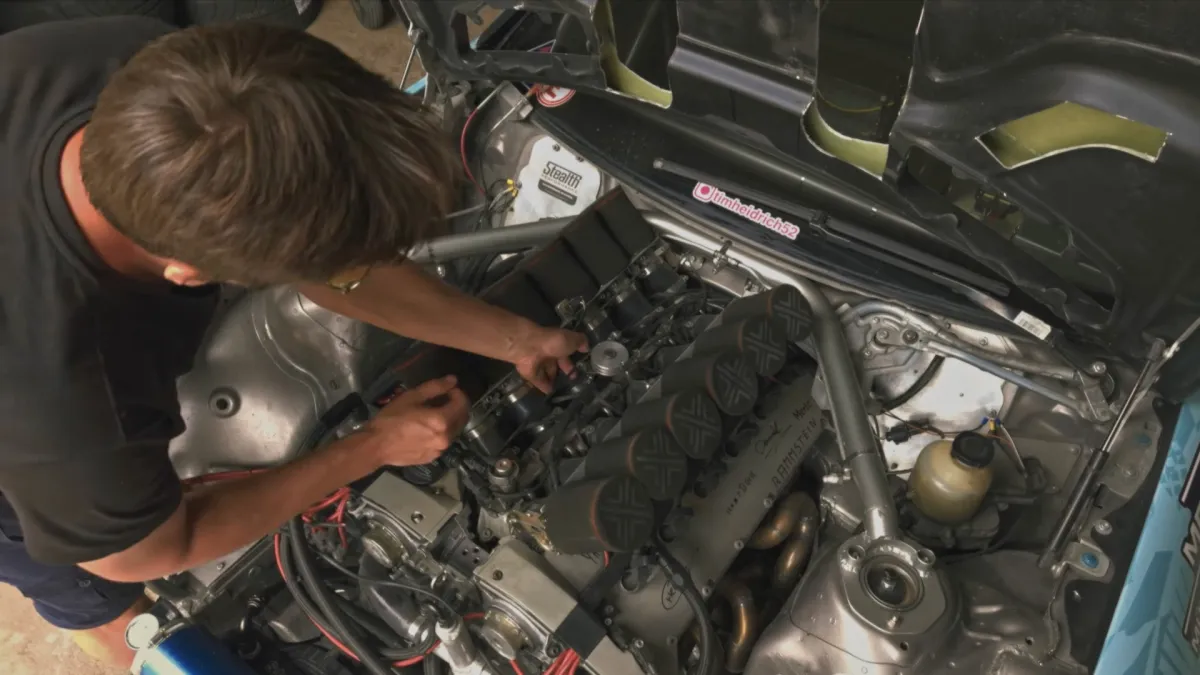
A workable V11 engine is an impossibility because it would require a different number of cylinders in each bank. However, there’s a way to simulate the sound of this impossible engine. Maisteer, a YouTube channel with a penchant for exhaust-sound experiments, pulled plugs on the 6.0-liter V12 in a modified R230 Mercedes-Benz SL to find out what a V11 (as well as a V9) sounds like.
Maisteer via YouTube
TBH, the 11-cylinder symphony didn’t sound that different from the correctly-functioning V12 to my ears. Maybe I was just distracted by the decidedly non-stock exhaust system, which had the Mercedes shrieking like a race car, or maybe I need a new pair of headphones. There was a slight unevenness from one cylinder (number three, in this case) not firing, but the overall tone sounds pretty much the same. Your listening experience may vary, and accompanying frequency meter readouts show a definite change at both the 400 Hertz and 800 Hz frequencies.
The V11 didn’t sound bad, either, which makes sense considering that a few years ago, another YouTuber simulated an inline-11 and the results were pretty good. Such an engine could theoretically work, but it would be too long to be practical.
I Turned a V12 into an V8… One Cylinder at a Time
The engine was then run as a V10 and a V9 by deactivating cylinder 10 and then cylinder six as well. Again, the odd-numbered configuration didn’t sound as different as expected. More interesting was the drop in range as more cylinders were deactivated. The engine picked up more bass along the way, with the exhaust descending into that familiar V8 rumble when the V12 was down four cylinders. Again, a frequency meter readouts shows the true difference between the various cylinder counts even if your ear can’t pick them up.
Engine sounds are foundational to car character, which is why automakers are stressing about how best to replace that chorus in electric cars. Hyundai has already developed a sci-fi soundtrack for its electric N models, Bentley thinks drums are the best option for its Torcal electric SUV, and BMW blended sounds from a number of sources for its Neue Klasse EVs.
Stephen has always been passionate about cars, and managed to turn that passion into a career as a freelance automotive journalist. When he’s not handling weekend coverage for The Drive, you can find him looking for a new book to read.
