

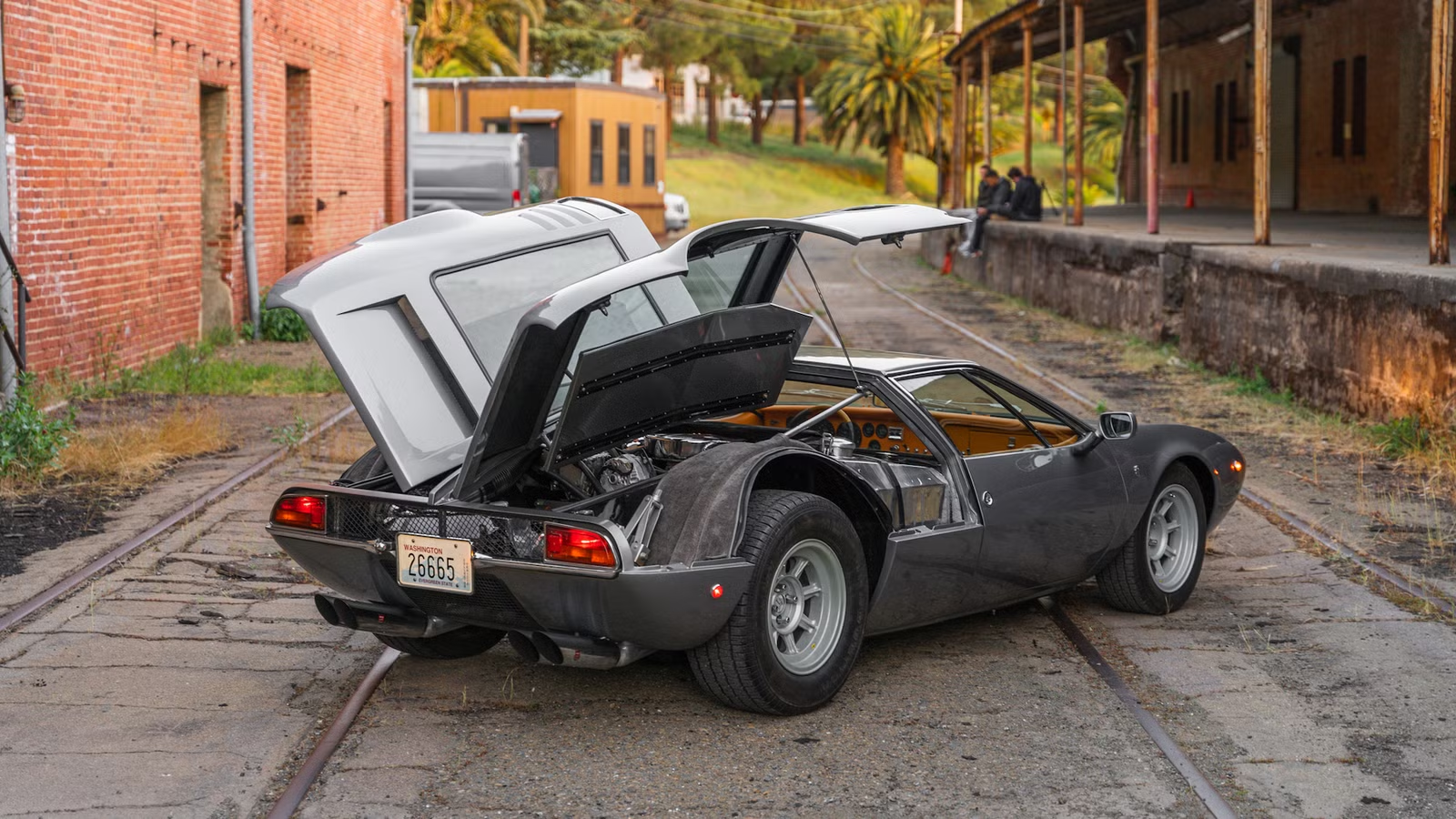
Few forces in automotive history have proven more creatively potent than a bruised ego. The industry has always run on competition, but some of its most extraordinary machines weren’t born from boardroom strategy — they were born from personal scores that needed settling.
Ferruccio Lamborghini famously launched an entire supercar brand after a perceived slight from Enzo Ferrari. And then there’s the story of Alejandro De Tomaso, who channeled his frustration with one of America’s most celebrated automotive figures into a mid-engine Italian masterpiece designed, quite literally, to devour its rival. That car was the De Tomaso Mangusta — and its origin story is as compelling as its gullwing engine bay.
Creating something to spite someone else is nothing new in the industry. Even Carroll Shelby drove a colleague to such frustration that the man became determined to build a car specifically to stick it to him. That car was the De Tomaso Mangusta, which was built to kill the Shelby Cobra.
A Labor Of Spite
The story of the De Tomaso Mangusta begins a few years before it entered production. Its founder, Alejandro De Tomaso, had been involved in a project with the famed American automotive icon Carroll Shelby. The project centered on De Tomaso helping Shelby develop new Can-Am race cars in late 1964, after Shelby determined that the Cobra was unfit to compete in the series. The problem was compounded by the need to match the 7.0-liter Chevrolets being fielded by Bruce McLaren’s racing team, who would later use a Chevy V8 for their first road car.
One thing led to another, and Shelby partnered with De Tomaso to develop a new racing car. The arrangement called for Shelby to provide financing, De Tomaso to handle engineering, and Peter Brock to lead the SCCA-approved design team. However, before any race cars could be completed, the partnership collapsed under a mix of conflicting interests and competing agendas. Shelby redirected his attention to the Ford GT40 program, early sketches of which Ford released some years ago. The failed collaboration ultimately gave rise to the 1965 Shelby-De Tomaso P70 and, later, the De Tomaso Sport 5000 — machines to which the De Tomaso P72, with its incredible carbon chassis, pays homage.
Alejandro De Tomaso was far from satisfied with how things had turned out. If anything, the falling-out sharpened his ambition. Buoyed by the modest success of the company’s first production car, the De Tomaso Vallelunga, he set out to prove himself to the world — and to Carroll Shelby — by developing an all-new model: the De Tomaso Mangusta.
Killing Cobras
Close
Model
1966 De Tomaso Mangusta
1965 Shelby Cobra 427
Engine
4.8-liter, naturally aspirated, V8
7.0-liter, naturally aspirated, V8
Horsepower
302 hp @ 6,100 rpm
485 hp @ 6,500 rpm
Torque
310 lb-ft @
480 lb-ft @ 3,500 rpm
0-60
5.9 seconds
4.3 seconds
Top speed
155 mph
165 mph
Alejandro De Tomaso was dead-set on proving his worth to Shelby — so much so that the name “Mangusta” is Italian for “mongoose,” the only animal known to prey on cobras, a pointed nod at the Shelby Cobra. The Mangusta’s chassis was a direct descendant of the one used in the 1965 Shelby-De Tomaso P70: a steel “spine” design with a stressed-member engine, meaning its V8 served as an active structural element, helping to transmit forces from the suspension and other hardware — a layout the De Tomaso Vallelunga had also employed. That engine was tucked behind two covers joined by a central hinge, allowing them to swing open in gullwing fashion for access.
Its seductive bodywork was the handiwork of celebrated designer Giorgetto Giugiaro, working from a design he had originally sketched for the Iso. The fiberglass body was married to De Tomaso’s spine chassis, with the whole car riding on a double-wishbone suspension setup featuring coil springs and telescopic shock absorbers at the front, and lower wishbones with top links, trailing arms, coil springs, and telescopic dampers at the rear.
1965 Shelby Cobra 427 front 3/4 angle in black while parkedMecum Auctions
Depending on the market, the Mangusta was powered by either a 4.7-liter or 4.9-liter Ford V8 — the same family of engines used in the Ford GT40 Mk I. Performance was genuinely impressive, and the car arrived with a feature list well ahead of many contemporaries: air conditioning, rack-and-pinion steering, and electric windows were all standard. A sumptuous interior, an arresting exterior, and motorsport-derived underpinnings made for a compelling package — but did it accomplish what De Tomaso intended? Did it dethrone the Shelby Cobra?
1965 Shelby Cobra 427 rear 3/4 high angle in black while parkedMecum Auctions
In raw power terms, no — at least not when measured against the Cobra’s hulking 7.0-liter V8. In the comparable 4.7-liter configuration, the gap narrows considerably. Regardless, the Mangusta succeeded in doing something arguably more important: it put Alejandro De Tomaso firmly on the global stage, a platform he would leverage alongside the Ghia design team to launch the De Tomaso Pantera — a car Ford would import to the US and sell through Lincoln dealerships.
The End Of The De Tomaso Mangusta
Production of the De Tomaso Mangusta ran from 1966 to 1971, during which time only 401 examples of the mid-engine Italian mongoose were built. Despite never truly dethroning Shelby’s beloved Cobra — in part because the two cars occupied quite different niches — the Mangusta was a genuine success for the Italian automaker, significantly raising the De Tomaso brand’s international profile.
After 1971, De Tomaso turned its attention to the ludicrous De Tomaso Pantera, itself deserving of an entire feature fawning over its sultry curves. Decades after production ended, Mangustas have continued to surface at auction, with a 1969 example having sold for close to $300,000. Fittingly, another 1969 Mangusta found a second life in pop culture, appearing in the cult classic Kill Bill as the wheels of the film’s main antagonist in the second installment of the franchise.
Sources: De Tomaso, BringATrailer, DK Engineering
