

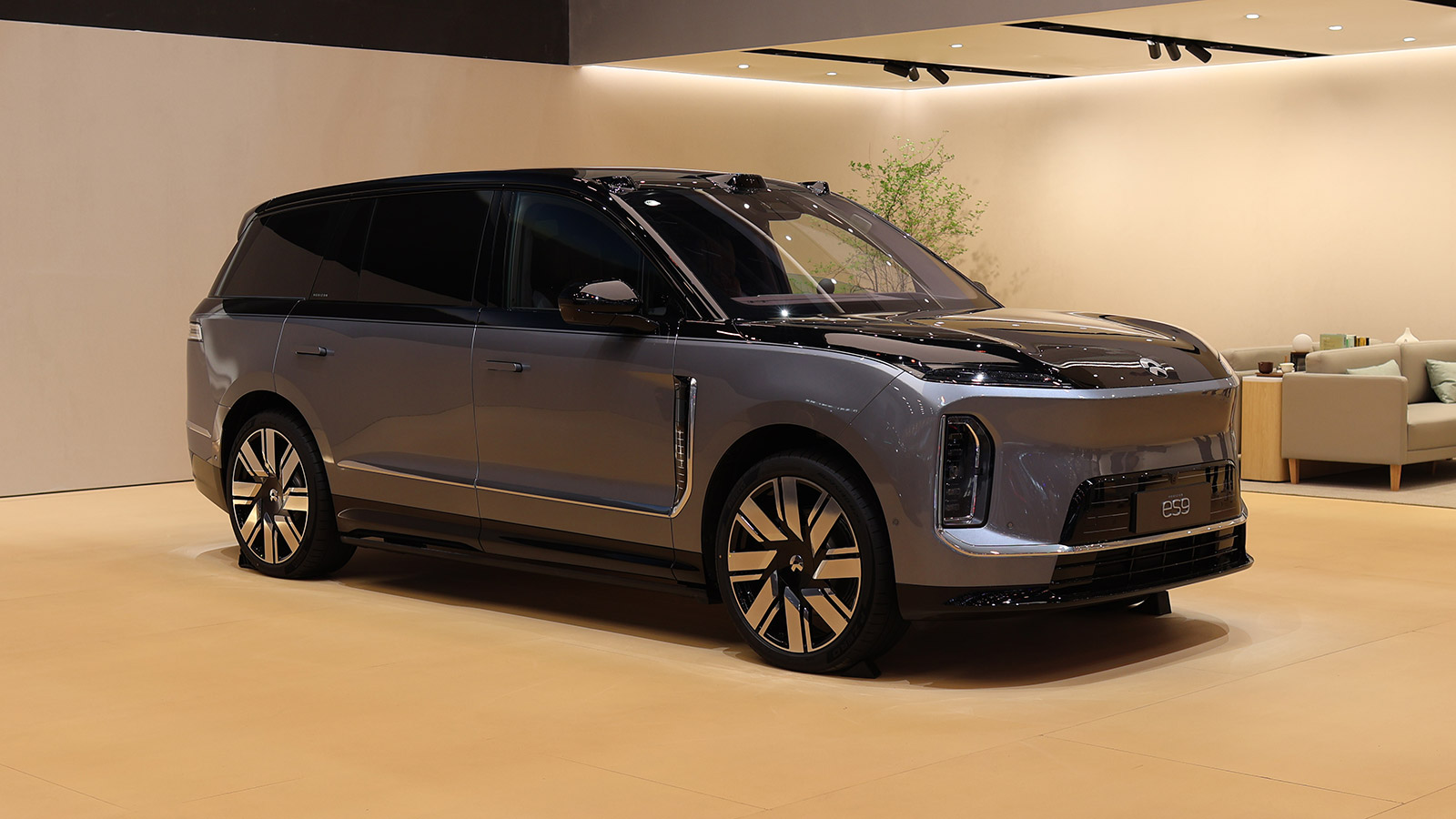
A Nio ES9 on display at the Beijing Auto Show in April 2026. Credit: CnEVPost
- The new rules provide size exemptions for radar, cameras and V2X antennas, creating more design space for autonomous-driving and vehicle-road coordination hardware.
- The new standard will be phased in from July 2027.
China has issued a new mandatory national standard on vehicle exterior dimensions, easing protrusion limits for smart-vehicle components such as radar, cameras and V2X antennas.
The change will give automakers more room to install autonomous-driving perception and communication hardware, reducing conflicts between new technologies and traditional vehicle-dimension rules.
China’s State Administration for Market Regulation (SAMR) said on Monday that it had approved the mandatory national standard GB 1589-2026.
The standard sets limits on the exterior dimensions, axle loads and masses of motor vehicles, trailers and combination vehicles. It will take effect on July 1, 2027.
The new rules establish dimension exemptions for sensing and communication components such as radar, cameras and V2X antennas to accommodate blind-spot monitoring, autonomous-driving perception and vehicle-road coordination.
The components can also be used for beyond-line-of-sight safety communications. The revision does not amount to a blanket increase in vehicle length and width limits, but instead provides targeted exemptions for specific smart-vehicle hardware.
The new standard also creates more structural design room for commercial new energy vehicles (NEVs). For single axles fitted with single tires on each side, the maximum permissible axle load will rise from 7,000 kilograms to 8,000 kilograms.
The regulator said the adjustment would help alleviate front-axle overloading caused by concentrated battery loads and give commercial NEVs greater flexibility in axle-load distribution and structural layout.
The rules also define streamlined semi-trailer tractors and streamlined articulated vehicles for the first time, setting the length limit for the latter at 18.1 meters to support the development of low-drag vehicles.
For articulated vehicles carrying 45-foot containers, the length limit will rise from 17.1 meters to 17.3 meters. The maximum distance from the centerline of the corresponding semi-trailer’s kingpin to its rearmost point will be 12.2 meters.
The standard will be implemented in phases. Models applying for new type approval must comply from July 1, 2027, while models with existing type approvals will be subject to the rules from January 1, 2028.
The regulator said the transition period would give automakers time to make technical upgrades, absorb related costs and manage the shift between existing and new products.
The standard requires autonomous driving systems to be at least as safe as a competent and attentive driver performing the dynamic driving task.
