

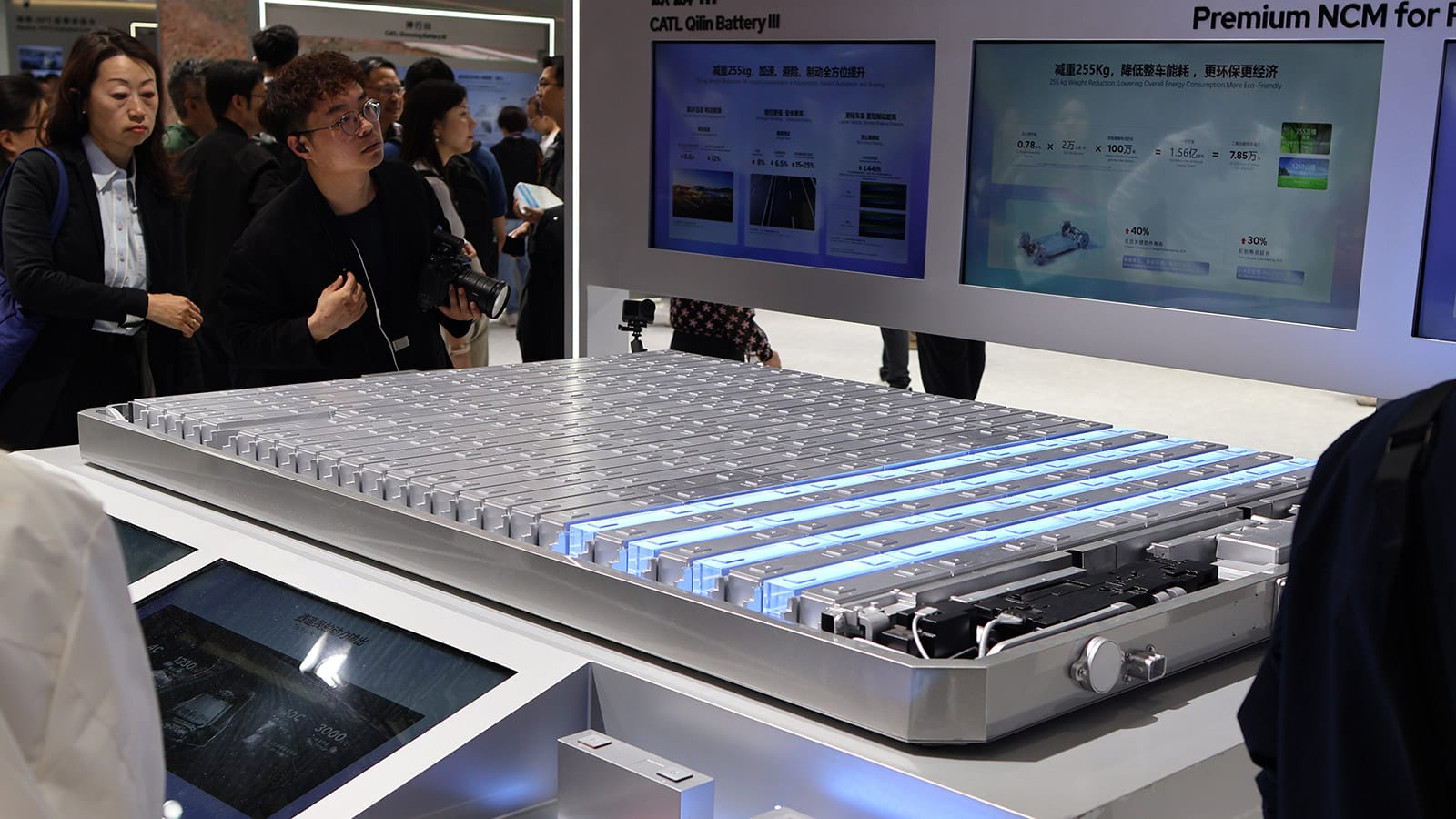
A CATL battery pack on display at the Beijing Auto Show in April 2026. Credit: CnEVPost
- Automakers that produce batteries in-house can avoid or deduct the consumption tax, while those buying externally will bear extra costs, Cui said.
- Automakers that do not make power batteries can never become world-class carmakers, he said.
China’s reinstatement of a consumption tax on lithium batteries will strongly propel automakers to make their own cells, Cui Dongshu, secretary-general of the China Passenger Car Association (CPCA), wrote in an article on Saturday.
China’s Ministry of Finance, General Administration of Customs, and State Taxation Administration jointly issued an announcement on July 17, imposing a 2% consumption tax on mature battery products such as lithium-ion batteries from September 1, 2026, with the rate rising to 4% from September 1, 2027.
Meanwhile, emerging technology products such as sodium-ion batteries and solid-state batteries will be exempt from the consumption tax through the end of 2028.
Cui believes the policy adjustment marks the formal opening of the curtain on “equal treatment for fuel and electric vehicles.” From the halving of the purchase tax and the removal of the vehicle and vessel tax exemption to the reinstatement of the battery consumption tax, the “protection period” of tax incentives for new energy vehicles (NEVs) is being phased out in a staged manner.
But he placed greater emphasis on a view he has long held: automakers must make their own batteries, and the levy of the lithium battery consumption tax will significantly favor this trend.
Cui pointed out that automakers’ profits are being heavily squeezed by battery makers. According to the 2025 Fortune Global 500 data, Chinese automakers on the list posted a combined profit of $14.7 billion, of which “a leading battery company” alone took $7.1 billion.
He described the situation as “too dire to look at,” saying automakers are “basically out of money.”
The leading battery company’s net profit reached 72.2 billion yuan ($10.7 billion) in 2025, exceeding the combined profits of 13 A-share listed automakers, he said. China’s auto industry posted a sales profit margin of just 3.4% in the first five months of 2026, still at a historic low, Cui noted.
According to the latest announcement, taxable battery products that taxpayers produce for their own use in the continuous production of taxable battery products are exempt from the consumption tax, while taxes already paid on externally purchased taxed batteries used in continuous production can be deducted based on the quantity used.
Cui said this means automakers that make their own batteries and install them directly in vehicles can avoid or deduct the consumption tax, while those relying on external procurement will have to bear the tax burden passed on by battery manufacturers.
By his calculation, lithium battery cells are currently priced at around 0.35-0.40 yuan per Wh, and the 2% tax rate translates into a cost impact of about 0.007-0.008 yuan per Wh, with the 2%-4% rates adding roughly thousands yuan or so to the cost of a single vehicle.
Cui said that while the impact on a single vehicle is limited, for an automaker producing 1 million vehicles a year, the cumulative added cost could reach hundreds of millions of yuan.
The battery consumption tax effectively draws a new cost divide between “automakers that make batteries” and “automakers that don’t,” he said.
Cui believes batteries account for at least about 25% of a vehicle’s price, and mastering core power battery capabilities is key for automakers to build long-term competitiveness.
Automakers that do not make power batteries can never become world-class carmakers, he said.
Currently, BYD (HKEX: 1211) is already a powerhouse in lithium iron phosphate (LFP) batteries, GWM (HKEX: 2333)-backed Svolt Energy ranks among the industry’s leaders in ternary battery installations, and automakers such as Geely have also invested in in-house power battery development, with some already capable of large-scale mass production, Cui noted.
Cui also said the tax exemptions for sodium-ion and solid-state batteries essentially provide automakers with a valuable policy window to position themselves in next-generation battery technologies.
At a critical stage when solid-state batteries are moving from the laboratory to mass production, the exemption lowers upfront investment costs, he said.
China’s major battery companies are racing to industrialize solid-state batteries, with CATL (HKEX: 3750), BYD, and several other manufacturers planning to achieve small-batch vehicle installations around 2027.
The policy shift comes as China’s NEV penetration rate keeps hitting new highs. In the first half of this year, China’s NEV retail sales reached 4.71 million units, accounting for 54% of the 8.72 million total passenger vehicle sales, according to CPCA data.
Demand for power batteries is equally strong. China’s cumulative power battery installations reached 335.6 GWh in the first six months of this year, up 12.0% year on year, according to data from the China Automotive Battery Innovation Alliance (CABIA).
Whoever first builds the capability to develop and produce batteries in-house will gain a cost advantage in this round of tax reform and thus secure a more favorable position in the next phase of market competition, Cui said.
Lithium-ion batteries will be subject to a 2% consumption tax from September 1, 2026, with the rate rising to 4% from September 2027.
($1 = 6.7733 yuan)
