

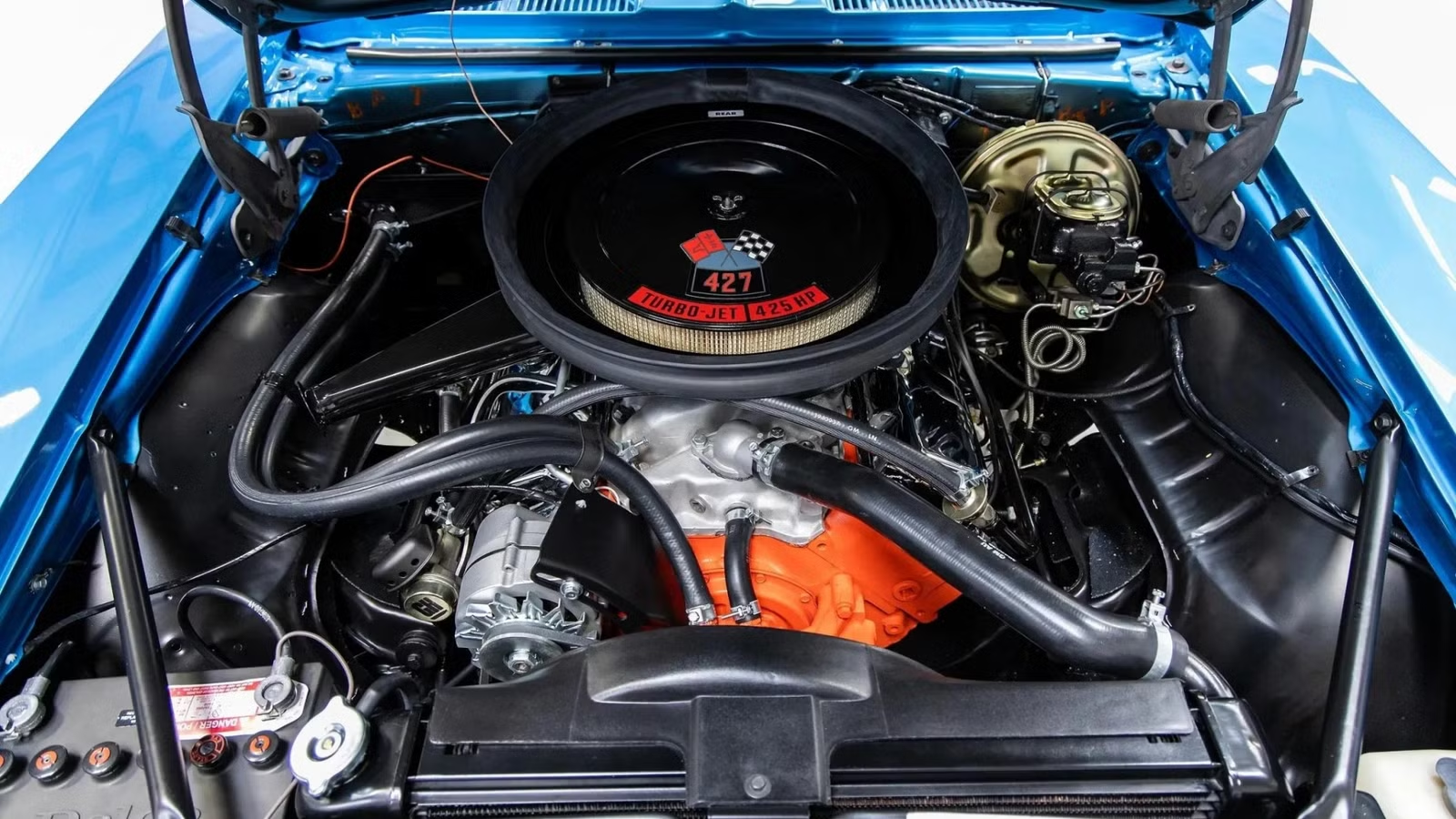
In 1969, Chevrolet devised a way to put its Can-Am-derived aluminum 427 CID V8 into a car that shouldn’t have had an engine that big: the Camaro ZL1. At the time, GM’s corporate regulations restricted its subsidiaries from putting engines larger than 400 cubic inches into its compact and intermediate vehicles until 1970. Luckily, the conglomerate’s internal COPO 9560 option allowed the 427-toting Camaro ZL1 to exist.
Officially, Chevrolet rated the COPO 9560 Camaro ZL1 with 430 horsepower and 450 pound-feet of torque. However, the real output figures turned out to be much higher than that. In total, fewer than 70 ZL1s were built in 1969, making them extremely rare. Its aluminum engine block shaved more than 100 lbs off total engine weight, and the actual COPO 9560 engine cost more than an entire base-spec Camaro at the time. But, if you paid the price, you’d have gotten a true race-derived engine hidden deep within a seemingly normal ’69 Camaro.
The Back Door To Big Power: Chevy’s 9560 COPO Option
1969 Chevrolet COPO Camaro Blue Front 3/4 Angled ViewBring A Trailer
GM designed its displacement restriction to try and keep large engines out of smaller vehicles. This way, smaller cars wouldn’t be ludicrously fast and placed in the market with the potential to cannibalize sales from other performance models, namely the Chevrolet Corvette. As such, one could not simply order a 1969 Camaro with a 427 CID V8 engine from the factory.
GM’s Central Office Production Order (COPO) program offered a convenient loophole for the horsepower-chasing Camaro enthusiast. It allowed Chevy to build unusual combinations that weren’t possible to build from the factory by conventional means. Two major players helped push the COPO 9560 ZL1 program into the spotlight: a drag racer by the name of Dick Harrell and Fred Gibb Chevrolet in LaHarpe, Illinois.
Both Fred Gibb Chevy and Harrell pressured Chevrolet into putting the ZL1 into regular production. The resulting COPO 9560 option package was born, featuring the Can-Am engine and a few other performance add-ons. Despite the huge push from both parties, only 69 total ZL1s — 47 manuals and 22 automatics — were produced in 1969, meaning its production was extremely limited, even by special-order-production standards.
The engine found within the ’69 ZL1 is related to Chevrolet’s L88 family, which found use in C2 and C3 Corvettes built between 1967 and 1969 that were optioned with the RPO L88 package. The L88 was all-aluminum, had racing-derived roots, and was significantly underrated by the factory. It was officially rated at 430 horsepower, but actually produced up to 580 hp, according to some dyno tests.
Such was the same story with the COPO 9560 Camaro.
The ZL1’s Official 430-hp Rating Was Nowhere Close To The Truth
1969 Chevrolet COPO Camaro Blue Rear 3/4 Angled ViewBring A Trailer
GM realized it could put anything it wanted on paper when it came to the 1969 Camaro ZL1’s power output, and that it didn’t necessarily have to back it up with real-world tests. Surviving factory dyno tests actually rated the engine around 575 hp, meaning GM had to have at least some knowledge of the massive discrepancy between fact and make-believe. After all, a 145-hp difference is hard to ignore.
Its official torque rating was completely wrong, too. The factory dyno reported 515 lb-ft of torque, 65 more than what GM’s official paperwork reported. Making all of that hidden power were things like the engine’s 12.0:1 compression ratio and a large, 850-CFM Holley carburetor. Some ’69 ZL1s reportedly came equipped with 780-CFM Holley units due to supply issues, but GM’s official reporting at the time stated the larger size was used.
Thanks to its high-performance nature, a stock ZL1 could run a 1/4-mile sprint in just 13.2 seconds at 110 mph. A stock 427-equipped Chevrolet Corvette was over a full second slower, with a reported trap time of roughly 14.3 seconds. Coming to the ZL1’s engine block itself, its use of aluminum managed to decrease overall engine weight by well over 100 lbs over the standard 427 CID engine.
In those days, car insurance was a costly prospect, and insurance companies would tailor their rates to the amount of power any given car made. Said companies were required to utilize factory-supplied data to determine pricing, so keeping the ZL1 Camaro’s horsepower rating at 430 meant its insurance rates were lower, enticing more folks to actually buy one. However, the price of the COPO 9560-equipped ZL1 Camaro alone was hard enough to swallow back then.
The Engine Cost More Than The Entire Car
1969 Chevrolet COPO Camaro Blue Front ViewBring A Trailer
If you were interested in fitting a ZL1 engine into your 1969 Camaro, you’d have to come up with $4,160 upfront, equivalent to about $37,970 in today’s money. For context, that’s like buying an entire 2026 Subaru BRZ ts. A base Camaro in 1969 cost just $2,727, meaning you’d have to write the car off roughly another 1.5 times just to get the hot ZL1 engine installed in it. If you fully optioned your ZL1 in 1969, you could push its MSRP over $7,200, or approximately $65,617 today.
Bearing all of that in mind, it becomes easier to see why only 69 examples were sold in 1969. Most younger folks who’d be interested in buying something like that at the time simply didn’t have the equivalent of $37k to spend on an engine alone, let alone alongside the price of a brand-new Camaro. The ZL1’s intended customer base were experienced drag racers interested in using it as a base for their own builds.
One important note: the COPO ZL1 Camaro was fast, but the Corvette could still beat it when properly optioned. While the standard 427 CID-equipped ‘Vette was decisively beaten in a quarter-mile sprint by the ZL1, an L88-equipped one was much faster. Over a 1/4-mile, it’s been reported to achieve times as quick as 12.5 seconds at speeds in excess of 110 mph. Of course, gearing and driver skill factor into 1/4-mile performance, too.
For buyers who wanted a ready-built drag racer and didn’t need to make many modifications, the 1969 Camaro ZL1 was one of the better buys available at the time, especially if racing a Corvette wasn’t the goal. Its extremely high price and relatively small advertising presence did more damage to its popularity than its performance specs did, which led to the COPO 9560 ZL1’s discontinuation after 1969.
The ZL1 Didn’t Die In 1969
1969 Chevrolet COPO Camaro Blue Side ViewBring A Trailer
The 427 CID engine found in the ZL1 Camaro continued on in Chevy’s high-performance racing legacy. In fact, certain modern drag engines are still loosely related to the now 57-year-old design. The 2025 NHRA JLine aluminum block, for example, shares some of its basic construction with the ZL1 engine. It uses a lightweight, high-strength block, along with open-chamber cylinder heads identical to the ones used by the ZL1.
This means that, even almost six decades later, the ZL1 engine’s basic design is still competitive in modern drag racing. Original ZL1 engine blocks are also regarded as virtually priceless. All of this serves to propel the 1969 ZL1’s value to heights rarely enjoyed by classic muscle cars, with some examples fetching over $1 million at auction. According to Classic.com, its average value is rising and currently sits at about $894,749.
Bring A Trailer
Like many good things, the ZL1’s existence owes itself to a willingness to bend the rules. Despite GM itself showing a “no big engines allowed” face to the car-buying public in 1969, it secretly allowed the production of the ZL1 via the COPO program. Both Dick Harrell and Fred Gibb Chevy virtually forced Chevrolet to make the COPO 9560 ZL1 available to the public. It was simply too expensive to become a mainstream success.
However, had it not been for their insistence, GM would never have created one of the most valuable classic muscle cars ever created. It just so happened that the ZL1 Camaro was also built on a lie.
Sources: GM, Camaros.org, Classic.com, MotorTrend, HOT ROD Magazine.
