

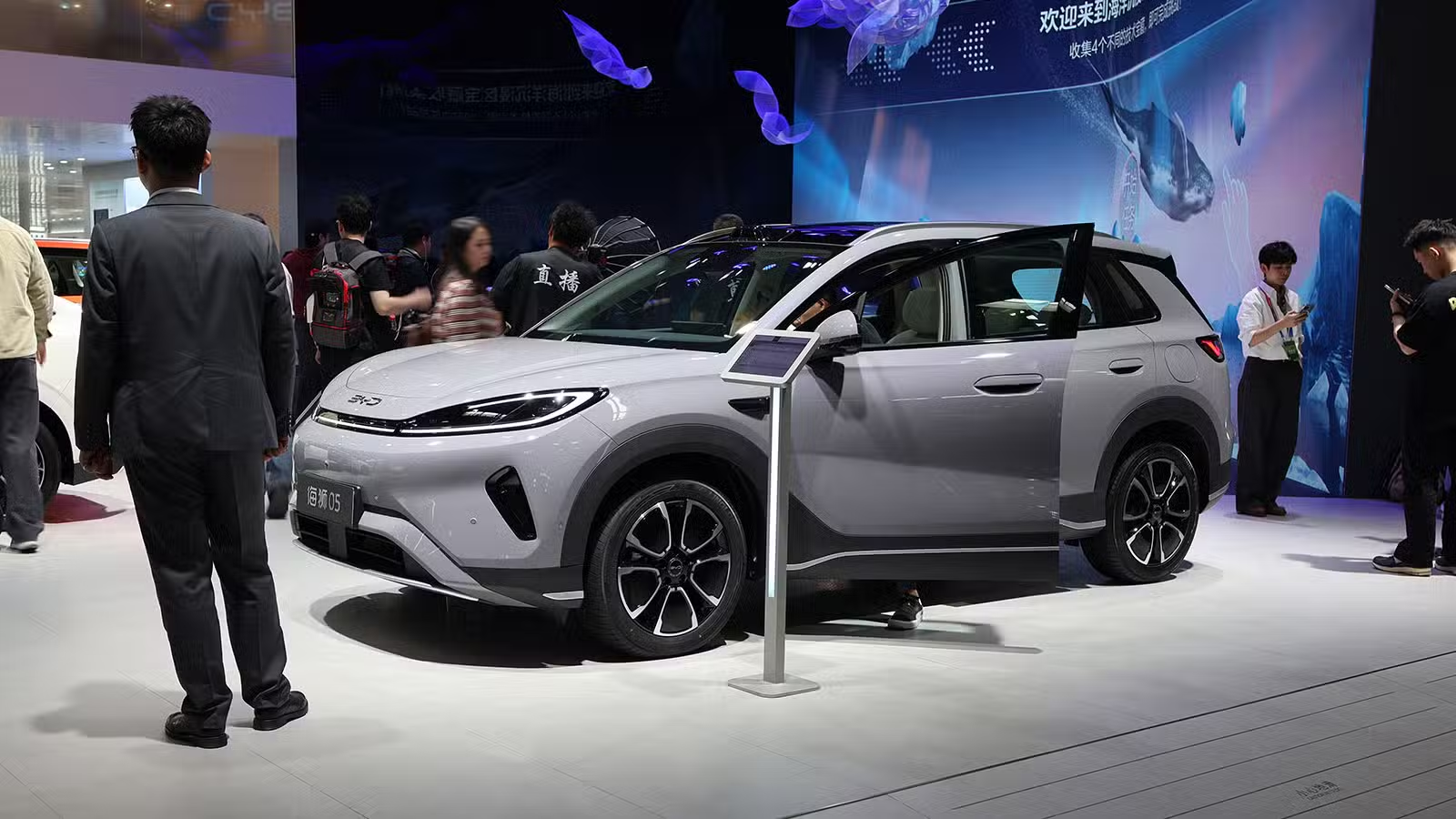
A BYD Sealion 05 on display at the Beijing Auto Show in April 2026. Credit: CnEVPost
- Plug-in hybrids and battery electric commercial vehicles will no longer be exempt from the vehicle and vessel tax from January 1, 2027.
- Battery electric passenger cars will remain untaxed, as they have no engine displacement and fall outside the scope of the tax.
China will scrap vehicle and vessel tax breaks for some new energy vehicles (NEVs) from January 1, 2027, the latest move by the government to scale back tax support for the industry as NEV penetration keeps hitting record highs.
Battery electric commercial vehicles, plug-in hybrid (including extended-range) vehicles, and fuel cell commercial vehicles will no longer be exempt from the vehicle and vessel tax from 2027, according to a statement on Friday.
Meanwhile, the policy of halving the vehicle and vessel tax for energy-saving vehicles will also be canceled, said the joint statement by the Ministry of Finance, the State Taxation Administration, and the Ministry of Industry and Information Technology.
Notably, battery electric passenger cars and fuel cell passenger cars are not affected by the adjustment. Under China’s vehicle and vessel tax law, these two types of vehicles have no engine displacement and thus fall outside the scope of the tax, remaining untaxed.
This means battery electric vehicle (BEV) passenger cars — the largest segment of China’s NEV market — will continue to enjoy de facto zero vehicle and vessel tax.
The vehicle and vessel tax is a property tax levied annually on the owners or managers of vehicles and vessels.
For passenger cars with an engine displacement of more than 1.6 liters and up to 2.0 liters, for example, the annual tax ranges from 360 yuan ($53) to 660 yuan.
Once the adjustment takes effect, taxpayers will need to pay the vehicle and vessel tax on both newly acquired and previously acquired vehicles of the four types mentioned above, at the applicable rates determined by provincial-level governments.
China’s Ministry of Finance said in a Q&A statement that the preferential policy, in place since 2012, has played a positive role in encouraging consumers to buy NEVs and energy-saving vehicles.
However, China’s NEV industry has been developing rapidly in recent years, and the policy environment has changed. In 2025, China’s NEV sales reached 16.49 million units, with NEVs accounting for more than 50% of domestic new car sales.
The Q&A statement also stressed that the above types of vehicles, like other fuel-powered vehicles, are high-value property. In 2025, the average selling price of plug-in hybrid (including extended-range) passenger cars was 218,000 yuan, with some models priced at more than 1 million yuan.
Resuming the levy of the vehicle and vessel tax on these vehicles will help promote tax fairness and strengthen the role of taxation in regulating income distribution, according to the Q&A statement.
The adjustment comes as NEV penetration in China’s market keeps setting new records. China’s NEV retail penetration rate hit a record high of 62.9% in May, exceeding 60% for the second consecutive month, according to data from the China Passenger Car Association (CPCA).
China Passenger NEV Penetration at Retail 2024-2026
Month
2024
2025
2026
January
32.8%
41.5%
38.6%
February
35.8%
49.5%
44.9%
March
41.6%
51.1%
51.5%
April
43.7%
51.5%
61.4%
May
47%
52.9%
62.9%
June
48.4%
53.3%
July
51.1%
54%
August
53.9%
55.2%
September
53.3%
57.8%
October
52.9%
57.2%
November
52.3%
59.3%
December
49.4%
59.1%
China passenger NEV penetration at retail
2024
2025
2026
As NEVs become the mainstay of sales, discussions about tax reform have been heating up. Cui Dongshu, secretary-general of the CPCA, called last month for China to reform its traditional road tax system, which is tied to fuel consumption.
Cui pointed out that NEVs consume no fuel and have long used public road resources at zero tax cost. Moreover, as they carry power batteries, NEVs are generally heavier than fuel-powered vehicles of the same class, causing more actual wear and tear on roads.
Cui proposes a statutory tax based on driving mileage and vehicle weight to address structural imbalances caused by declining fuel tax revenues.
($1 = 6.7891 yuan)
