

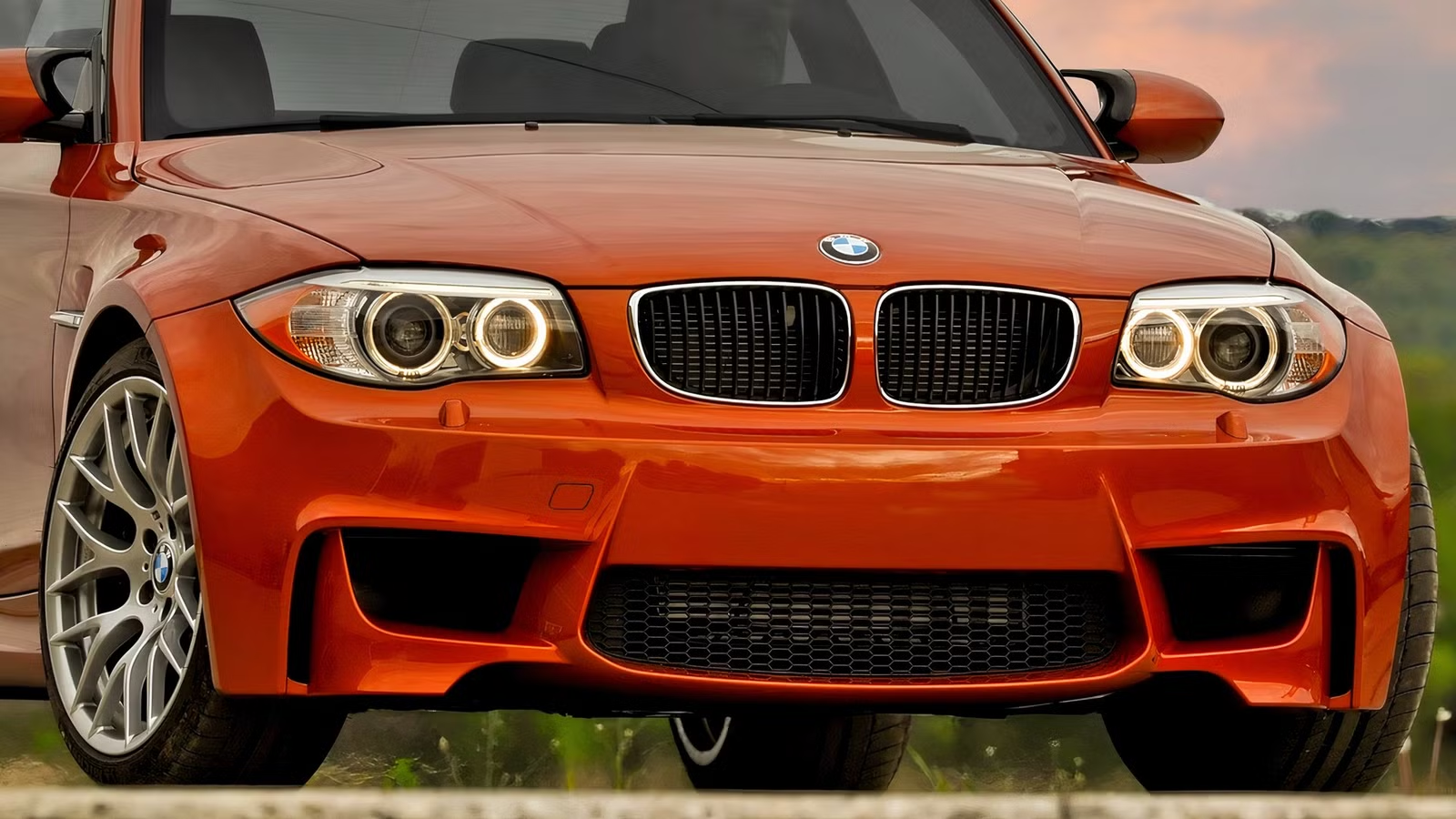
Not all cars are created equal. BMW’s 1 Series Coupe range has always consisted of a mixture of mundane coupes and convertibles with a handful of trims that had some inclination toward performance, like the BMW 135i Coupe, which would eventually morph into what we now know as the 2 Series Coupe.
However, at the start of the 2010s, BMW did what it does best and created a lightweight, agile, powerful sports car, and did so by infusing the 1 Series CCoupe frame with several components from the automaker’s indomitable M3 model. The result of this medley saw the birth of the BMW 1M Coupe, one of the best sports cars the Bavarian manufacturer has ever concocted.
One Above All
2011 BMW 1M Coupe Exterior Finished In Coupe Taking Corner BMW
The BMW 1M is the result of BMW’s engineers sneakily creating a car that was free from upper management meddling. Its history can be traced back to 2009 when it began as an after-hours project, but the BMW engineers spent most of the time developing what would become the BMW 1M over weekends. According to legend, the BMW 1M was codenamed “Pyrat” because that was the name of the spiced rum the engineers enjoyed, which makes sense. After all, the entire car seems like the result of two drunken engineers lobbing “what ifs” at one another.
2011 BMW 1M Coupe Exterior Finished In Orange Rear With Mountains In DistanceBMW
It was not the best time to try and create a brand-new car, as the Great Recession had just subsided, and the possibility of BMW’s higher-ups approving a new car that would cost a substantial amount of money was slim. As such, these ambitious engineers decided to source parts from other models, most notably the E92 BMW M3. Because of the cost-cutting tactics used to develop the BMW 1M, BMW’s management gave permission for production by the end of 2009.
The high-performance 1 Series model was easy to produce since it could be made on the same production line as the Leipzig production plant’s other BMW 1 Series models. Like many high-performance models, the BMW 1M was honed through extensive testing on the Nürburgring, and its development period lasted roughly one year.
2011 BMW 1M Coupe Exterior Finished In Orange Side ProfileBMW
The BMW 1M coupe debuted in 2011 and quickly became a highly sought-after model despite objections and disapproval from some M enthusiasts. BMW planned to produce only 2,700 examples of the BMW 1M coupe, but after seeing the public reaction to the potent sports car, the production cap was removed, and ultimately, 6,309 examples were produced before production ended in 2012. It was and still is the greatest 1 Series BMW has ever created.
Made Of BMW M Hand-Me-Downs
2011 BMW 1M Coupe Exterior Finished In Orange Driving Along Twisty RoadBMW
Initially, the BMW 1M coupe received mixed reactions from the public. Some loved it, while others labeled it unworthy of the M badge, as it strayed from the formula of a rear-wheel-drive model powered by a naturally aspirated inline-six engine developed by BMW’s M division and designated with the “S” prefix. Instead, the BMW 1M coupe sourced its commendable power output from a twin-turbocharged inline six-cylinder engine called the N54B30TO engine.
Some might recall that the N54 was also offered in the BMW 135i coupe and the BMW Z4 sDrive 35iS, but the two engines are significantly different. In the BMW 1M, the N54 engine received changes to its turbochargers, exhaust system, and a revision of its ECU. The muscular coupe also had an over-boost function that temporarily increased its torque output. Still, it wasn’t a full-fat M engine and that made people angry.
2011 BMW 1M Coupe Exterior Engine Bay Close-UpBMW
To accommodate 335 hp being fed directly to its rear wheels and to keep costs down, a substantial amount of parts was sourced from the purpose-built BMW E92 M3. These parts included the M Compound brakes, the Bilstein electronically controlled aluminum dampers, the limited-slip differential, the entire rear subframe, the rear axle, wing mirrors, and the suspension components sourced from the BMW M3. Furthering its performance abilities were elements like the variable M Differential lock, a covering brake control system, a dry braking function, and an M Dynamic Mode.
2011 BMW 1M Coupe Interior With Black Seats And Red StitchingBMW
Mechanical components aside, the BMW 1 Series coupe was distinguished from the standard 1 Series range by its emboldened wheel arches, which were increased by 71 mm at the front and 44 mm at the back compared to the BMW 135i. Also, it featured other visual elements bespoke to the 1M, like its front bumper.
An Instant Classic
2011 BMW 1M Coupe Exterior Finished In OrangeBMW
While several enthusiasts were somewhat upset about the part sharing, they were quickly silenced once they got behind the wheel. The 1M was a throwback to the early years of BMW M production models. It was small, had a powerful straight-six under the hood, a manual gearbox in the middle, and all the power went to the rear wheels. There were no driving modes. The traction control was either on or off. It was the essence of driving and as soon as word got out, people flocked to buy the car.
The BMW 1M coupe is now remembered as one of the best models ever to wear the M badge and stands as an example of a time when BMW made cars that people would want to drive rather than models that led with gimmicks first and performance second. When it debuted, the BMW 1M coupe was an extremely enticing and appealing model that offered impressive performance for a base price of $47,010.
Unfortunately, for anyone interested in the BMW 1M coupe, prices on the used market are not as pleasing as the driving experience of the twin-turbocharged coupe.
The average sales price after 15 years is still $64,069. And mint models are easily selling for $80,000 to $100,000. The most expensive sale on record in the USA is $118,000… Just imagine where is will be in another 15 years.
BMW says that the nimble, compact, and powerful coupe “upheld the legacy of pure driving,” which is an ideal that served as a cornerstone philosophy of the automaker’s greatest hits. The Bavarian automaker never released a follow-up to the BMW 1M Coupe. The M2 became a series production car, while the magnificent M2 CS used a full-fat M engine. Neither of these cars have managed to retain value as well as the 1M.
The 1M was also intended to be a limited production car, and the only reason BMW eked out over 6,000 examples was the public’s reception. Despite adding more units to the production, the 1M remains a very special purchase to this day.
Sources: BMW M, BringATrailer, Cars&Bids
