

Tesla has finally re-unveiled its next-generation Roadster, originally unveiled in quite different form back in 2017. So since I did a technical breakdown of how it would work last time, I thought I’d give a quick update with what we know about the new version.
Back in 2017, the Roadster was unveiled as the car that would “give a hard-core smack down to gasoline powered cars.”
At the time, electric cars had already proven themselves with extremely quick acceleration numbers. But there weren’t many true electric sportscars (except, of course, the original Tesla Roadster from 2008, the car that started it all).
The next-gen Roadster was intended to change that, with a smaller, low-to-the-ground car built for speed, rather than comfort or efficiency. Of course, you’d still get some of those other goals as with any EV, but the idea was to win races, to beat gas cars around a track.
And then…. a decade happened. It’s been almost 9 years since that car was first shown off, and Tesla has not released it. Meanwhile, plenty of other companies have released their own electric sportscars, and set records in doing so.
The Rimac Nevera R hit 300km/h (186mph) a full 3.5 seconds faster than a Bugatti Chiron Super Sport, the Xiaomi SU7 Ultra – made by a smartphone company – set a Nürburgring record, and Porsche went even faster, electrically. And another Chinese company, BYD, showed off that its car can jump, an artifact of its active suspension system.
There are even some tricky, fully track-focused EVs that have beaten every car ever with truly videogame-like performance, and the ability to drive upside down – you can even buy it.
So the path Tesla intended to forge is looking less like an untamed wild, and more like a well-tread trail at this point. Maybe everyone hasn’t marched on it, but Tesla is no longer the first.
But Tesla has had the most impressive demo, you have to give it that.
In its demo, it made some wild claims about the car – and then backed them up. Musk said the car would be able to fly, and it did. It did a flip in the air as well. It accelerated from 0-60 in under 1 second, a number that no other car has gotten even close to. It drove upside down.
How did it do all these things, and what do they mean? Will they help the car beat every track record around the world, as Musk promised tonight? Well, it’s time for a quick primer on vehicle dynamics.
(For the purposes of this article, we’re going to treat everything that happened tonight as if it was real, not faked. While a lot of it looked surprising, we do know that fan cars are real, rocket boosters could increase acceleration, and we’ve seen flying machines that self-right with small gas thrusters, so it’s all plausible enough, even if the car’s movements in the air looked much quicker than you’d expect out of a car. Besides, it’s lazy to just say “it’s all fake” – we’d rather try to examine what seems plausible, and what doesn’t, and just use this as a jumping off point to teach people a bit about vehicle dynamics. So strap in.)
Driving upside-down
The first demo showed the Roadster driving up a hot wheels-like track, going fully vertical, and then upside down.
This was accomplished through a “fan car” system, like the McMurtry Spierling, the other car which drove upside down and was mentioned above. Tesla calls it a “multi-mode suction system.”
Fans on the vehicle are used to create a low pressure zone underneath the car, causing ambient air pressure to push the car against the surface it’s stuck to. This is enabled by skirts underneath the vehicle which seal off the vehicle underside so air can’t ingress into the low pressure zone.
This was described in a patent, and is a clever improvement on McMurtry’s system and previous fan car systems, as it allows the skirts to be adjusted so the car can be used in a wider array of circumstances other than smooth track surfaces.
The downforce numbers on Tesla’s display are incredibly high, and seem potentially unreal to me. There’s no need for 4,700kg of downforce on what is presumably a sub-2,000kg car. Musk did mention that Tesla wanted to keep the car “light”, and while many supercars these days push 2,000kg and more, there’s no way a 2 seater is that much heavier than that benchmark…right?
In comparison to the McMurtry Spierling, that car is around 1,000kg and pulls around 2,000kg of downforce to do the things it does. So Tesla is not just running more ridiculous downforce numbers, but also running a larger ratio of weight to downforce than McMurtry’s car. It’s not completely out of the question that it’s running 4,700kg, but that number is still surprisingly large to me and I wouldn’t be surprised if some liberties were taken.
A hint can be seen in other statements about the Roadster’s capabilities – Tesla says it will be capable cornering at 2G, which is plenty impressive enough, though the Spierling claims it can pull up to 3 lateral Gs in a corner.
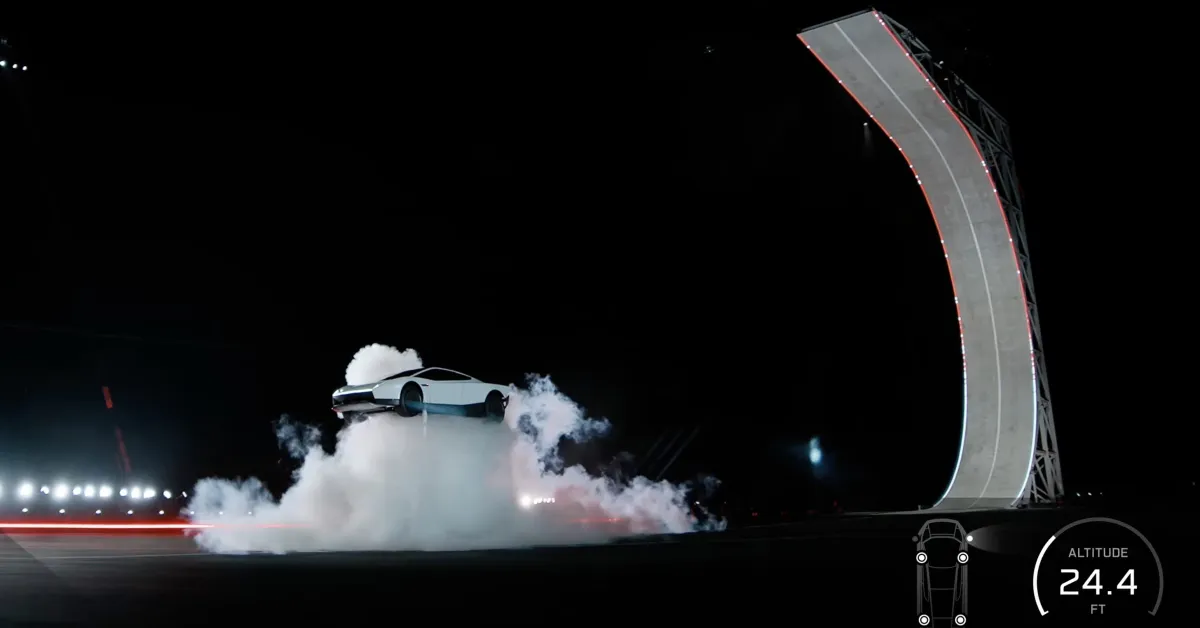
Jumping off the ramp, then landing. Also, a kickflip
The next trick involved driving up the ramp, jumping off the end and then landing.
This uses the vehicle’s “cold gas thrusters” that have been placed around the car.
Tesla announced separately that the car would come with three trim levels: Performance, Thrust, and Rocket. Rocket is the only one that is “air ready,” and has cold gas thrusters mounted around the vehicle, including underneath, which allow it to fly for short distances.
This is done by compressing air and holding it in tanks onboard the vehicle. While other trim levels are 2-seaters, the “Rocket” trim only has one seat – with the space for the other seat presumably taken up by larger gas tanks so the car has enough juice to fly for short distances.
Admittedly, I know less about rockets than I do about car dynamics, so I have little useful to say about how realistic it is to hold enough gas to produce enough force to do these stunts with a full-size vehicle. But I can tell you what benefits they would provide if they do work as Tesla says they will.
Tesla also showed off the car doing a “kickflip” over the rest of its vehicles, which uses the same technology as the jump did.
This made for an impressive demo, but offers no real performance benefit in terms of driving.
The fan car system provides additional downforce – this is because tires can only work so hard, and adding apparent weight to a car while maintaining its mass (yes, these are two different things) can make those tires work harder. This helps in basically anything you would want to use tires for – so, y’know, every aspect of vehicle performance.
But rockets that push the car upwards do not do any such thing. Those provide “upforce,” which is a word that nobody has uttered because it’s not something you want – unless you’re trying to play a trick on Mark Webber. Pushing the car upwards just makes the tires work less, and hurts performance by a lot.
Worse, including the thrusters for this system adds weight and complexity. That means another thing that can break, and another thing that slows the vehicle down. As Musk said, Acceleration = Force / Mass, so if you add mass, you are decreasing acceleration.
So the jumping is just a party trick, and will not help with performance.
However, the side thrusters could add cornering capability. Downforce makes tires work harder, which is good, but another thing you can do is just not make the tires work at all. By shooting air out of the side of the car during a corner, you are adding lateral acceleration through something other than the tires, so even when the tires are maxed out in the amount of lateral acceleration they can provide, your jets are providing a little more.
(The car will also have steer-by-wire, which should help make cornering easier for a driver, allowing tight turns with less steering input at lower speeds)
So the jump is dumb, but the side thrusters could do something. Which leads us to the more important thrusters: on the rear.
0-60 in 1 second, aided by thrusters
Then Tesla showed a recorded 0-60 test utilizing rear thrusters, wherein the vehicle reached 60mph in 1 second.
Tesla recorded a 0-60 time in 1.0 seconds. That’s almost a record. It says it can go faster.
Later in the show, Tesla did a live demonstration, and claimed that the car hit 60mph in 0.81 seconds, after some technical difficulties with the timer. Tesla later said, in a tweet, that the top-spec version of the car would be able to hit 0-60 in under 0.59 seconds.
Cold gas thrusters strike again here, with four ports at the rear of the vehicle that push a huge plume of gas behind it. These produce 80 kilo-Newtons of force, a number that is used to measure rocket force but does not translate well to horsepower.
Much as described above, if you are at the limit of what tires can do, you can try to find force some other way. The thrusters push the car forward even when the tires can’t push any harder, which enables the car to essentially break the same physics laws that every other car is limited by.
The “fan car” system does help with forward acceleration too, the same way it helps with all other types of lateral acceleration. But the rockets out the back are what give it that extra oomph, allowing it to hit 60mph in under a second, and seemingly in only a few car lengths worth of distance.
Importantly, we don’t know the specifics of this test, which do matter for 0-60 times. Often, 0-60 tests include a “one foot rollout,” where the timer doesn’t start counting until the car starts moving at least a foot. That first foot can take a while for some cars (typically, electric cars accomplish the rollout portion faster, due to high low-end torque), but it’s just how the tests have been done for a while.
That might matter more than usual here, because Tesla clearly activated the thrusters well in advance of when the car started moving, as can be seen in slow-motion video shown during the event here.
With frame-by-frame analysis, the car is still not moving, even after the gas thrusters have started spinning up.
If the thrusters take some time to “wind up,” then they’re less useful for certain types of acceleration tasks – and give back some of the benefits of electric propulsion, the instant torque. Hopefully Tesla has not just invented the electric version of turbo lag.
Moveable wing
The car has an adjustable rear wing, which is perhaps the most “traditional” performance improvement on the car.
This is one of multiple wing configurations
These exist in many vehicles these days, and solve the primary problem of wings.
When people talk about “coefficient of drag” or Cd, which has become a popular stat to quote on an EV, everyone accepts that a lower number is better. If your car makes less drag, it’s more efficient, which means it can go farther with the energy it has. (cross-sectional area also counts – a large car with a low Cd can still lose more energy to drag than a small car with a lower Cd, because a larger car simply pushes more air around).
But drag sometimes offers a performance benefit. Formula One cars actually have extremely high drag coefficients – the most efficient EVs get close to 0.2 Cd, but an F1 car can have a drag coefficient of 0.7 or even 1.0 or higher.
This is because F1 cars actually use all that air for downforce. Instead of letting the air flow smoothly around the vehicle, they actively try to push the air upwards, which in turn pushes the car downwards (Newton’s third law of motion, equal and opposite reactions), which allows the tires to work better.
The problem is that when the car is going in a straight line, it doesn’t need that much downforce. At top speed, that downforce is just drag, which slows the car down.
So, active aerodynamics solves this problem. If you can put up a wing to push air down when you want it, then hide the wing so it lets the air fly by at higher speeds, you can have the best of both worlds. More downforce when cornering, and less drag at high speed.
The concept overall is called “aerodynamic efficiency.” How much downforce you can get through a certain method without adding more drag. A wing offers good downforce, but lots of drag – an active wing helps eliminate the drag downside. (and going back to the fan car system above, that offers a lot of downforce with little drag)
Battery size?
At the original Roadster unveiling in 2017, Tesla said the car would have a 600 mile range. This made headlines, and people thought it was a big deal, or thought it was impossible that the car would have so much more range than everything else on the market.
But range numbers don’t really matter. It’s entirely possible to make an EV with a thousand mile range, but the problem is that car would be terrible. You’d have to spend too much space on batteries, they’d be too heavy, they’d be expensive, and you’d get diminishing returns because the more battery you add, the more battery you have to add to move the weight of that battery around, etc.
So 600 miles of range was kind of bad news for the Roadster. The main reason it had so much range is because EV batteries have a careful balance of many considerations – energy density, power density, cycle life, temperature response, charging speed, and so on and so forth.
At the time, Tesla’s chosen chemistry was rather high on energy density, but comparatively lower on power density. Energy is how much range you have in the battery, and power is how quickly you can get that energy out of it.
So, similar to needing to add more batteries to get more energy onboard the car, Tesla also had to add more batteries to get more power out of the car. If Tesla wanted to get the Roadster up to 1,000hp+, it would need a massive battery – and that was the point behind the “600 mile range.”
Now, we’re hearing that the new version of the next-gen Roadster will have a smaller battery, with Tesla only saying it will have a range of “over 300 miles.”
We don’t know if this is because the car will have less power than originally planned, or if Tesla has managed to get more power out of its cells… but it’s probably a bit of both.
Here you can see the four rear thrusters
It’s likely relying on its boosters and fan car system to pick up the performance slack and reach the absurd numbers Tesla is promising, and realizes that a gigantic battery is not as necessary once you have other ways to push the wheels around.
The location of the battery is of interest too – in Tesla’s photos, the seating position looks quite high, which suggests that the battery is low in the vehicle, as is the case on most of Tesla’s other vehicles.
This driver is sitting high enough that there looks to be a battery between him and the bottom of the car.
This offers a lower center of gravity, which helps with cornering. But it also means a higher seating position, which feels less “sporty.” The original 2008 Roadster actually had the battery placed behind the cockpit, leading vehicle balance to feel like a mid-engined car. The upcoming Porsche 718 EV has a similar configuration.
A low-slung battery will make the Roadster’s cornering feel more neutral, but perhaps less “fun” than a tail-heavy vehicle. Between that and the fan car system, it will probably feel like it’s on rails.
Edit: On further examination, a couple frames of the “kickflip” portion of the video show the underbody of the car
This does not look like Tesla’s typical underbody, which is usually flat, as the battery is there. An underbody with lots of parts hanging off of it is bad for aerodynamics, so this is one of the benefits of putting a battery on the bottom of an EV.
This frame also leads us to the possibility that this car may not have had a battery in it at all. Which could help to explain the car’s fast movements in the air, if it was a thousand pounds lighter than a production vehicle might be… and also another reason that nobody was allowed near the kick-flipping cars to examine them closely. So I know I said at the start that I would take this whole thing seriously, but keep your conspiracy hats handy, boys and girls.
Top speed: rockets probably don’t do much
Tesla quotes top speed at over 230mph. It says that number will only be reachable by the Rocket version of the car, but we’re skeptical that the rockets will have much effect at top speed.
At high speed, your tires are not working very hard to accelerate the car (they’re still working hard, and you need special rated tires for high speed operation, but they are no longer the thing limiting acceleration). Most of your power is going to defeating air drag (which goes up exponentially with speed), and the relative force between the tires and the road is quite minimal.
So the whole point of the rockets (and the fan car system) is nullified here – you don’t need to find another method to take stress off the tires, because the wind is what’s stopping you, not the tires.
Using the rear thrusters for a boost when you reach top speed could help add a few more mph, but as we don’t know how much capacity the tanks have, any top speed benefit may not last for long. The rockets are better used in corners, anyway, I’d say.
We don’t know the tanks’ capacity, but we do know Tesla used different cars for each demo, which could be due to a capacity limitation
So when Tesla claims the Rocket trim can go 230mph, but doesn’t quote a top speed for other trims, this could be due to some other factor. (During the presentation, Musk also mused if the car should be able to reach at least mach 0.5 – which would be ~380mph at sea level, which is unlikely, given the current record is 308.34mph, with an asterisk)
Perhaps the Rocket trim is lighter because of the removal of the second seat (though it loses some of that weight reduction through the addition of tanks + useless downward-pointing thrusters), perhaps it comes with higher-rated tires or a more lenient software governor, or maybe it uses a different or larger battery than the other models. We just don’t know yet, but we hope to get more information soon.
How practical are these thrusters?
Another company, Dreame, a Chinese robot vacuum maker, also proposed using thrusters on an electric hypercar – but it was going to use solid rocket boosters rather than cold gas thrusters. Those would be one-time-use, and need to be recharged each time. It would have made 100kN of thrust and hit 0-60 in 0.9 seconds, but Dreame cancelled the project, which seemed inevitable.
A cold gas thruster is a much better idea, since it doesn’t need to be recharged with solid rocket fuel each time.
But it does need to fill its tanks with pressurized gas, and we don’t know how long that will take, or how much energy it will take. Will the car be able to fill the tanks on straightaways, then deplete them on turns? If so, how long of a straightaway does it need? And will that divert power from the wheels to the air compressors at high speeds, when you’re already taxing the battery to the max at high speeds?
Or, is the party trick only a once-every-few-minutes sort of thing, and you won’t be able to use it for more than a few turns before heading back to the pits?
Tesla seems to think it will be enough to set track records, but that seems to be already possible with the fan car system. McMurtry is setting track records with its Spierling, and it doesn’t have any thrusters out the back or sides.
The radius of debris and smoke runs in the tens of meters
Finally, will you even be able to use them at all on anything other than a closed course? In today’s demo, the crowd was hundreds of yards away, which is a fair precaution for the first demonstration of a car doing a kickflip.
But it wasn’t just the kickflip that was concerning. The plume of gas sprayed out of the back of the car on acceleration, or on turning, seemed massive. It went tens of meters away.
So it certainly doesn’t seem like it should usable on public roads, as debris from the road would be kicked up into other cars, pedestrians, or whatever. Tesla says the “Rocket” is invite-only, and is “not approved for public road use.” But it says nothing under the “Thrust” trim entry, despite that it has the rear thrusters, which could cause plenty of damage.
Even on a closed track, you don’t want to be blowing tire marbles (discarded bits of rubber from tires) into a crowd beside the track, or knocking over marshals or braking boards or blowing all the hair off of too-adventurous squirrels that get too close to the track. It just seems impractical.
Heck, can a human even use these systems at all? For the demos, nobody was in the car. The movements in the air seemed incredibly rapid, much more rapid than you’d expect any several-thousand-pound object would be able to move in the air.
The speed of the acceleration displayed in the air would be at minimum disorienting to any average person. This is the sort of thing that fighter pilots train for years to do. And we’re just going to let people buy the car with Rocket mode and operate it, even as an “invite-only” product? Where? How? What happens if they have a medical episode? Will cars come with a G-suit to stop you from blacking out while operating flight mode? What happens to that compressed air in a crash?
But then, the question of practicality is somewhat moot. With the various mentions of SpaceX during today’s presentation, it seems clear that one major motivating factor behind Tesla’s recent product announcements is to push the idea of a SpaceX/Tesla merger, which would allow Musk to gain more power/money without actually accomplishing the goals required of him.
And besides, we have seen a reveal of a product that never actually made its way to public sales, which existed for the purpose of selling a merger before… so we wouldn’t count on that “2028, actually” promise.
So… there you go, that’s a quick reaction/explainer about the various abilities shown off, why they exist, and how practical they seem. If you’ve got any questions (or, if a physicist/engineer, any non-pedantic corrections, I’m trying to keep this somewhat accessible here), noticed anything interesting, or just want to say what you think about what we know of the technical capabilities of this car, leave them below in the comments.
Charge your electric vehicle at home using rooftop solar panels. Find a reliable and competitively priced solar installer near you on EnergySage, for free. They have pre-vetted installers competing for your business, ensuring high-quality solutions and 20-30% savings. It’s free, with no sales calls until you choose an installer. Compare personalized solar quotes online and receive guidance from unbiased Energy Advisers. Get started here. – ad*
FTC: We use income earning auto affiliate links. More.
