

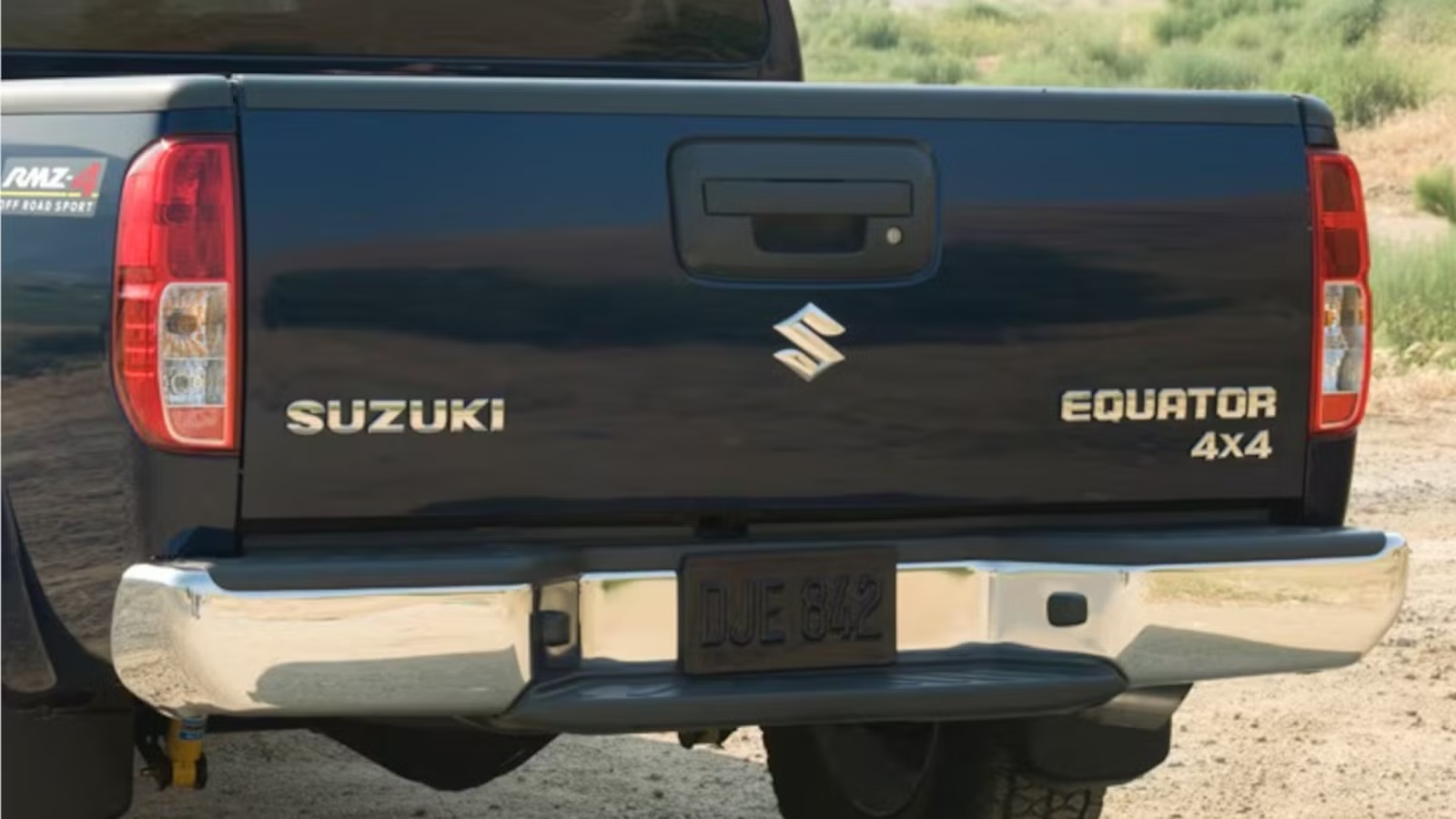
It can be difficult to find a durable used truck for a reasonable price, since models that have achieved such a good reputation tend to hold their value particularly well. As a result, a little hack is to look for a vehicle rebadged by a brand with less of a commanding reputation in the pickup truck world, since these don’t tend to fend off depreciation as well.
The Suzuki Equator is a perfect example of such a vehicle, since it was overlooked during its prime against trucks from better-known brands. Now, it’s a cheap pickup that can work hard and last the distance.
The Equator Hides A Nissan-Shaped Secret
A front three-quarter shot of a 2009-2012 Suzuki EquatorSuzuki
The Equator turned up in Suzuki dealerships for the 2009 model year, and it was an attempt by the small Japanese manufacturer to try and secure a foothold in the lucrative pickup truck market. It had been struggling to make much of an impression in the US auto market, since it primarily focused on smaller and more efficient vehicles. By grabbing a piece of the pickup market, Suzuki hoped it could boost its profile and profits considerably.
Without the spare cash needed to develop its own pickup truck, Suzuki instead cut a deal with Nissan to borrow the Frontier midsize truck and rebadged it as the Equator. The beauty of the deal was that Suzuki would save a fortune on development costs, while hopefully enhancing its reputation as a brand that produced tough and reliable cars for the competitive American battleground. Nissan, meanwhile, would net some extra income by offloading a load of its new trucks to Suzuki.
Suzuki made practically no alterations to the truck before sending it to dealers. There was only a revised front fascia and minor interior changes to set it apart from the Frontier. Nissan built the Equators at its Tennessee assembly plant before delivering them to Suzuki’s door. This arrangement was a golden opportunity for bargain hunters, since you could have a Frontier in everything but name, but for over $1,000 less than the Nissan version.
The Equator Boasts The Same Bulletproof Engines As The Nissan
2012 Suzuki Equator V6 engine topSuzuki
As long as you’re not a badge snob, saving that extra cash was handy when you consider the Equator relied on the same solid powerplants that you could find under the hood of the Frontier. Lower-end variants got a naturally aspirated 2.5-liter inline-four that made 152 horsepower and 171 pound-feet of torque going to the rear wheels. Nissan’s 4.0-liter V6 was available in the range-topping Sport and RMZ-4 variants. Available in rear- and four-wheel-drive forms, the larger unit made 261 hp and 281 lb-ft of torque.
Both engines have fared well over the years in terms of reliability. The V6 is the true star of the show, though. Nissan’s VQ-family of V6 engines is one of the most renowned six-cylinder designs in the world. It has racked up a load of awards due to impressive dependability and performance. The five-speed manual transmission, which was included with the four-cylinder engine, and five-speed automatic unit are equally strong. The V6 was available exclusively with the automatic.
Because the Equator used a ladder-frame chassis, owners could treat it as a relentless workhorse. Like the Frontier, it sported a payload capacity of up to 1,471 pounds, and a towing ability of up to 6,500 pounds.
You Can Get A Small Discount By Opting For Suzuki’s Truck
A rear three-quarter shot of a 2009-2012 Suzuki EquatorSuzuki
The beauty of the Equator is that you can essentially get all the benefits of the excellent Frontier of the era, but without having to pay the premium of having it with a Nissan badge on the nose. Since Suzuki had nowhere near the reputation that Nissan had in the pickup truck world, few customers opted to save a bit of cash by going to their local Suzuki dealer. While Nissan delivered just shy of 220,000 Frontiers between 2008 and 2012, Suzuki only managed to sell 7,774 Equators during the same period.
The project was nothing short of a disaster for Suzuki, and the Equator’s failure was one of the reasons the manufacturer pulled out of the US market for good in 2012. Still, the Equators that sold have long outlasted the brand’s stay in the US. Today, buyers can find them cheap on the used market.
Tidy 2012 examples with around 120,000 miles on the clock can be found at around the $10,000 mark. There are also plenty of trucks with north of 150,000 on their odometers for sale for around $5,000. Given the strength of the truck’s design, and the stout engines beneath the skin, a well-maintained example can easily last thousands more miles. Do your homework, and you could find a workhorse that still has plenty of life left for peanuts.
Generally, an equivalent Frontier with the same mileage and condition would cost about $2,000 more than a comparable Equator, letting you save a decent chunk of cash on an identical machine.
Keeping The Equator Running Won’t Be A Headache
2009 Suzuki Equator Blue Front Angled View Dirt DrivingSuzuki
Of course, we wouldn’t blame you for being skeptical regarding the upkeep of a used Equator, since Suzuki hasn’t been active in the US for well over a decade. Well, fear not, because the Equator is a Frontier with different badges; so all the components underneath are pure Nissan. Parts for the Frontier are still plentiful because of the truck selling well, so finding spare parts isn’t a problem. Plus, due to how dependable the machine is, you can anticipate a minimal outlay to keep the truck running reliably.
RepairPal estimates that the Equator should cost around $441 per year to keep running smoothly, which is ultra-cheap for a larger midsize pickup. The only frequent problems involve faulty driveshaft bearings and control arms, but these issues fall under standard wear-and-tear concerns. As for which engine is more reliable, you’re in very safe hands with either option.
Both units frequently exceed the 300,000-mile barrier with regular maintenance, and the four-cylinder in particular has been known to even reach a million miles. The Equator is every bit as tough as the Frontier it was built alongside, but it can save you a little bit of cash on the used market. The real difference comes down to whether you want the more fuel-efficient four-cylinder or the V6’s extra pulling power. The four-cylinder can manage 21 miles per gallon on average, as opposed to the V6’s 17 MPG. So we wouldn’t blame you for opting to save some gas money given the current costs.
There may not be a huge difference in the amount of money saved versus an equivalent Frontier on the face of it, but the extra $2,000 or so could cover three to five years of maintenance. Sounds pretty good to us.
Base Trim Engine
2.5L Inline-4 Gas
Base Trim Transmission
5-Speed Manual
Base Trim Drivetrain
Rear-Wheel Drive
Base Trim Horsepower
152 hp
Base Trim Torque
171 lb-ft @ 4400 rpm
Fuel Economy
19/23 MPG
Base Trim Battery Type
Lead acid battery
Sources: RepairPal, Suzuki.
