

In the days before automated headlights, nighttime drivers would subconsciously flick a stalk to move between high beam and low beam when navigating a two-lane road. Their nighttime journeys would fully rely on this very basic technology so they wouldn’t blind oncoming drivers, and most were happy when automated systems took over that chore. But in recent years, drivers outside of America have taken advantage of a slice of new technology that’s far more sophisticated.
Many of them could access a properly certified adaptive system, where the light behaves more like a live image than a bulb. In this case, the road ahead would stay bright, but the system would form a darker pocket around any oncoming car, so the other driver could still see where they were going. And these adaptive driving beam (ADB) headlights have become a very sophisticated feature of some modern-day vehicles to help alleviate one of the biggest challenges of driving at night. But US buyers had to wait a long time to access this all-important safety and comfort upgrade and even now, they may not know where to actually find it.
The Moment High Beams Stop Acting Like High Beams
2026 Audi Q3 lightsAudi
When drivers take to a dark rural highway with no streetlights and poorly defined shoulders, they rely heavily on their vehicle’s high beam system. They need as much long-distance visibility as they can get to read the road and maintain a reasonable speed as they undertake their journey. But a conventional automatic high beam system has only one real choice if it detects oncoming traffic, and it will immediately drop back to low beams. While that certainly protects the visibility of the oncoming driver, it’s not the most ideal outcome for the host.
In this kind of environment, true ADB is significantly more sophisticated. It keeps the useful parts of the high beam alive while concentrating only on the areas that could cause glare for the oncoming driver. It reduces light in those areas by reshaping the beam itself. The camera and control software automatically detect other road users and adjust the light accordingly.
The end result will depend on the system in question and may involve matrix segments, shutters, individual LEDs, or pixel-level control. But the system can generate a moving light pattern that preserves reach into empty parts of the road for the host driver while dimming only the light that would otherwise direct toward the oncoming motorist. Many people consider this to be one of the greatest technological breakthroughs from a nighttime safety point of view. It’s not just a styling signature or a luxury flourish, but a completely different way of using light where it really matters.
Why America Got Adaptive Headlights So Late
2024 Rivian R1T Truck water fordingRivian
Europe is often criticized for having safety and technology rules that seem far too complicated and more restrictive than elsewhere. In this case, however, Europe’s approach was fundamentally different from that of the US and allowed adaptive driving beam systems to come into play much earlier. In fact, Europe allowed these systems under its adaptive front lighting framework as early as 2006, while in the US, drivers had to wait for the regulatory architecture itself to come into line.
At the time when the Europeans were adopting the system, the NHTSA had one set of rules regarding lighting installation and separate rules for the devices themselves. In contrast to Europe, the US FMVSS 108 rule was firmly centered around compliant low beams and high beams rather than a dynamic beam system that could constantly redraw itself. For the longest time, the US effectively banned ADB systems because there was no clear compliance route for them. Automakers could sell matrix-looking lamps, and they were perfectly capable of installing the appropriate hardware. But the rules meant that full ADB functionality could never be used on US vehicles.
Eventually, the NHTSA caught up and in 2022 created a new adaptive driving beam category. This covered a long-range forward visibility beam which would automatically modify its projected light to dynamically reduce glare. And with that amendment, American buyers finally had access to the best headlight system in the world.
Rivian was the first manufacturer to really take advantage of this functionality, while Tesla also confirms pixel-dimming adaptive headlights in some Model Y and Model 3 vehicles.
Rivian R1S Dual-Motor AWD Specifications
Motor
Dual electric motors
Transmission
Single-speed direct drive
Drivetrain
All-wheel drive
Power
533 hp
Torque
610 lb-ft
The 2026 XC90 Volvo has its own matrix-design lighting with automatic high beams, which appears to imply (at least) ADB behavior. Ironically, Audi is yet to offer this system to US buyers, even though the company helped popularize it in Europe.
The Technical Difference Between Real ADB And Matrix LED
Audi Digital Matrix LED Headlamp ConfigurationAudi
There’s a clear difference between the old and new systems in how they switch between high and low beam. While a basic auto high beam system can still be useful, it’s still either one thing or the other, as it detects light ahead and toggles between its high and low settings. A true ADB system can maintain high beam zones at all times, if necessary, while creating reduced intensity areas if cars are either directly in front or oncoming.
The NHTSA ruling captures the idea in regulatory language. It says adaptive beams can have areas with reduced intensity, unreduced intensity, or somewhere in between. This means a lamp can project different brightness levels to different parts of the road ahead. It can continue to shine its light on an empty shoulder to look for obstacles or irregularities while dimming around a speeding pickup that’s coming the other way. And it can also reduce glare from reflective signs or wet surfaces while still maintaining a very useful long-distance reach.
Related
Tesla Model Y Finally Bringing This High-Tech Headlight Feature To America
Other automakers really need to get on this.
Interestingly, the NHTSA didn’t simply adopt or copy the framework from Europe but built its own compliance approach. While there’s an established 2.5-second adaptation allowance within Europe’s ECE book, the NHTSA took a far more detailed approach to the process. It wanted to focus on glare maxima, specific test scenarios, and component-level photometry instead.
All this technicality meant that there was a divergence between US and European rules, so automakers faced a dilemma. They couldn’t simply import the European systems unchanged and while the lamps on American cars may still look very similar, US-compliant ADB systems nevertheless need to comply with a specific American rule book.
Manufacturers Show How Messy The Rollout Still Is
2026 Audi Q3 from the front three-quarter angleAudi
Even though it’s one of the smallest players in the domestic industry, Rivian still offers the cleanest US example of this system so far. Its second-generation R1S and R1T have the new headlight hardware and adaptive driving beam technology. Rivian said that its system was a way for drivers to remain aware on dark roads, as ADB would dynamically adapt to oncoming traffic. Meanwhile, Tesla offers Model Y and Model 3 vehicles with adaptive headlights that can dim individual high-beam pixels to reduce glare, but it seems that not every vehicle will come with the system in place. Owners will still need to search to verify whether they can even switch on the adaptive headlight functionality on their particular car.
Related
The Only Car Brand To Offer Full Adaptive Driving Beam Headlights In America
An archaic US rule regarding headlights have automakers in the dark. But one switched on company found a way around it.
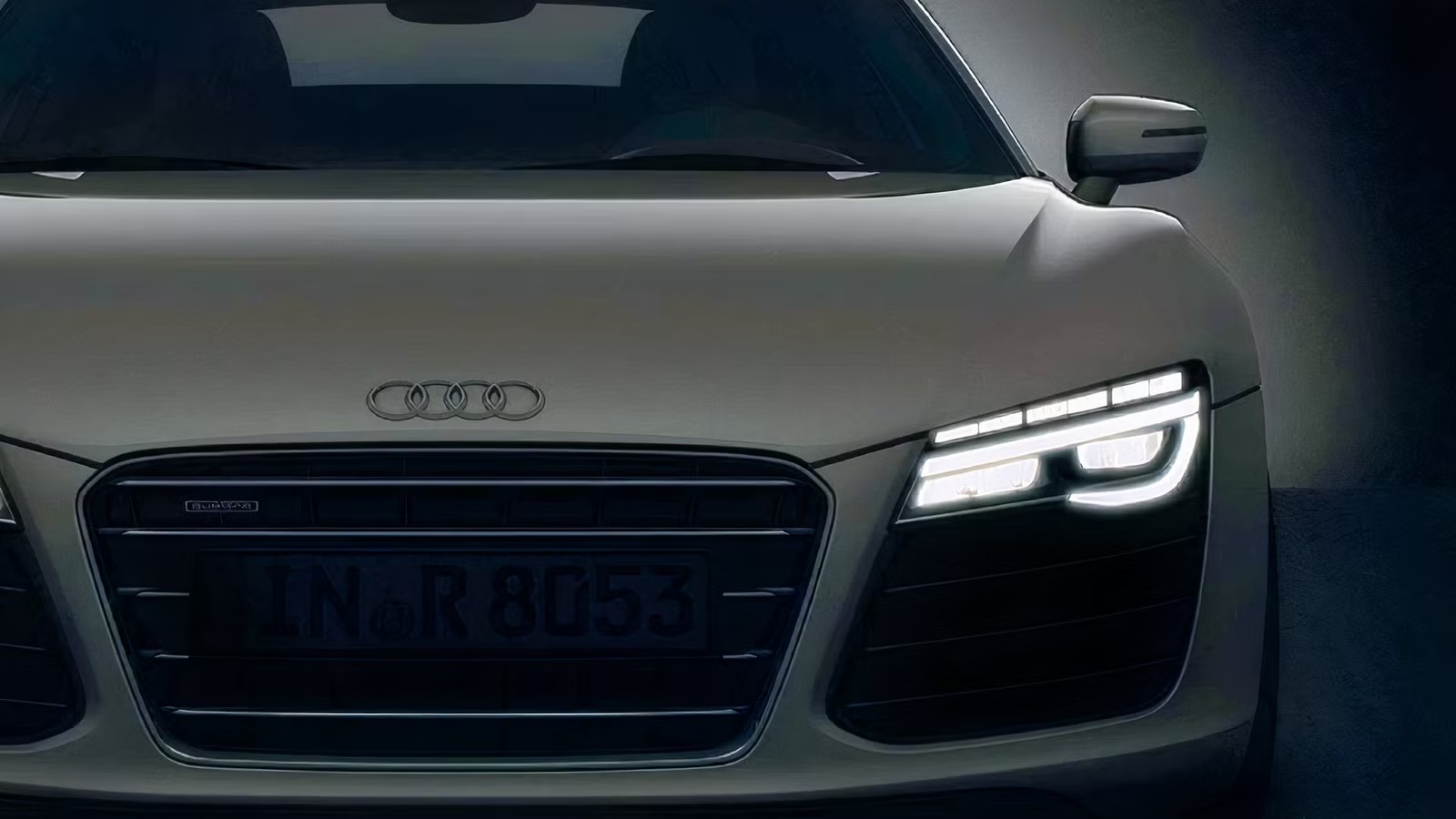
Audi is more complicated again, even though it’s been a lighting leader across the world for more than a decade. It debuted matrix LED headlights on the Audi A8 in Europe back in 2013, and its latest global-market Q3 has micro-LED digital matrix technology. This trick system has 25,600 individually controlled micro-LEDs, as well as high-resolution light functions. But that still doesn’t make a US-bound Audi Q3 automatically an ADB car, and it appears that buyers cannot access these headlights just yet.
How To Buy The Real Thing And Not Just The Badge
The latest Tesla Model Y gets the customary massive screen.Tesla
These matrix trick headlights are still not guaranteed in the US market. Shoppers will still need to look at a vehicle’s official build sheet to see if it includes adaptive driving beams, adaptive headlights, pixel headlights, or a clear description of the new-tech automatic high beams. The fact that a car has a matrix LED design does not necessarily mean that it has ADB technology.
Even though availability is sketchy, adaptive driving beam headlights are far from gimmicky and surely a modern car technology that’s long overdue in America. Europe got the regulatory pathway first, but the US didn’t open its own path until 2022, with the first credible American-market examples only now appearing. So, the big takeaway here is that ADB is just allowable and not a requirement, so the rollout will likely remain uneven. And while the capability is finally real for US buyers, the skill now is knowing exactly where to find it.
Sources: Audi, Rivian, Tesla, NHTSA, Federal Register.
