

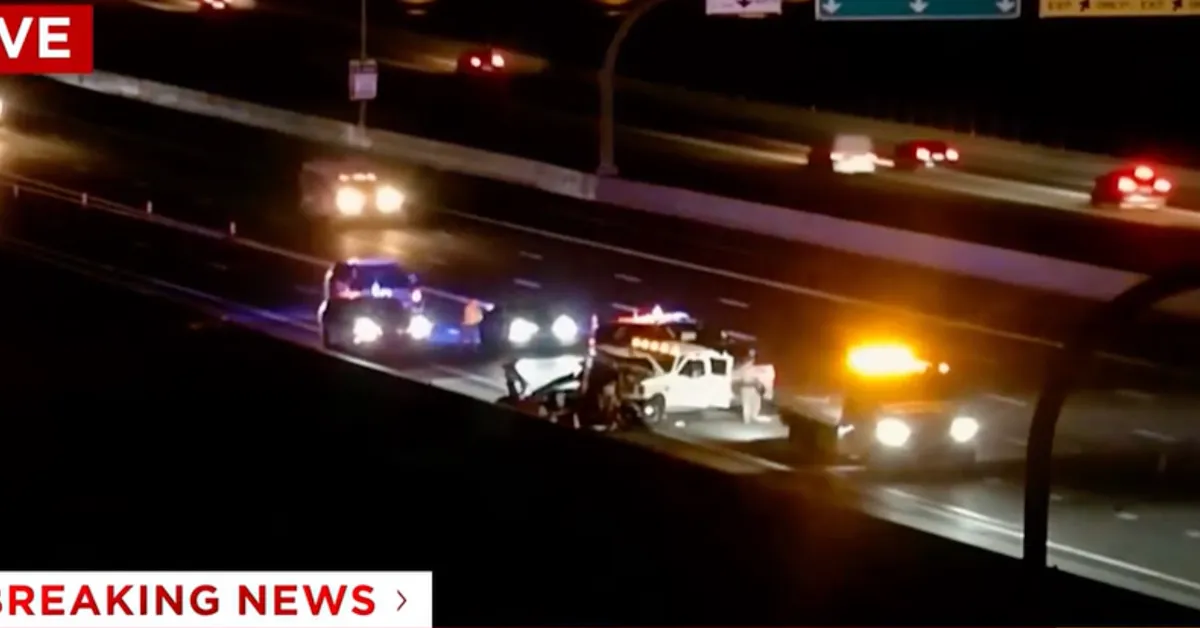
Weeks after a Tesla Model 3 sat stopped in a live Florida interstate lane and its driver was killed, it happened again — a 2020 Model 3, stopped dead on a Phoenix-area freeway at 3 a.m., rear-ended by a pickup, its driver dead at the scene.
And as in the Florida case that we revealed today, no one investigating knew what Tesla’s own data shows: the car’s driver-assist system was engaged. This is part of an ongoing Electrek series matching previously reported Tesla crashes to the company’s own redacted NHTSA data.
What happened on Loop 202
Just after 3 a.m. on October 31, 2025, a Tesla sedan was struck from behind by a Ford F-350 pickup on the eastbound Loop 202 (Red Mountain) freeway near Dobson Road in Mesa, Arizona. The Tesla’s driver died at the scene, and the eastbound freeway was closed for hours, Arizona’s Family (KPHO/KTVK) and 12News reported.
The initial coverage was thin — the Arizona Department of Public Safety said only that two vehicles were involved and didn’t detail injuries. No report identified the car as a Tesla with a driver-assist system, and none mentioned Autopilot or “Full Self-Driving.”
What Tesla told the federal government
Electrek matched that crash to a redacted report in Tesla’s filings to the National Highway Traffic Safety Administration, under a Standing General Order that requires automakers to report crashes where a Level 2 driver-assist system was engaged within 30 seconds of impact.
In the report, Tesla identifies the vehicle as a 2020 Model 3, marks the automation “Engagement Status” as “Verified Engaged,” and lists the car’s pre-crash movement as “Stopped” at 0 mph in a freeway lane, in clear weather with no unusual road conditions. It says the Tesla was struck across its entire rear by the front of the pickup — a straightforward rear-end into a stationary car.
Crucially, Tesla says it holds the event-data recorder, telematics, and video from the car — everything needed to show why it was stopped. Then it redacts the three fields that would explain it: the crash narrative, the software version (which hides whether it was Autopilot or “Full Self-Driving”), and whether the road was within the system’s approved operating area — all as “confidential business information,” the same redactions Tesla applies to 99.9% of its reports.
We’ve compiled the full NHTSA record for this crash, showing exactly what Tesla disclosed and what it blacked out.
A pattern, not a one-off
This is now the second fatal crash Electrek has documented with the same signature: a 2020 Tesla Model 3, driver-assist verified engaged, stopped at 0 mph in a live freeway lane, rear-ended, its driver killed — both in October 2025, one in Florida and one in Arizona.
There is an obvious candidate for why a driver-assist car would stop in traffic. Tesla has a long-documented phantom braking problem, in which Autopilot brakes hard for obstacles that aren’t there — an issue that drew an NHTSA investigation and a class-action suit. A system that stopped the car in a travel lane, or failed to keep it moving, would fit. So would a driver medical event with the system holding the car. Only Tesla’s data distinguishes between them. Both are problematic.
How we know it’s the same crash: NHTSA leaves a few fields unredacted — city, vehicle, month, and an incident time logged in UTC. Converted to Arizona time, Tesla’s timestamp lands at about 3 a.m. on the same freeway, with the same fatal outcome and the same 2020 Model 3 that DPS and local outlets reported. Electrek has filed a public-records request with the Arizona Department of Public Safety for the crash report, and to ask whether Tesla shared its data — the raw telematics, or only its own interpretation of it — with investigators.
Electrek has contacted DPS to let them know Tesla confirmed its ADAS was active at the time of the crash and to ask whether Tesla communicated that to the authorities.
Electrek’s Take
As always, we don’t know that Tesla’s driver-assist caused this death, any more than we do in the Florida case. But two men are dead in nearly identical circumstances a few weeks apart, both in cars that Tesla’s own records say had the driver-assist engaged and stopped in a live freeway lane — and in both, Tesla is holding the data that would explain it while the investigating agency is left without.
In both cases, we didn’t even know that Tesla’s ADAS were involved in these publicly reported crashes until we were able to make the connection with Tesla’s own redacted NHTSA report.
That is the problem with letting a company redact what its cars did in fatal crashes. A single sealed report is a mystery; a second one with the same fingerprint is a pattern that the public, regulators, and the families are entitled to understand. Tesla has the EDR, the telematics, and — in this case — the video. When Autopilot or “Full Self-Driving” is verified engaged in a fatal crash, how the car behaved is not a trade secret.
Tesla is already under NHTSA investigation over how it reports these crashes. We’ll keep matching these crashes, one by one, until the record is complete.
If you’re a Tesla owner, powering your EV with home solar is one of the smartest ways to lock in low fuel costs. With electricity rates climbing nearly 10% last year, home solar protects you against future rate increases. And with lease and PPA options, you can go solar with zero upfront cost and start saving immediately. If you want to find the best deal, check out EnergySage. It’s a free service with hundreds of pre-vetted installers competing for your business, so you save 20 to 30% compared to going it alone. No sales calls until you pick an installer. Get your free quotes here.
FTC: We use income earning auto affiliate links. More.
